For Easy Tasks, Brain Preps and Decides Together
March 6, 2007 For Easy Tasks, Brain Preps and Decides Together

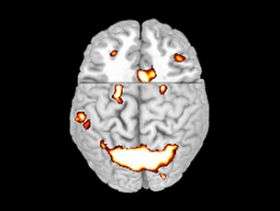
A brain scan illustrates areas that became active when the subject was presented with a stimulus. In this study, those same areas also became active when the subject was cued to the task, indicating that the same areas of the brain that respond to stimulus also contribute to preparation. Credit: Eric Schumacher/Georgia Tech

A Georgia Tech researcher has discovered that for tasks involving spatial processing, preparing for the task and performing it are not two separate brain processes, but one – at least when there are a small number of actions to choose from. The research appears online in the journal Brain Research.

In a brain imaging study using functional magnetic resonance imaging (fMRI), Eric Schumacher, assistant professor of psychology at the Georgia Institute of Technology, along with colleagues from the University of Pittsburgh and the University of California, Berkeley, monitored the activity of brain regions in subjects while they responded to visual stimuli.

The researchers predicted that when they gave the subjects a cue that they were about to perform a hard task, only the superior parietal cortex, known for its involvement in spatial attention, and the premotor cortex, known for planning movements, would activate. Then, the prefrontal cortex, known for its role in decision-making, would activate after the stimulus was presented. But they were wrong.

"We found that all of these regions began to activate when the subjects prepared to do the task, even the prefrontal, which is the region that makes the decision on what to do," said Schumacher. "Activating the decision-making region even before the stimulus is presented seems to allow for a quicker response, it allows the brain to get a running start."

Subjects were loaded into an MRI scanner and then shown a disk on a screen prompting them to press a button. They had two different tasks to perform, one labeled easy, and one hard. During the easy task, subjects were asked to push a button using the fingers of their left hand if the disk appeared on the left of the screen and their right hand if the disk appeared on the right. The hard task was manually incompatible, so that if the disk appeared on the left, they were to push the buttons using their right hand and vice-versa. Sometimes a visual cue prompted them that they were about to perform the hard or the easy task, sometimes it did not.

When the tasks were cued, all three regions of the brain increased their activity. When there was no cue, there was less activity.

So what does this mean in the real world?

"One analogous situation might be when you're driving and coming up on an intersection where there is a stale green light. You may get ready for the light to change to yellow and then red. My research suggests that this preparation for the upcoming change and appropriate responses involves the same brain regions that are involved in actually pressing the brake (or gas) once the light turns red or yellow," said Schumacher.

Source: Georgia Institute of Technology


print this article email this article download pdf blog this article bookmark this article     Stumble it Digg this share on Facebook retweet share on Reddit add to delicious
Rate this story - 5 /5 (12 votes)


March 6, 2007 all stories

Comments: 0

5 /5 (12 votes)
  • Stumble this up

  • Digg this

  • share this

  • hide
  • Related Stories

  • Study: Can meditation sharpen our attention?
    created Nov 13, 2009 | popularity not rated yet | comments 0
  • Finding the seat of language? Researchers look into Broca's brain
    created Oct 26, 2009 | popularity not rated yet | comments 0
  • Scans show learning 'sculpts' the brain's connections
    created Oct 09, 2009 | popularity not rated yet | comments 0
  • Our Emotions Can Lead Us Astray When Assessing Risks
    created Sep 23, 2009 | popularity not rated yet | comments 0
  • You can't trust a tortured brain: Neuroscience discredits coercive interrogation
    created Sep 21, 2009 | popularity not rated yet | comments 0


  • hide
  • Relevant PhysicsForums posts

  • nesfatin
    created 12 hours ago
  • Obsessive Compulsive Disorder
    created Nov 20, 2009
  • West's zone 2 starling resistor respiratory physiology
    created Nov 18, 2009
  • 50-0-50 rule
    created Nov 18, 2009
  • More from Physics Forums - Medical Sciences

Other News

New cancer target for non-Hodgkin's lymphoma

Medicine & Health / Cancer

created 12 hours ago | popularity 5 / 5 (1) | comments 0

Physician-scientists from Weill Cornell Medical College have discovered a molecular mechanism that may prove to be a powerful target for the treatment of non-Hodgkin's lymphoma, a type of cancer that affects lymphocytes, ...


Surface bacteria maintain skin's healthy balance

Medicine & Health / Research

created 13 hours ago | popularity 5 / 5 (4) | comments 0

On the skin's surface, bacteria are abundant, diverse and constant, but inflammation is undesirable. Research at the University of California, San Diego School of Medicine now shows that the normal bacteria living on the ...


Gene mismatch influences success of bone marrow transplants

Medicine & Health / Genetics

created 12 hours ago | popularity 4 / 5 (1) | comments 0

A commonly inherited gene deletion can increase the likelihood of immune complications following bone marrow transplantation, an international team of researchers reports in the November 22 advance online issue of Nature Ge ...


New understanding about mechanism for cell death after stroke leads to possible therapy

Medicine & Health / Research

created 13 hours ago | popularity not rated yet | comments 0

Scientists at the Brain Research Centre, a partnership of the University of British Columbia Faculty of Medicine and Vancouver Coastal Health Research Institute, have uncovered new information about the mechanism by which ...


Cancer metabolism discovery uncovers new role of IDH1 gene mutation in brain cancer

Medicine & Health / Cancer

created 13 hours ago | popularity not rated yet | comments 0

Agios Pharmaceuticals today announced that its scientists have established, for the first time, that the mutated IDH1 gene has a novel enzyme activity consistent with a cancer-causing gene, or oncogene. This breakthrough ...