An architectural plan of the cell
March 6, 2007
Fission Yeast Cell

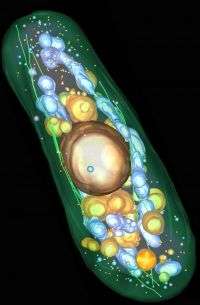
The electron tomogram of a complete yeast cell reveals the cellular architecture. It shows plasma membrane, microtubules and light vacuoles (green), nucleus, dark vacuoles and dark vesicles (gold), mitochondria and large dark vesicles (blue) and light vesicles (pink). Credit: Johanna Höög, EMBL Heidelberg

Like our body every cell has a skeleton that provides it with a shape, confers rigidity and protects its fragile inner workings. The cytoskeleton is built of long protein filaments that assemble into networks whose overall architecture and fine detail can only be revealed with high resolution electron microscopy images.

Researchers at the European Molecular Biology Laboratory (EMBL) and the University of Colorado have now obtained the first 3D visualization of a complete eukaryotic cell at a resolution high enough to resolve the cytoskeleton's precise architectural plan in fission yeast. The image of this unicellular organism will be published in this week's issue of the journal Developmental Cell and reveals remarkable insights into the fine structure of the cytoskeleton as well as its interactions with other parts of the cell.

A key component of the cytoskeleton are long, tube-like filaments called microtubules. They are dynamic structures built of constantly growing and shrinking rows of elementary proteins called tubulins. To increase their rigidity microtubules associate in bundles and interact with stabilizing proteins in complex networks, which are essential for many cellular processes such as polar growth.

"To really understand the architecture of the cytoskeleton you have to see the entire cell in three dimensions," says Claude Antony, whose team carried out the research at EMBL, "but at the same time you need a very good resolution to be able to investigate its structural details. It is impossible to obtain such detailed images of a eukaryotic cell with normal microscopes."

To bridge the gap between global overview and structural detail Antony's team collaborated with yeast and electron microscopy expert Richard McIntosh at the University of Colorado. Using a technique called electron tomography, Johanna Höög, PhD student in Antony's lab, took pictures of sequential sections of a yeast cell from many different angles through an electron microscope and combined these snapshots into a 3D reconstruction on the computer. A similar principle is used to generate brain scans.

For the first time they could see directly what previous studies in fission yeast only suggested. In times when a cell is not dividing a microtubule bundle consists of 4-5 individual filaments that are physically connected with each other via minute bridges likely formed by proteins. In the networks created through this crosslinking the orientation of microtubules is crucial. The filaments are polar structures, their two ends grow and shrink at different rates. The study created a precise map indicating the location of all growing and shrinking microtubule ends in the cell.

The images also shed light on other important functions of microtubules, revealing that the cytoskeleton determines the correct positioning of mitochondria, the energy-producing organelles, throughout the cell.

"Our 3D image of fission yeast can serve as a reference map of the cell for all biologists interested in its architecture," says Johanna Höög. "You can extract information about all sorts of cellular structures and processes from it or use it to place findings into the spatial context of the cell."

Yeast is one of the most commonly used model organisms in biology. It has many similarities with higher eukaryotes, including multicellular organisms. Many of the insights gained into its cellular organisation are likely to apply also to mammals. In mammalian nerve cells, for example, microtubule bundles similar to those observed in yeast are essential for the transmission of the signal from cell to cell.

Source: European Molecular Biology Laboratory

4.6 /5 (12 votes)  

Rank 4.6 /5 (12 votes)
Tags

Related Stories
Relevant PhysicsForums posts

More news stories

Entire genome of extinct human decoded from fossil

(PhysOrg.com) -- In 2010, Svante Pääbo and his colleagues presented a draft version of the genome from a small fragment of a human finger bone discovered in Denisova Cave in southern Siberia. The ...

Biology / Biotechnology

created Feb 07, 2012 | popularity 4.7 / 5 (58) | comments 44 | with audio podcast

Why are there so few fish in the Earth's oceans?

(PhysOrg.com) -- A Stony Brook University researcher has found that, contrary to popular belief, there are not plenty of fish in the sea.

Biology / Plants & Animals

created Feb 08, 2012 | popularity 4.3 / 5 (17) | comments 25 | with audio podcast

Miami battling invasion of giant African snails

No one knows how they got there. But an invasion of African giant snails has southern Florida in a panic over potential crop damage, disease and general yuckiness surrounding the slimy gastropods.

Biology / Ecology

created Feb 10, 2012 | popularity 4.5 / 5 (2) | comments 5

The power of estrogen -- male snakes attract other males

A new study has shown that boosting the estrogen levels of male garter snakes causes them to secrete the same pheromones that females use to attract suitors, and turned the males into just about the sexiest ...

Biology / Plants & Animals

created Feb 10, 2012 | popularity 4.8 / 5 (6) | comments 2 | with audio podcast

Deciding to go left or right: Researchers use device to determine that lower animals can navigate too

For decades, scientists have associated binary decision making — opting to go left or right — with higher-ranking animals, including humans. A team of Harvard researchers, however, is rewriting that ...

Biology / Plants & Animals

created Feb 09, 2012 | popularity 4 / 5 (1) | comments 4 | with audio podcast


Walney offshore wind farm is world's biggest (for now)

(PhysOrg.com) -- The Walney wind farm on the Irish Sea--characterized by high tides, waves and windy weather--officially opened this week. The farm is treated in the press as a very big deal as the Walney ...

GPS court ruling leaves US phone tracking unclear

A US Supreme Court decision requiring a warrant to place a GPS device on the car of a criminal suspect leaves unresolved the bigger issue of police tracking using mobile phones, legal experts say.

Europeans protest controversial Internet pact

Tens of thousands of people marched in protests in more than a dozen European cities Saturday against a controversial anti-online piracy pact that critics say could curtail Internet freedom.

Europe stakes billion-dollar bet on new rocket

A pencil-slim rocket is scheduled to lift into space from South America on Monday, carrying a billion-dollar bet that Europe can grab a juicy slice of the market to place satellites in low orbit.

Study finds that anti-diabetic medication can prevent the long-term effects of maternal obesity

In a study to be presented today at the Society for Maternal-Fetal Medicine's annual meeting, The Pregnancy Meeting, in Dallas, Texas, researchers will report findings that show that short therapy with the anti-diabetic medication ...

Netflix settlement trims 14 pct off 4Q earnings

(AP) -- Netflix pressed the rewind button on its fourth-quarter earnings after settling allegations that the video subscription service violated a consumer-privacy law.