Solar energy conversion offers a solution to help mitigate global warming
March 6, 2007 Solar energy conversion offers a solution to help mitigate global warming

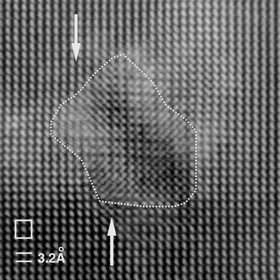
The dotted white line shows a nanodot inclusion in the crystalline structure of the thermoelectric material Ag0.86Pb18SbTe20, seen in high resolution transmission electron microscopy. Controlling nanoscale inclusions like this one will enable the next-generation of thermoelectric materials with significantly higher efficiency for converting the sun’s heat to electricity. The inclusion is about 10 nm in diameter. From Eric Quarez, Kuei-Fang Hsu, Robert Pcionek, N. Frangis, E. K. Polychroniadis, and Mercouri G. Kanatzidis, JACS 127, 9177 (2005). Image courtesy of M. Kanatzidis.

Solar energy has the power to reduce greenhouse gases and provide increased energy efficiency, says a scientist at the U.S. Department of Energy's Argonne National Laboratory, in a report published in the March issue of Physics Today.

Last month, The Intergovernmental Panel on Climate Change (IPCC) of the United Nations released a report confirming global warming is upon us and attributing the growing threat to the man-made burning of fossil fuels.

Opportunities to increase solar energy conversion as an alternative to fossil fuels are addressed in the Physics Today article, co-authored by George Crabtree, senior scientist and director of Argonne's Materials Science Division, and Nathan Lewis, professor of Chemistry at Caltech and director of its Molecular Materials Research Center.

Currently, between 80 percent and 85 percent of our energy comes from fossil fuels. However, fossil fuel resources are of finite extent and are distributed unevenly beneath Earth's surface. When fossil fuel is turned into useful energy through combustion, it often produces environmental pollutants that are harmful to human health and greenhouse gases that threaten the global climate. In contrast, solar resources are widely available and have a benign effect on the environment and climate, making it an appealing alternative energy source.

"Sunlight is not only the most plentiful energy resource on earth, it is also one of the most versatile, converting readily to electricity, fuel and heat," said Crabtree. "The challenge is to raise its conversion efficiency by factors of five or ten. That requires understanding the fundamental conversion phenomena at the nanoscale. We are just scratching the surface of this rich research field."

Argonne carries out forefront basic research on all three solar conversion routes. The laboratory is creating next-generation nanostructured solar cells using sophisticated atomic layer deposition techniques that replace expensive silicon with inexpensive titanium dioxide and chemical dyes. Its artificial photosynthesis program imitates nature using simple chemical components to convert sunlight, water and carbon dioxide directly into fuels like hydrogen, methane and ethanol. Its program on thermoelectric materials takes heat from the sun and converts it directly to electricity.

The Physics Today article is based on the conclusions contained in the report of the Basic Energy Sciences Workshop on Solar Energy Utilization sponsored by the U.S. Department of Energy. Crabtree and Lewis served as co-chairs of the workshop and principal editors of the report. The key conclusions of the report identified opportunities for higher solar energy efficiencies in the areas of:

-- Electricity – important research developments lie in the development of new, less expensive materials for solar cells, including organics, thin films, dyes and shuttle ions, and in understanding the dynamics of charge transfer across nanostructured interfaces.

-- Fuel – solar photons can be converted into chemical fuel more resourcefully by breeding or genetically engineering designer plants, connecting natural photosynthetic pathways in novel configurations and using artificial bio-inspired nanoscale systems.

-- Heat – controlling the size, density and distribution of nanodot inclusions during bulk synthesis could enhance thermoelectric performance and achieve more reliable and inexpensive electricity production from the sun's heat.

Source: Argonne National Laboratory


print this article email this article download pdf blog this article bookmark this article     Stumble it Digg this share on Facebook retweet share on Reddit add to delicious
Rate this story - 4 /5 (51 votes)


March 6, 2007 all stories

Comments: 0

4 /5 (51 votes)
  • Stumble this up

  • Digg this

  • share this

  • hide
  • Related Stories

  • Tesla Roadster Goes 313 Miles on a Single Charge
    created 11 hours ago | popularity not rated yet | comments 0
  • Solar power generation around the clock
    created Nov 05, 2009 | popularity not rated yet | comments 0
  • Toward home-brewed electricity with 'personalized solar energy'
    created Nov 04, 2009 | popularity not rated yet | comments 0
  • Japan aims to bury greenhouse gas emissions
    created Nov 01, 2009 | popularity not rated yet | comments 0
  • Obama team: US needs bill to lead in clean energy
    created Oct 28, 2009 | popularity not rated yet | comments 0


  • hide
  • Relevant PhysicsForums posts

  • How do you separate things from centrifugal force?
    created 2 hours ago
  • Physical Science...need help
    created 2 hours ago
  • Calculating a Damping Constant
    created 4 hours ago
  • Bodies in motionÂ…..
    created 6 hours ago
  • More from Physics Forums - General Physics

Other News

Engineers image nanostructure of a solid acid catalyst and boost its catalytic activity

Nanotechnology / Nanomaterials

created 5 hours ago | popularity 5 / 5 (1) | comments 2

The catalytic processes that facilitate the production of many chemicals and fuels could become much more environmentally friendly thanks to a breakthrough achieved by researchers from Lehigh and Rice Universities.


New transparent insulating film could enable energy-efficient displays

New transparent insulating film could enable energy-efficient displays

Nanotechnology / Nanomaterials

created 9 hours ago | popularity 4.9 / 5 (7) | comments 0

Johns Hopkins materials scientists have found a new use for a chemical compound that has traditionally been viewed as an electrical conductor, a substance that allows electricity to flow through it. By orienting ...


Ideal nanoparticle cancer therapies surf the bloodstream

Nanotechnology / Bio & Medicine

created 10 hours ago | popularity 5 / 5 (1) | comments 0

Eric Shaqfeh studies blood at Stanford University, using computer models that simulate how the fluid and the cells it contains move around. On November 11 at a meeting of the scientific society AVS, he will present his latest ...


New Digital 'Electronics' Concept May Continue Moore's Law

New Digital 'Electronics' Concept May Continue Moore's Law

Nanotechnology / Nanophysics

created Nov 05, 2009 | popularity 4.6 / 5 (57) | comments 9

(PhysOrg.com) -- Computers of the future could be operating not on electrons, but on tiny waves traveling through an electron "fluid," if a new proposal is successful. The new circuit design, recently introduced ...


Nanoparticles for gene therapy improve

Nanoparticles for gene therapy improve

Nanotechnology / Bio & Medicine

created Nov 06, 2009 | popularity 5 / 5 (5) | comments 3

(PhysOrg.com) -- About five years ago, Professor Janet Sawicki at the Lankenau Institute in Pennsylvania read an article about nanoparticles developed by MIT's Robert Langer for gene therapy, the insertion ...