Tonga quake not conducive to tsunami
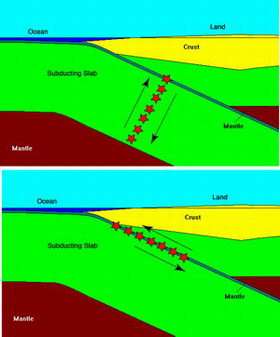
March 6, 2007 Earthquake Model

The figure shows the dynamics of a slab-tear earthquake (top), compared with a shallow thrust earthquake (bottom). The slab-tearing event typically doesn´t feature an accompanying tsunami. Credit: Washington University in St. Louis

Seismologists at Washington University in St. Louis and their colleagues in Australia, Japan and Tonga have determined why a large earthquake in Tonga did not cause a large tsunami. A tsunami warning was issued around the Pacific Rim following the magnitude 8.0 earthquake on May 3, 2006, but the resulting tsunami was very minor and caused no damage.

Tsunamis generally result from shallow-thrust earthquakes, which occur when the seafloor is pushed downward beneath the land in places like Japan, Chile, Indonesia and Mexico. The researchers found instead that this earthquake was slab-tearing event — a rupturing of the down-going seafloor beneath Tonga. This explains why the tsunami was smaller than expected, and suggests that large earthquakes in Tonga may typically be of the slab-tearing variety, consistent with the lack of large historical tsunamis in Tonga.

Douglas A. Wiens, Ph.D., Washington University professor of earth and planetary sciences in Arts & Sciences, and his collaborators quickly assembled their equipment and deployed seven stations to record the aftershocks some 60 kilometers beneath the surface. Washington University technical scientist Patrick Shore and graduate student David Heeszel, along with Australian and Tongan co-workers, installed the seismographs. Shore and Heeszel sailed on a small ship for several days to deploy the seismographs on a group of islands near Ha'apai, Tonga.

"A shallow-thrust earthquake's main shock would have been shallower than what we found," Wiens said. "Because that part of the world does not want a repeat of the Sumatra experience, we wanted to determine the nature of the earthquake. Our Washington University group has done extensive analyses of Tongan earthquakes, so other researchers and the National Science Foundation got in touch quickly and we had equipment installed in early June."

"The Sumatra earthquake surprised a lot of people, and the size of the Tongan one also surprised us, so we wanted to make sure there was not a tsunami hazard in the region," Wiens said. "If all the large earthquakes are of the slab-tearing variety like the May 2006 event, it doesn't appear that there is one."

Heeszel and Wiens presented their results at the Winter Meeting of the American Geophysical Union, held Dec. 10-15, 2006 in San Francisco.

Source: Washington University in St. Louis


print this article email this article download pdf blog this article bookmark this article     Stumble it Digg this share on Facebook retweet share on Reddit add to delicious
Rate this story - 4.4 /5 (14 votes)


March 6, 2007 all stories

Comments: 0

4.4 /5 (14 votes)
  • Stumble this up

  • Digg this

  • share this

  • hide
  • Related Stories

  • Killer earthquakes shake scientific thought
    created Oct 11, 2009 | popularity not rated yet | comments 0
  • Discovered: world's largest tsunami debris
    created Sep 25, 2008 | popularity not rated yet | comments 0
  • Submerged volcanoes pose tsunami threat
    created Jul 28, 2005 | popularity not rated yet | comments 0
  • Self-sacrifice among strangers has more to do with nurture than nature
    created Oct 12, 2009 | popularity not rated yet | comments 0
  • Major Pacific earthquake prompts tsunami warning
    created Mar 20, 2009 | popularity not rated yet | comments 0


  • hide
  • Relevant PhysicsForums posts

  • The IPCC and the term "most"
    created 5 hours ago
  • Is global warming a fact?
    created 6 hours ago
  • Random variability of wind patterns
    created 21 hours ago
  • Record precipitation in the UK
    created Nov 22, 2009
  • More from Physics Forums - Earth

Other News

New computer-developed map shows more extensive valley network on Mars

New computer-developed map shows more extensive valley network on Mars

Space & Earth / Space Exploration

created 5 hours ago | popularity 4.5 / 5 (4) | comments 0

New research adds to the growing body of evidence suggesting the Red Planet once had an ocean.


Supervolcano eruption -- in Sumatra -- deforested India 73,000 years ago

Supervolcano eruption -- in Sumatra -- deforested India 73,000 years ago

Space & Earth / Earth Sciences

created 7 hours ago | popularity 4.4 / 5 (5) | comments 0

A new study provides "incontrovertible evidence" that the volcanic super-eruption of Toba on the island of Sumatra about 73,000 years ago deforested much of central India, some 3,000 miles from the epicenter, ...


Spitzer Telescope Observes Baby Brown Dwarf

Spitzer Telescope Observes Baby Brown Dwarf

Space & Earth / Astronomy

created 4 hours ago | popularity 4.8 / 5 (5) | comments 0

(PhysOrg.com) -- NASA's Spitzer Space Telescope has contributed to the discovery of the youngest brown dwarf ever observed -- a finding that, if confirmed, may solve an astronomical mystery about how these ...


Is global warming unstoppable?

Space & Earth / Environment

created 16 hours ago | popularity 3.9 / 5 (21) | comments 20

In a provocative new study, a University of Utah scientist argues that rising carbon dioxide emissions - the major cause of global warming - cannot be stabilized unless the world's economy collapses or society builds the ...


The Crab Nebula: A Cosmic Icon

The Crab Nebula: Energy for 100,000 Suns

Space & Earth / Astronomy

created 4 hours ago | popularity 4.7 / 5 (3) | comments 0

(PhysOrg.com) -- A star's spectacular death in the constellation Taurus was observed on Earth as the supernova of 1054 A.D.