Double-star systems cycle between big and small blasts
March 7, 2007
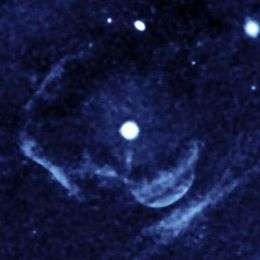
This image, from the far-ultraviolet detector on GALEX, was processed to enhance the appearance of the diffuse emissions from the shell around Z Cam. Credit: Image courtesy NASA/JPL-Caltech
Certain double, or binary, star systems erupt in full-blown explosions and then flare up with smaller bursts, according to new information gathered by NASA’s Galaxy Evolution Explorer (GALEX) and analyzed by a team of astronomers, including postdoctoral researcher Mark Seibert of the Carnegie Observatories.
The data bolster a 20-year-old theory suggesting that double star systems experience both explosion types, rather than just one or the other. It also implies that the systems cycle between blast types, hiccupping every few weeks with small surges and experiencing giant outbursts every 10,000 years or so.
The discovery, appearing in the March 8 issue of the journal Nature, centers around a binary system called Z Camelopardalis (Z Cam). Astronomers have long known Z Cam to be a cataclysmic binary—a system that features a collapsed, dead star, or white dwarf, which sucks hydrogen-rich matter from its companion like a stellar vampire. The stolen material forms an orbiting disk of gas and dust around the white dwarf.
Astronomers divide cataclysmic binaries into two classes—dwarf novae, which erupt in smaller, "hiccup-like" blasts, and classical novae, which undergo huge explosions. Classical novae explosions are 10,000 to one million times brighter than those of dwarf novae, and they leave behind large shells of shocked gas.
In 2003, Seibert examined ultraviolet images collected by GALEX during its Survey of Nearby Galaxies. He noticed a never-before-seen arc and linear features surrounding Z Cam that indicated the presence of a massive shell—evidence that the dwarf nova had in fact undergone a classical nova explosion a few thousand years ago. The features had remained invisible up to this point because they cannot be easily detected at optical wavelengths. However, they are easily seen at the ultraviolet wavelengths detected by GALEX.
"You could actually see it immediately, but we had to convince ourselves that we were really seeing a nova remnant," Seibert said. "If true, it would represent the largest nova remnant yet known. But it was especially shocking to find it associated with such a diminutive dwarf nova system. Everyone was skeptical and it took a considerable amount of time and effort to be certain."
About 530 light years from Earth, Z Cam was one of the first dwarf novae ever detected. For decades, observers have watched the system hiccup with regular outbursts. It brightens about 40-fold every 3 weeks or so, when an instability causes some of the material drawn by the white dwarf to crash onto its surface. Theory holds that Z Cam and other recurring dwarf novae should eventually accumulate enough matter and pressure from their swirling disks of hydrogen to trigger gigantic classical novae explosions. But no one had found definitive evidence for this until Seibert’s discovery in 2003.
Other team members confirmed that the structures detected by GALEX were indeed parts of a massive shell of gas surrounding Z Cam. Narrowband images from Kitt Peak National Observatory near Tucson, Ariz., Palomar Observatory near San Diego, Calif., and the Wise Observatory near Mizpe Ramon, Israel, along with optical spectroscopic measurements made at the Lick Observatory near San Jose, Calif., contributed to this verification.
"The new images are the strongest evidence yet in favor of the cyclic evolution scenario of these binary stars," said lead author Mike Shara of the American Museum of Natural History in New York. "It’s gratifying to see such strong evidence for this theory finally emerge after all this time."
Source: Carnegie Institution
-
Engineers build first sub-10-nm carbon nanotube transistor
Feb 01, 2012 |
4.9 / 5 (31) |
30
-
Something old, something new: Evolution and the structural divergence of duplicate genes
Jan 31, 2012 |
4.6 / 5 (7) |
1
-
The hidden nanoworld of ice crystals: Revealing the dynamic behavior of quasi-liquid layers
Jan 30, 2012 |
5 / 5 (3) |
1
-
Stock market network reveals investor clustering
Jan 27, 2012 |
3.9 / 5 (23) |
8
-
Of microchemistry and molecules: Electronic microfluidic device synthesizes biocompatible probes
Jan 26, 2012 |
5 / 5 (1) |
0
-
Never ending outer space.....
5 hours ago
-
Neutron Star fragments?
7 hours ago
-
stationary or not?
11 hours ago
-
Scale of the Universe
Feb 10, 2012
-
Titan's lack of impact craters
Feb 09, 2012
-
Real pictures of black hole eating a star?
Feb 08, 2012
- More from Physics Forums - General Astronomy
More news stories
Europe stakes billion-dollar bet on new rocket
A pencil-slim rocket is scheduled to lift into space from South America on Monday, carrying a billion-dollar bet that Europe can grab a juicy slice of the market to place satellites in low orbit.
Space & Earth / Space Exploration
18 hours ago |
3.5 / 5 (2) |
0
Political leaders play key role in how worried Americans are by climate change: study
More than extreme weather events and the work of scientists, it is national political leaders who influence how much Americans worry about the threat of climate change, new research finds.
Feb 06, 2012 |
5 / 5 (6) |
72
NASA budget will axe Mars deal with Europe: scientists
US President Barack Obama's budget proposal to be submitted next week for 2013 will cut NASA's budget by 20 percent and eliminate a major partnership with Europe on Mars exploration, scientists said Thursday.
Space & Earth / Space Exploration
Feb 10, 2012 |
5 / 5 (3) |
48
Humans may have helped the decline of African rainforests 3000 years ago
(PhysOrg.com) -- Large areas of rainforests in Central Africa mysteriously disappeared over three thousand years ago, to be replaced by savannas. The prevailing theory has been that the cause was a change ...
High planetary tilt lowers odds for life?
Highly-tilted worlds would have extreme seasons, subjecting life to alternating periods of scorching and subzero temperatures. This could make the development of all but hardiest, simplest creatures a long ...
Space & Earth / Space Exploration
Feb 06, 2012 |
4.8 / 5 (12) |
14
|
Walney offshore wind farm is world's biggest (for now)
(PhysOrg.com) -- The Walney wind farm on the Irish Sea--characterized by high tides, waves and windy weather--officially opened this week. The farm is treated in the press as a very big deal as the Walney ...
GPS court ruling leaves US phone tracking unclear
A US Supreme Court decision requiring a warrant to place a GPS device on the car of a criminal suspect leaves unresolved the bigger issue of police tracking using mobile phones, legal experts say.
Europeans protest controversial Internet pact
Tens of thousands of people marched in protests in more than a dozen European cities Saturday against a controversial anti-online piracy pact that critics say could curtail Internet freedom.
Study finds that anti-diabetic medication can prevent the long-term effects of maternal obesity
In a study to be presented today at the Society for Maternal-Fetal Medicine's annual meeting, The Pregnancy Meeting, in Dallas, Texas, researchers will report findings that show that short therapy with the anti-diabetic medication ...
Netflix settlement trims 14 pct off 4Q earnings
(AP) -- Netflix pressed the rewind button on its fourth-quarter earnings after settling allegations that the video subscription service violated a consumer-privacy law.
Navy to begin tests on electromagnetic railgun prototype launcher
The Office of Naval Research (ONR)'s Electromagnetic (EM) Railgun program will take an important step forward in the coming weeks when the first industry railgun prototype launcher is tested at a facility ...