Looking for 'Stripes' in High-Tc superconductors
March 7, 2007 Looking for 'Stripes' in High-Tc superconductors

John Tranquada

In LBCO, as in all materials, negatively charged electrons repel one another. But by trying to stay as far apart as possible, each individual electron is confined to a limited space, which costs energy. To achieve a lower-energy state, the electrons arrange themselves with their spins aligned in alternating directions on adjacent atoms, a configuration known as antiferromagnetic order.

As mentioned above, scientists can dope the material with electron "holes," or the absence of electrons, to allow the electrons/holes to move more freely and carry current as a superconductor. The question is: How do these holes arrange themselves?

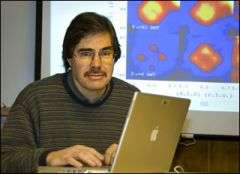
Brookhaven physicist John Tranquada answered that question during his talk about superconducting "stripes" at the March 2007 meeting of the American Physical Society. Studies conducted by Tranquada and other Brookhaven researchers support the controversial theory that the holes segregate themselves into stripes that alternate with antiferromagnetic regions in the material.

"There's a lot of excitement in trying to understand why these materials are superconducting, and there's plenty of controversy surrounding it," Tranquada said.

Most recently, Tranquada's research group examined the effect of the stripes on vibrations in the crystal lattice. Lattice vibrations play a role in pairing up the electrons that carry current in conventional superconductors. At the Laboratorie Leon Brillouin, Saclay, in France, researchers bombarded samples of superconducting materials and the same stripe-ordered non-superconductor with beams of neutrons and measured how the beams scattered.

Comparing the energy and momentum of the incoming beams with those scattered by the samples gives the scientists a measure of how much energy and momentum is transferred to the lattice vibrations. Each of these vibrations normally has a particular, well-defined frequency for a given wavelength. But in the superconductor experiment, at a particular wavelength, the scientists observed an anomaly: a wider range of frequencies in the lattice vibrations.

The scientists observed this anomalous signature most clearly in samples with observable stripe order, but they also saw it in samples of good superconductors without static stripes. This indicates the presence of dynamic stripes - meaning that the stripes can wiggle through the crystal lattice - and suggests that stripes might be important in the mechanism for high-Tc superconductivity, Tranquada said.

Source: BNL


print this article email this article download pdf blog this article bookmark this article     Stumble it Digg this share on Facebook retweet share on Reddit add to delicious
Rate this story - 4 /5 (7 votes)


March 7, 2007 all stories

Comments: 0

4 /5 (7 votes)
  • Stumble this up

  • Digg this

  • share this

  • hide
  • Related Stories


  • hide
  • Relevant PhysicsForums posts

  • Work done on femur
    created 2 hours ago
  • Magnet and Motors?
    created 3 hours ago
  • Effect of Volume on Revolution
    created 3 hours ago
  • Hydrostatic pressure
    created 5 hours ago
  • More from Physics Forums - General Physics

Other News

Stars Fueled by Dark Matter Could Hold Secrets to the Universe

Stars Fueled by Dark Matter Could Hold Secrets to the Universe

Physics / General Physics

created Nov 03, 2009 | popularity 4.5 / 5 (51) | comments 41

(PhysOrg.com) -- The first stars in the universe may have been very different from the stars we see today, yet they may hold clues to understanding some of the mysterious features of the universe. These "dark ...


Second Law of Thermodynamics May Explain Economic Evolution

Second Law of Thermodynamics May Explain Economic Evolution

Physics / General Physics

created Nov 02, 2009 | popularity 4.3 / 5 (30) | comments 28

(PhysOrg.com) -- Terms such as the "invisible hand," laissez-faire policy, and free-market principles suggest that economic growth and decline in capitalist societies seem to be somehow self-regulated. Now, ...


High-performance plasmas may make reliable, efficient fusion power a reality

High-performance plasmas may make reliable, efficient fusion power a reality

Physics / Plasma Physics

created Nov 02, 2009 | popularity 4.7 / 5 (39) | comments 32

In the quest to produce nuclear fusion energy, researchers from the DIII-D National Fusion Facility have recently confirmed long-standing theoretical predictions that performance, efficiency and reliability ...


'Teapot effect' solved

Solving Teapot Effect

Physics / General Physics

created Nov 02, 2009 | popularity 4.9 / 5 (11) | comments 10

(PhysOrg.com) -- A team of scientists from France have worked out why teapots dribble at low flow rates, and how to stop them. The effect is called the "teapot effect", and solving it could finally put an ...


Laser accelerated protons to the highest energies so far

Researchers use trident laser to accelerate protons to record energies

Physics / General Physics

created Nov 02, 2009 | popularity 4.7 / 5 (6) | comments 10

An international team of physicists at Los Alamos National Laboratory has succeeded in using intense laser light to accelerate protons to energies never before achieved. Using this technique, scientists can ...