Paving the Way for Crystal Growth
March 7, 2007 Paving the Way for Crystal Growth

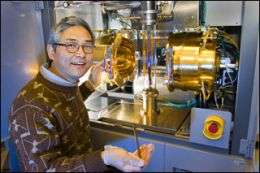
Genda Gu

In order to study the properties of LBCO superconductors, scientists need to produce large, single crystals of the material - a difficult task that wasn't possible until recently. At the state-of-the-art crystal growth facility in Brookhaven's physics building, physicist Genda Gu and his colleagues have perfected the process. Gu discussed his crystal growth method at the March 2007 meeting of the American Physical Society.

The crystals are grown in an infrared image furnace, a machine with two mirrors that focuses infrared light onto a feed rod, heating it to about 2,200 degrees Celsius (3,992 degrees Fahrenheit) and causing it to melt.

Under just the right conditions, Gu and his colleagues can make the liquefied material recrystallize as a single uniform crystal. At present, the most interesting form of LBCO has one barium atom for every eight copper atoms, or a 1/8 "doping," at which point the material loses its superconductivity. Achieving this high barium concentration is extremely difficult and is the reason many scientists previously opted to use different but related materials for their research on superconducting stripes and other properties, Gu said.

"LBCO was the first high-temperature superconductor discovered, but everyone switched over to studying other materials for a while because they weren't able to grow single crystals with a concentration of barium greater than 11 percent," Gu said. "Now, we can study the whole class of high-Tc materials."

Each crystal takes about a month to make, with precise control over growth temperature, atmosphere, and other factors. Brookhaven is currently capable of making crystals with barium concentrations up to 16.5 percent, a world record, Gu said.

Source: BNL


print this article email this article download pdf blog this article bookmark this article     Stumble it Digg this share on Facebook retweet share on Reddit add to delicious
Rate this story - 4.8 /5 (5 votes)


March 7, 2007 all stories

Comments: 0

4.8 /5 (5 votes)
  • Stumble this up

  • Digg this

  • share this

  • hide
  • Related Stories

  • Diamonds are a laser's best friend
    created Sep 18, 2009 | popularity not rated yet | comments 0
  • 'Single-Crystal' Superconductors are a Big Step for the Field
    created Aug 28, 2008 | popularity not rated yet | comments 0
  • Electron microscopy enters the picometer scale
    created Jul 24, 2008 | popularity not rated yet | comments 0
  • Shells - a unique climate archive on the ocean floor
    created Jul 10, 2008 | popularity not rated yet | comments 0
  • Rounding up gases, nano-style
    created Feb 01, 2008 | popularity not rated yet | comments 0


  • hide
  • Relevant PhysicsForums posts

  • Ionization vs. photo-generation - what is the difference?
    created Nov 25, 2009
  • Ising model
    created Nov 24, 2009
  • Photon replica
    created Nov 24, 2009
  • Planck's Radiation Law and Stefan's Law
    created Nov 24, 2009
  • More from Physics Forums - Atomic, Solid State, Comp. Physics

Other News

Superconductor magnet heat shield being developed

Superconductor magnet spacecraft heat shield being developed

Physics / General Physics

created 17 hours ago | popularity 5 / 5 (15) | comments 14

(PhysOrg.com) -- European space agencies and an aerospace giant are developing a new re-entry heat shield that will use superconductor magnets to generate a magnetic field strong enough to deflect the superhot ...


Bacteria

Plasma produces KO cocktail for MRSA

Physics / General Physics

created 18 hours ago | popularity 4.9 / 5 (11) | comments 2

MRSA (methicillin-resistant Staphylococcus Aureus) and other drug-resistant bacteria could face annihilation as low-temperature plasma prototype devices have been developed to offer safe, quick, easy and un ...


Restored machine to explore mysteries of Big Bang (AP)

Restored machine to explore mysteries of Big Bang

Physics / General Physics

created Nov 21, 2009 | popularity 4.6 / 5 (18) | comments 26

(AP) -- Scientists are preparing the world's largest atom smasher to explore the depths of matter after successfully restarting the $10 billion machine following more than a year of repairs.


Scientists react as they stand in front of a screen at CERN

First atoms reported smashed in Large Hadron Collider (Update)

Physics / General Physics

created Nov 23, 2009 | popularity 4.5 / 5 (30) | comments 22

Two circulating beams on Monday produced the first particle collisions in the world's biggest atom smasher, the Large Hadron Collider (LHC), three days after its restart, scientists announced.


nuclear power plant

Doubts raised on nuclear industry viability

Physics / General Physics

created Nov 19, 2009 | popularity 3 / 5 (22) | comments 19

(PhysOrg.com) -- The investment in nuclear power has been growing around the world over the last few years, being viewed as a means for countries to control their energy security, avoid the price fluctuations ...