Scientists find genes involved in the battle between Hessian flies and wheat
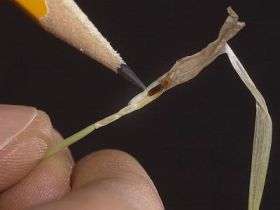
Wheat has ways to battle the tiny, red wormlike insects that nibble on the plant's leaves and can destroy crops worldwide, but the Hessian fly larvae that survive eventually evolve methods to overcome plant defenses.
Purdue University and USDA-Agriculture Research Service scientists trying to thwart the insect have identified Hessian fly genes that nullify toxins that wheat produces to protect itself from the munching larvae. The researchers report their findings in the Feb. 6 issue of the journal Proceedings of the National Academy of Sciences.
Richard Shukle, a USDA-ARS entomologist and Purdue adjunct assistant professor, is working with colleagues to learn more about how the flies feed and why they can't establish a feeding site on plants that are resistant to the larvae.
"The focus of our work is to try to understand how the insect overcomes plant resistance and use that basic knowledge to enhance the durability of wheat against Hessian fly attack by combining several genes for resistance or through some other novel strategies," said Shukle, senior and corresponding author of the paper.
The toxic oxygen compound defense mechanism in resistant plants stresses the larvae, which then fight back, he said. This is confirmed by the Hessian fly larvae's increased production of enzymes triggered by their antioxidant genes in order to detoxify wheat anti-insect poisons.
"Hessian fly larvae are under stress when they encounter resistant wheat plants," Shukle said. "This stress includes starvation when they can't establish a feeding site. The larvae also are under stress from toxic molecules, including poisonous oxygen compounds."
Researchers know little about the biochemical mechanisms involved when larvae - the early stages of the gnat-sized Hessian fly - try to feed on resistant wheat plants that are able to defend themselves, Shukle said. While the insects can't establish feeding sites on resistant plants, the larvae can alter the physiology and change the level of certain proteins in susceptible plants. This forces the plant to feed the larvae.
On resistant plants, Hessian fly larvae encounter defense mechanisms that include poisonous oxygen compounds, Shukle said. These compounds, also called reactive oxygen species, can be produced either by the plant or within the Hessian fly larval digestive system. These poisons then disrupt the insects' gut function.
"The larvae probe the plant to open a sustained feeding site," said Jonathan Neal, a Purdue entomologist and another author of the paper. "Resistant plants block the larvae from establishing a feeding site. It's as if larvae keep trying to open doors because they are programmed to look for a feeding site.
"In resistant plants, the doors are all locked. Then the larvae finally crawl down to the base of the plant and die. This is death by frustration."
Hessian flies can be controlled by using specifically bred wheat varieties called resistant wheat cultivars. Infestations by the flies also can be prevented by planting wheat after the fly is no longer active and laying eggs. This "fly-free date" is set in different regions according to climate.
The study represents a step in understanding the complexity of antioxidant defense responses during interaction between Hessian flies and wheat, he said. It may also be applicable to other insect-plant interactions.
Hessian flies have been in the United States for more than 200 years, apparently accidentally introduced by German mercenaries during the Revolutionary War.
The flies are found worldwide, but the U.S. infestation has been mainly in the Southeast. In Georgia during the 1980s, wheat crop losses totaled $28 million in one year when the insect overcame the plant's resistant gene that was being used at the time.
Over the past two years, the pest also has caused extensive yield losses in southeastern Missouri and a resurgence occurred in Oklahoma in 2006. Most recently, a Hessian fly infestation was identified near Lafayette, Ind., where the insect hadn't been reported for more than a decade.
Source: Purdue University


