NASA Completes Key Review of Orion Spacecraft
March 7, 2007 Orion

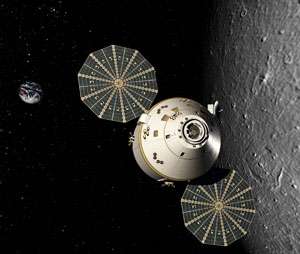
Orion in lunar orbit. Image credit: Lockheed Martin Corp.

NASA has established a requirements baseline for the Orion crew exploration vehicle, bringing America's next human spacecraft a step closer to construction.

The Orion Project completed its system requirements review in cooperation with its prime contractor, Lockheed Martin, March 1. The review marked the first major milestone in the Orion engineering process and provided the foundation for design, development, construction and safe operation of the spacecraft that will carry explorers to Earth orbit, to the moon, and eventually to Mars. The detailed requirements established in this review will serve as the basis for ongoing design analysis work and systems testing.

"This is a significant step in the development of a space transportation system that will expand our horizons to include other worlds," said Skip Hatfield, Orion Project manager at NASA's Johnson Space Center in Houston.

The Orion review followed an overall review of requirements for the Constellation Program that was completed in November. Similar reviews are planned later this spring for ground and mission operations systems that will support Constellation launch systems and space flight operations ground infrastructure.

"We have now completed program-wide launch vehicle and human spacecraft system requirements reviews," said Constellation Program Manager Jeff Hanley. "These are important pieces of a management and engineering puzzle that will allow us to accomplish the goal of putting humans back on the moon."

The Orion requirements data set was reviewed by agency and contractor scientists and engineers from across the country. More than 1,700 topics covering all aspects of vehicle performance, design and qualification were discussed during the course of the formal review.

Once all project-level reviews are complete, the Constellation Program will hold another full review to update baseline requirements. A lunar architecture systems review of equipment associated with surface exploration and science activities on the moon is expected in the spring of 2009.

Credit: NASA


print this article email this article download pdf blog this article bookmark this article     Stumble it Digg this share on Facebook retweet share on Reddit add to delicious
Rate this story - 3.7 /5 (21 votes)


March 7, 2007 all stories

Comments: 0

3.7 /5 (21 votes)
  • Stumble this up

  • Digg this

  • share this

  • hide
  • Related Stories


  • hide
  • Relevant PhysicsForums posts

  • The shape of our solar system's orbits.
    created Nov 07, 2009
  • Above or Below the Line of Nodes
    created Nov 07, 2009
  • Supernova vs. Nova?
    created Nov 07, 2009
  • Supernova's Gamma Rays and Comets
    created Nov 06, 2009
  • More from Physics Forums - General Astronomy

Other News

Planetary Society plans new 'solar sail'

Space & Earth / Space Exploration

created 5 hours ago | popularity 5 / 5 (1) | comments 0

(AP) -- Four years after its first solar sail ended up in the ocean instead of orbit, The Planetary Society announced Monday that by the end of 2010 it will try again to launch a spacecraft that will be propelled by the ...


Antarctica glacier retreat creates new carbon dioxide store

Antarctica glacier retreat creates new carbon dioxide store

Space & Earth / Earth Sciences

created 15 hours ago | popularity 3.5 / 5 (4) | comments 0

Large blooms of tiny marine plants called phytoplankton are flourishing in areas of open water left exposed by the recent and rapid melting of ice shelves and glaciers around the Antarctic Peninsula. This ...


L-R: Chiwetel Ejiofor, Amanda Peet and John Cusack at the premiere of "2012"

NASA on crusade to debunk 2012 apocalypse myths

Space & Earth / Space Exploration

created 10 hours ago | popularity 4 / 5 (1) | comments 1

The world is not coming to an end on December 21, 2012, the US space agency insisted Monday in a rare campaign to dispel widespread rumors fueled by the Internet and a new Hollywood movie.


Australian scientists call for urgent 'global cooling' to save coral reefs

Space & Earth / Environment

created 6 hours ago | popularity 3 / 5 (2) | comments 0

(PhysOrg.com) -- Australian marine scientists have issued an urgent call for massive and rapid worldwide cuts in carbon emissions, deep enough to prevent atmospheric CO2 levels rising to 450 parts per million (ppm).


NASA satellites make a movie and get rainfall, wind info on Ida

NASA satellites make a movie and get rainfall, wind info on Ida (w/ Video)

Space & Earth / Earth Sciences

created 11 hours ago | popularity not rated yet | comments 0

NASA satellites are amazing examples of technology. The TRMM satellite peers into tropical cyclones and can tell how much rain is falling per hour and where. QuikScat uses microwave technology to measure Ida's ...