Prototype Space Probe Prepares to Explore Earth's Deepest Sinkhole
March 7, 2007
Prototype Space Probe Prepares to Explore Earth's Deepest Sinkhole

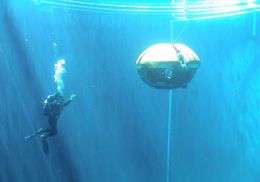
Doctoral student Marcus Gary SCUBA dives with the DEPTHX probe during initial in-water tests at The University of Texas at Austin Applied Research Laboratories wet test facility.

Scientists return this week to the world's deepest known sinkhole, Cenote Zacatón in Mexico, to resume tests of a NASA-funded robot called DEPTHX, designed to survey and explore for life in one of Earth's most extreme regions and potentially in outer space.

If all goes well with this second round of testing and exploration, the team will return in May for a full-scale exploration of the Zacatón system.

Sinking more than 1,000 feet, Zacatón has only been partially mapped and its true depth remains unknown.

During eight years of research, doctoral student Marcus Gary and hydrogeology professor Jack Sharp from The University of Texas at Austin's Jackson School of Geosciences, discovered the system's unusual hydrothermal nature is analogous to liquid oceans under the icy surface of Jupiter's moon Europa.

Technology developed to explore the sinkholes could be applied to future space probes of Europa, where scientists believe that deep cracks and holes in the ice offer a chance of finding extraterrestrial life.

The technology could also be used to explore Earth's ice-bound polar lakes, which hold clues to the origins of life on Earth.

Microbes which appear to be new to science have been discovered floating in deep water and lining rocks in Zacatón. Far below sunlight's ability to penetrate, they may get their energy from nutrients welling up from hot springs. Gary and others speculate that previously undocumented life may await discovery in the murky depths.

William Stone of Stone Aerospace in Del Valle, Texas, heads the exploration project, named DEPTHX after the robot, a deep phreatic thermal explorer that NASA funded with $5 million. In addition to the geoscientists from The University of Texas at Austin, collaborators include robotics experts, engineers, geobiologists and geochemists from Carnegie Mellon University, Colorado School of Mines and Southwest Research Institute.

The probe is designed to map underwater caves, measure geochemical properties of the water, search for microbes and other life forms, and bring back samples for subsequent analysis.

The team conducted initial tests of the probe's navigation capabilities in February, successfully mapping La Pilita, the second deepest sinkhole in the Zacatón system. Operations during this first mission showed that DEPTHX could find its way through underwater space, collect samples in unexplored areas and navigate back to the surface.

Unique in the world of robotic explorers, DEPTHX is autonomous. The probe does not rely on instructions from humans to decide where to go or what to do. It creates 3-D maps of previously unexplored areas as it swims along and then uses those same maps to navigate back to the surface.

Cenote Zacatón first achieved notoriety when two divers attempted to reach the bottom in 1994. One of them, Sheck Exley, died in the attempt. The other, Jim Bowden, survived, descending to a record depth of 925 feet. The outcome caused scientists to rethink ways that Zacatón could be explored safely.

Gary first began visiting Cenote Zacatón in 1993 as a commercial diving guide. He was inspired by the unique environment to pursue a doctorate in geology. He has continued investigating the system of underwater caves to understand how they formed and evolved over time, working with a network of explorers and scientists to increase awareness of the system's scientific value.

"We brought this place into international recognition with the cave community and now with the scientific community," said Gary. "People in cave diving knew it was there because Sheck died there. He was a pioneer in cave diving and legendary for 30 years, holding previous world depth records. That's all it was known for. Now it has potential for a lot of future research."

Source: University of Texas at Austin

4.1 /5 (20 votes)  

Filter


Move the slider to adjust rank threshold, so that you can hide some of the comments.


Display comments: newest first

nilbud
Jul 08, 2008

Rank: not rated yet
Why not tie a lump of lead onto a rope and find out how deep it is for a couple of hundred bucks?
snwboardn
Jul 08, 2008

Rank: not rated yet
I don't think a lump of lead on a rope will detect life on Europa.
QubitTamer
Sep 26, 2008

Rank: not rated yet
All these worlds are yours, except Europa. Attempt no landings there...

Best not to piss off our Galactic Overlords who created our intelligence with their Monoliths!
Rank 4.1 /5 (20 votes)
Tags

Relevant PhysicsForums posts
  • Do some geologists actually act a lot like Randy Marsh?
    created6 hours ago
  • Discrepancy between oxygen and carbon-dioxide levels
    createdFeb 09, 2012
  • where gems are found in the world
    createdFeb 09, 2012
  • Wind Waves in Reservoir ~ Wind run-up and Wind set-up
    createdFeb 08, 2012
  • Balance of oxygen in the atmosphere
    createdFeb 01, 2012
  • The case for a methanol-based economy
    createdJan 30, 2012
  • More from Physics Forums - Earth

More news stories

Europe stakes billion-dollar bet on new rocket

A pencil-slim rocket is scheduled to lift into space from South America on Monday, carrying a billion-dollar bet that Europe can grab a juicy slice of the market to place satellites in low orbit.

Space & Earth / Space Exploration

created 4 hours ago | popularity 3.5 / 5 (2) | comments 0

NASA sees wide-eyed cyclone Jasmine

Cyclone Jasmine's eye has opened wider on NASA satellite imagery, as it moves through the Southern Pacific Ocean.

Space & Earth / Earth Sciences

created 20 hours ago | popularity 3.5 / 5 (2) | comments 2

NASA sees Giovanna reach cyclone strength, threaten Madagascar

Tropical Storm 12S built up steam and became a cyclone on February 10, 2012 as NASA's Terra satellite passed overhead. Residents of east-central Madagascar should prepare for this cyclone to make landfall ...

Space & Earth / Earth Sciences

created 20 hours ago | popularity not rated yet | comments 0

Political leaders play key role in how worried Americans are by climate change: study

More than extreme weather events and the work of scientists, it is national political leaders who influence how much Americans worry about the threat of climate change, new research finds.

Space & Earth / Environment

created Feb 06, 2012 | popularity 5 / 5 (6) | comments 68

Humans may have helped the decline of African rainforests 3000 years ago

(PhysOrg.com) -- Large areas of rainforests in Central Africa mysteriously disappeared over three thousand years ago, to be replaced by savannas. The prevailing theory has been that the cause was a change ...

Space & Earth / Environment

created Feb 10, 2012 | popularity 4.3 / 5 (13) | comments 15 | with audio podcast report


Europeans protest controversial Internet pact

Tens of thousands of people marched in protests in more than a dozen European cities Saturday against a controversial anti-online piracy pact that critics say could curtail Internet freedom.

Walney offshore wind farm is world's biggest (for now)

(PhysOrg.com) -- The Walney wind farm on the Irish Sea--characterized by high tides, waves and windy weather--officially opened this week. The farm is treated in the press as a very big deal as the Walney ...

GPS court ruling leaves US phone tracking unclear

A US Supreme Court decision requiring a warrant to place a GPS device on the car of a criminal suspect leaves unresolved the bigger issue of police tracking using mobile phones, legal experts say.

Study finds that anti-diabetic medication can prevent the long-term effects of maternal obesity

In a study to be presented today at the Society for Maternal-Fetal Medicine's annual meeting, The Pregnancy Meeting, in Dallas, Texas, researchers will report findings that show that short therapy with the anti-diabetic medication ...

Netflix settlement trims 14 pct off 4Q earnings

(AP) -- Netflix pressed the rewind button on its fourth-quarter earnings after settling allegations that the video subscription service violated a consumer-privacy law.

Anonymous briefly knocks CIA website offline (Update 2)

The website of the Central Intelligence Agency was briefly inaccessible on Friday after the hacker group Anonymous claimed to have knocked it offline.