Gamma-Ray Burst Challenges Theory
March 8, 2007 By Bob Naeye Gamma-Ray Burst Challenges Theory

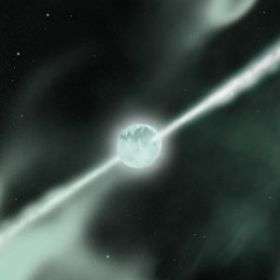
The core of a massive star in a distant galaxy collapses, ending its life -- though there is little effect visible at the surface. Deep inside, twin beams of matter and energy begin to blast their way outward. Within seconds, the beams have eaten their way out of the star, and observers at Earth see it as a gamma-ray burst, GRB 060729A. Credit: Phil Plait SSU NASA E/PO; Aurore Simonnet SSU NASA E/PO

In a series of landmark observations gathered over a period of four months, NASA's Swift satellite has challenged some of astronomers' fundamental ideas about gamma-ray bursts (GRBs), which are among the most extreme events in our universe. GRBs are the explosive deaths of very massive stars, some of which eject jets that can release in a matter of seconds the same amount of energy that the sun will radiate over its 10-billion-year lifetime.

When GRB jets slam into nearby interstellar gas, the resulting collision generates an intense afterglow that can radiate brightly in X-rays and other wavelengths for several weeks. Swift, however, has monitored a GRB whose afterglow remained visible for more than 125 days in the satellite's X-ray Telescope (XRT).
Gamma-Ray Burst Challenges Theory

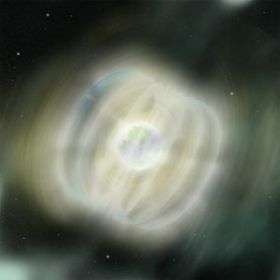
The outer envelope of the star explodes outward, causing a supernova. Deep at the heart of this event, the core has shrunk into a fantastically dense magnetar, a neutron star possessing a magnetic field trillions or even quadrillions of times stronger than Earth's. The magnetism is what powers the long glow of X-rays seen by Earthbound scientists. Credit: Phil Plait SSU NASA E/PO; Aurore Simonnet SSU NASA E/PO

Swift's Burst Alert Telescope (BAT) detected the GRB in the constellation Pictor on July 29, 2006. The XRT picked up GRB 060729 (named for its date of detection) 124 seconds after BAT's detection. Normally, the XRT monitors an afterglow for a week or two until it fades to near invisibility. But for the July 29 burst, the afterglow started off so bright and faded so slowly that the XRT could regularly monitor it for months, and the instrument was still able to detect it in late November. The burst's distance from Earth (it was much closer than many GRBs) was also a factor in XRT's ability to monitor the afterglow for such an extended period.

The slow fading of the X-ray afterglow has several important ramifications for our understanding of GRBs. "It requires a larger energy injection than what we normally see in bursts, and may require continuous energy input from the central engine," says astronomer Dirk Grupe of Penn State University, University Park, Penn., and lead author of an international team that reports these results in an upcoming issue of the Astrophysical Journal.

One possibility is that the GRB's central engine was a magnetar — a neutron star with an ultra-powerful magnetic field. The magnetar's magnetic field acts like a brake, forcing the star's rotation rate to spin-down rapidly. The energy of this spin-down can be converted into magnetic energy that is continuously injected into the initial blast wave that triggered the GRB. Calculations by paper coauthor Xiang-Yu Wang of Penn State show that this energy could power the observed X-ray afterglow and keep it shining for months.

A burst observed on January 10, 2007, also suggests that magnetars power some GRBs. GRB 070110's X-ray afterglow remained nearly constant in brightness for 5 hours, then faded rapidly more than tenfold. In another paper submitted to the Astrophysical Journal, an international group led by Eleonora Troja of the INAF—IASF of Palermo, Italy, proposes that a magnetar best explains these observations.

"People have thought for a long time that GRBs are black holes being born, but scientists are now thinking of other possibilities," says Swift principal investigator Neil Gehrels of NASA's Goddard Space Flight Center in Greenbelt, Md., a co-author on both studies.

Another surprising result from GRB 060729 is that the X-ray afterglow displayed no sharp decrease in brightness over the 125-day period that it was detected by the XRT. Using widely accepted theory, Grupe and his colleagues conclude that the angle of the GRB's jet must have been at least 28 degrees wide. In contrast, most GRB jets are thought to have very narrow opening angles of only about 5 degrees. "The much wider opening angle seen in GRB 060729 suggests a much larger energy release than we typically see in GRBs," says Grupe.

Source: Goddard Space Flight Center


print this article email this article download pdf blog this article bookmark this article     Stumble it Digg this share on Facebook retweet share on Reddit add to delicious
Rate this story - 4.8 /5 (66 votes)


March 8, 2007 all stories

Comments: 0

4.8 /5 (66 votes)
  • Stumble this up

  • Digg this

  • share this

  • hide
  • Related Stories

  • Blast from the Past Gives Clues About Early Universe
    created Oct 28, 2009 | popularity not rated yet | comments 0
  • The Case of the Missing Gamma-ray Bursts
    created Oct 23, 2008 | popularity not rated yet | comments 0
  • 'Naked Eye' Gamma Ray Burst Was Aimed Squarely At Earth
    created Sep 10, 2008 | popularity not rated yet | comments 0
  • Swift, Gemini probe mysterious explosion in the distant past
    created Jan 08, 2008 | popularity not rated yet | comments 0
  • Intergalactic 'shot in the dark' shocks astronomers
    created Dec 18, 2007 | popularity not rated yet | comments 0


  • hide
  • Relevant PhysicsForums posts

  • The shape of our solar system's orbits.
    created 14 hours ago
  • Above or Below the Line of Nodes
    created 18 hours ago
  • Supernova vs. Nova?
    created Nov 07, 2009
  • Supernova's Gamma Rays and Comets
    created Nov 06, 2009
  • Our Moon
    created Nov 06, 2009
  • Question about a Carl Zeiss lens
    created Nov 05, 2009
  • More from Physics Forums - General Astronomy

Other News

Success in 'space elevator' competition (AP)

Success in 'space elevator' competition (Update 3)

Space & Earth / Space Exploration

created Nov 05, 2009 | popularity 4.3 / 5 (33) | comments 50

(AP) -- A robot powered by a ground-based laser beam climbed a long cable dangling from a helicopter on Wednesday to qualify for prize money in a $2 million competition to test the potential reality of the ...


'Dropouts' pinpoint earliest galaxies

'Dropouts' pinpoint earliest galaxies

Space & Earth / Astronomy

created Nov 06, 2009 | popularity 4.1 / 5 (9) | comments 12

Astronomers, conducting the broadest survey to date of galaxies from about 800 million years after the Big Bang, have found 22 early galaxies and confirmed the age of one by its characteristic hydrogen signature ...


Space hotel taking bookings for 2012 opening

Space hotel taking bookings for 2012 opening

Space & Earth / Space Exploration

created Nov 05, 2009 | popularity 4.4 / 5 (20) | comments 11

(PhysOrg.com) -- The first orbiting space hotel is on track to open for its first customers in 2012, but hurry, as bookings are filling fast.


This undated file picture shows part of the Pastoruri snowcapped mountain in the central Peruvian Andes

'Whitewash' could slow global warming: Peruvian scientist

Space & Earth / Earth Sciences

created Nov 04, 2009 | popularity 1.4 / 5 (9) | comments 11

A Peruvian scientist has called on his country to help slow the melting of Andean glaciers by daubing white paint on the rock and earth left behind by receding ice so they will absorb less heat.


In a Galaxy Far, Far Away...

In a Galaxy Far, Far Away...

Space & Earth / Astronomy

created Nov 06, 2009 | popularity 4.8 / 5 (4) | comments 10

(PhysOrg.com) -- Astronomers have published the discovery of the farthest known object in the cosmos: a star that exploded when the universe was only 630 million years old -- only 4.6% of its current age. ...