Digital Crystal Video Receiver: Researchers Patent Process for Aircraft Radar Warning Receivers
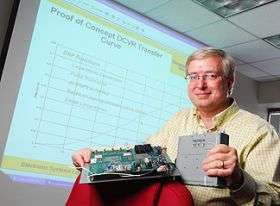
Researchers at the Georgia Tech Research Institute have patented a discovery that could significantly increase reliability and reduce cost in equipment that helps protect U.S. military aircraft from attack.
The patent covers a device called a digital crystal video receiver (DCVR), a vital part of the radar warning receiver (RWR) system that alerts an aircraft crew to enemy ground-radar activity. GTRI researchers Michael J. Willis and Michael L. McGuire, working with Air Force scientist Charlie W. Clark, have patented a way to use digital circuitry to perform many functions formerly allotted to more-problematic analog chips.
Specifically, the researchers have moved a critical operation -- the logarithmic transfer function -- from the analog to the digital domain. The logarithmic transfer function coordinates the input and output of a radar warning receiver’s signal-processing system.
“Electronic analog technologies have a number of error sources and limitations when subjected to the extended temperature range that our military requires,” said Willis, a principal research engineer with GTRI’s Electronic Systems Laboratory (ELSYS). “By moving the logarithmic transfer function into the digital signal-processing domain, we've improved the stability of the circuit.”
Analog circuits, traditionally used to detect real-world phenomena such as sound or temperature, hold a multitude of continuous values across any given range. By contrast, digital circuits process information in discrete steps governed by the binary code that computers use.
In radar warning receivers, Willis explains, the continuous-scale analog implementation has been difficult to calibrate and maintain. By contrast, the digital domain needs no calibration and is more robust.
The digital version is also far less expensive to manufacture.
“Moving the logarithmic transfer function from analog to digital probably reduces production costs of a radar warning receiver by a factor of between five and 10,” he said. “The cost of the digital video portion could become nearly insignificant in comparison to the cost of the remainder of the RWR system.”
The new digital crystal video receiver is comprised of an analog-to-digital converter and a programmable logic component. Together, they're able to transfer most received analog signals to the more-reliable digital domain.
Earlier crystal video receiver architectures, Willis explains, detected radio-frequency (RF) signals immediately, without intermediate processing. Such analog “direct-conversion” receivers often needed multiple receivers to detect radar signals over a range of frequencies.
By contrast, the DCVR’s improvements include a capacity to readily detect RF signals through a wide range of frequencies using up-to-date broadband receiver techniques.
Scientists use the word “video” to describe this technology because the receiver demodulates received radar signals into video waveforms. The new digital crystal video receiver approach subjects those video waveforms to digital signal processing, producing a digital equivalent with a logarithmic function to make processing easier.
“Adding the word ‘digital’ to the older term ‘crystal video receiver’ emphasizes that technology advances have allowed us to overcome many limitations of the older-generation, crystal-based, direct-conversion receivers,” Willis said.
The initial sponsored research involved a radar warning receiver used on a number of U.S. military aircraft, Willis said. The discovery may have other military applications as well.
Commercial applications are also possible, he said. The discovery could be applied not only to radar warning receivers but to any receiver that requires a logarithmic transfer function. Thus, it could be used in many types of radios or in other devices that involve signal receiving and processing capabilities.
The recent patent, shared by GTRI and the U.S. government, is significant because it protects the technology. Still, Willis said, the patent is only another step in an ongoing process leading to field deployment.
Currently, he said, GTRI is studying how to implement the new technology. He expects it will take two years to complete the design process and transition the final implementation into production.
Source: Georgia Institute of Technology


