Astronomers detect echoes from ancient supernovae
A team of astronomers has found faint visible “echoes” of three ancient supernovae by detecting centuries-old light reflected by interstellar gas clouds hundreds of light-years removed from the original explosions.
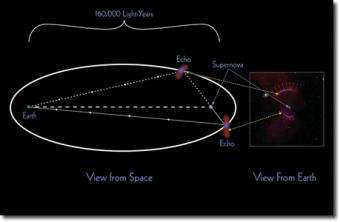
This graphic shows a schematic of the geometry of the light path that creates a supernova light echo, shown as if the process could be viewed from the side. An echo occurs when the Earth is at one foci of an imaginary ellipse and the supernova remnant is at the other, with dust clouds that happen to be located at the surface of the resulting ellipse. When the light from the supernova reaches these dust clouds, it is reflected toward an observer located at Earth. To this observer, the reflection appears as an arc; this arc would be a full, circular slice through the ellipse (as viewed from Earth) if dust were equally distributed around the full volume of space that that the supernova light is traveling through. P. Marenfeld and NOAO/AURA/NSF
Located in a nearby galaxy in the southern skies, the three exploding stars flashed into short-lived brilliance at least two centuries ago, and probably longer. The oldest is likely to have occurred more than 600 years ago.
Just as a sound echo can occur when sound waves bounce off a distant surface and reflect back toward the listener, a light echo can be seen when light waves traveling through space are reflected back toward the viewer.
The light echoes were discovered by comparing images of the Large Magellanic Cloud (LMC) taken years apart. By precisely subtracting the common elements in each image and analyzing what variable objects remain, the team looked for evidence of dark matter that might distort the light of stars in a transitory way, as part of a second-generation sky survey called SuperMACHO. SuperMACHO builds on the discoveries of the MACHO project, which started at Lawrence Livermore National Laboratory in 1989.
“The exciting thing for me is that the light echo discovery was serendipity,” said Livermore astronomer Kem Cook, a co-author on the paper that appears in the Dec. 22, 2005, edition of Nature. “We are carrying out a large wide-field, time-domain survey looking for the signature of dark matter, and as a bonus we are discovering unexpected things like these light echoes. Serendipitous discoveries are a key element of large surveys and will likely be an important element of even larger future surveys in which LLNL is involved, such as the Large Synoptic Survey Telescope.”
The careful image analysis also revealed a small number of concentric, circular-shaped arcs that are best explained as light moving outward over time, and being scattered as it encounters dense pockets of interstellar dust. Team members then fit perpendicular vectors to the curves of each arc system, which were found to point backward toward the sites of three recent supernovae remnants found previously via their X-ray glow by the orbiting Chandra X-ray Observatory.
“Without the geometry of the light echo, we had no way of knowing just how old these supernovae were,” said astronomer Armin Rest of the National Optical Astronomy Observatory (NOAO), lead author of the paper. “Some relatively simple mathematics can help us answer one of the most vexing problems that astronomers can ask – exactly how old is this object that we are looking at?”
This technique can be applied to famous supernovae in history. “Imagine seeing light from the same explosion first seen by Johannes Kepler some 400 years ago, or the one recorded by Chinese observers in 1006,” said Christopher Stubbs of the Harvard-Smithsonian Center for Astrophysics (CfA), co-author of the paper and principal investigator for the SuperMACHO program. “These light echoes give us that possibility.”
In principle, astronomers can split the light echo into a spectrum to investigate what type of supernova occurred. “We have the potential with these echoes to determine the star’s cause of death, just like the archaeologists who took a CT scan of King Tut’s mummy to find out how he died,” said co-author Arti Garg of CfA.
Astronomers also can use supernova light echoes to measure the structure and nature of the interstellar medium. Dust and gas between the stars are invisible unless illuminated by some light source, just as fog at night is not noticeable until lit by a car’s headlights. A supernova blast can provide that illumination, lighting up surrounding clouds of matter with its strobe-like flash.
“We see the reflection as an arc because we are inside an imaginary ellipse, with the Earth at one focus of the ellipse and the ancient supernovae at the other,” explained Nicholas Suntzeff of NOAO. “As we look out toward the supernovae, we see the reflection of the light echo only when it intersects the outer surface of the ellipse.”
An unusual aspect of the arcs is that they generally appear to move much faster than the speed of light. This does not violate the cosmic speed limit, which states that no object can move faster than light. “What our telescopes see is the reflection moving, and not any physical object,” Suntzeff said. “It is also very exciting that our observations confirm the visionary prediction of Fritz Zwicky in 1940 that light from ancient supernovae could be seen in echoes of the explosion.”
The Livermore portion of the work is funded by National Nuclear Security Administration.
Other co-authors of the paper are Mark Huber and Sergei Nikolaev of Lawrence Livermore, Knut Olsen and Chris Smith of the Cerro Tololo Inter-American Observatory in Chile, Jose Luis Prieto of Ohio State University, Douglas Welch of McMaster University, Ontario, Canada, Andrew Becker and Gajus Miknaitis of the University of Washington, Marcel Bergmann of the Gemini Observatory, and Alejandro Clocchiatti and Dante Minniti of Pontifica Universidad Católica de Chile.
Source: Lawrence Livermore National Laboratory


