SMART-1's bridge to the future exploration of the Moon
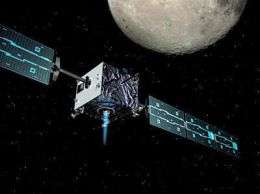
March 9, 2007 Artist's impression of ESA's SMART-1

Artist's impression of ESA's SMART-1 mission at the Moon. SMART-1 was launched in September 2003, and arrived to the Moon on 15 November 2004, after a long spiralling around during which it tested new technologies, including solar-electric propulsion for future applications in interplanetary travels. The mission ended through lunar impact on 3 September 2006. Credits: ESA - AOES Medialab

ESA's SMART-1 moon mission has become a bridge to the future of lunar science and exploration.

"SMART-1 data are helping to choose future landing sites for robotic and possible manned missions, and its instruments are upgraded and being flown again on the next generation of lunar satellites," says Bernard Foing, ESA SMART-1 Project scientist. "Even its spectacular impact campaign is helping NASA to plan their own moon crash."

SMART-1's mission lasted from launch on 27 September 2003, to its controlled impact on the Moon on 3 September 2006. During that time, the mission's innovative approach to technology and science created new solutions to old problems that are now being carried forward to the next generation of lunar missions, in line with the recommendations of the International Lunar Exploration Working Group (ILEWG).

The miniature camera, AMIE, weighed just 2 kilograms yet the images it returned are being used to choose possible landing sites for future missions. The choice of landing sites depends upon criteria such as the scientific importance of the area, the ease of landing and operation and, if it is to become a human base, the availability of lunar resources. SMART-1 has imaged Apollo and Luna landing sites, and potential possible landing sites for humans at the lunar poles.

To follow up the technological breakthroughs of SMART-1, ESA is providing three instruments for the Indian Moon mission Chandrayaan-1. Two are direct descendents from SMART-1: the infrared spectrometer, SIR2, and the X-ray spectrometer, C1XS. The third (SARA) is a precursor to an instrument that will fly on ESA's Bepi-Colombo mission to Mercury.

ESA and European scientists are also collaborating with the Japanese, who are currently preparing the large lunar spacecraft, Selene, which will launch this year carrying two subsatellites and 300 kilograms of sophisticated instruments.

During SMART-1's mission, ESA provided the Chinese with details of the spacecraft's position and transmission frequencies, so that the Chinese could test their tracking stations and ground operations by following it. This was part of their preparation for Chang'E 1, an orbiter due to be launched in October 2007.

SMART-1 experts are collaborating with NASA to prepare for Lunar Reconnaissance Orbiter (LRO) that will provide new imaging, radar and other key measurements needed for future exploration of the Moon. LRO is due to be launched at the end of 2008. ESA is sharing the experience of SMART-1's impact campaign to help prepare the Lunar Crater Observation and Sensing Satellite (LCROSS), which will be launched with LRO. The LCROSS shepherd spacecraft will watch the spent upper-stage of its rocket crash into a dark lunar crater, hopefully releasing water vapour and thus proving that ice exists on the lunar surface.

"Having flown SMART-1, we have now established collaborations with other countries that will help to take us into the future of lunar exploration," says Foing.

Source: European Space Agency


print this article email this article download pdf blog this article bookmark this article     Stumble it Digg this share on Facebook retweet share on Reddit add to delicious
Rate this story - 4 /5 (6 votes)


March 9, 2007 all stories

Comments: 0

4 /5 (6 votes)
  • Stumble this up

  • Digg this

  • share this

  • hide
  • Related Stories


  • hide
  • Relevant PhysicsForums posts

  • The shape of our solar system's orbits.
    created Nov 07, 2009
  • Above or Below the Line of Nodes
    created Nov 07, 2009
  • Supernova vs. Nova?
    created Nov 07, 2009
  • Supernova's Gamma Rays and Comets
    created Nov 06, 2009
  • More from Physics Forums - General Astronomy

Other News

Planetary Society plans new 'solar sail'

Space & Earth / Space Exploration

created 2 hours ago | popularity not rated yet | comments 0

(AP) -- Four years after its first solar sail ended up in the ocean instead of orbit, The Planetary Society announced Monday that by the end of 2010 it will try again to launch a spacecraft that will be propelled by the ...


L-R: Chiwetel Ejiofor, Amanda Peet and John Cusack at the premiere of "2012"

NASA on crusade to debunk 2012 apocalypse myths

Space & Earth / Space Exploration

created 7 hours ago | popularity 4 / 5 (1) | comments 1

The world is not coming to an end on December 21, 2012, the US space agency insisted Monday in a rare campaign to dispel widespread rumors fueled by the Internet and a new Hollywood movie.


Antarctica glacier retreat creates new carbon dioxide store

Antarctica glacier retreat creates new carbon dioxide store

Space & Earth / Earth Sciences

created 12 hours ago | popularity 3.5 / 5 (4) | comments 0

Large blooms of tiny marine plants called phytoplankton are flourishing in areas of open water left exposed by the recent and rapid melting of ice shelves and glaciers around the Antarctic Peninsula. This ...


NASA satellites make a movie and get rainfall, wind info on Ida

NASA satellites make a movie and get rainfall, wind info on Ida (w/ Video)

Space & Earth / Earth Sciences

created 7 hours ago | popularity not rated yet | comments 0

NASA satellites are amazing examples of technology. The TRMM satellite peers into tropical cyclones and can tell how much rain is falling per hour and where. QuikScat uses microwave technology to measure Ida's ...


The GOES-12 satellite sees Large Hurricane Ida nearing landfall

The GOES-12 satellite sees Large Hurricane Ida nearing landfall

Space & Earth / Earth Sciences

created 8 hours ago | popularity 5 / 5 (1) | comments 0

Residents of the U.S. Gulf coast thought they were getting a break this hurricane season until Ida showed up. Today, November 9, Ida is a hurricane and is headed for a landfall in the western Florida Panhandle ...