Microscopic instrument aboard Air Force Academy satellite to study plasma bubbles
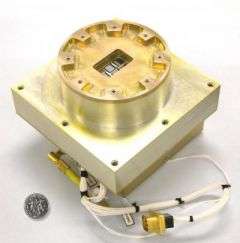
Researchers from the Johns Hopkins University Applied Physics Laboratory (APL), in Laurel, Md., in conjunction with scientists from NASA Goddard Space Flight Center and the U.S. Air Force Academy, have developed a tiny analyzer to study depletions of plasma (known as plasma bubbles) in the ionosphere, a phenomenon that can disrupt satellite communications.
The Flat Plasma Spectrometer (FlaPS) is one of three experimental payloads onboard the Air Force Academy's Falconsat-3 microsatellite that launched last night on an Atlas V from Cape Canaveral Air Force Station, Fla. The six-month mission is demonstrating an improved technology to help the Air Force better understand and forecast plasma bubbles. Conceived by NASA GSFC and the Air Force Academy, and designed and fabricated by APL, FlaPS reduces a plasma spectrometer from the size of a coffee urn to that of a teacup.
"We've aggressively miniaturized the instrument by applying manufacturing techniques used in the micro-electronics world to build personal computer components," says Robert Osiander, APL's principal investigator for the FlaPS program.
Although the instrument isn't unique in terms of its science data, it is unique in terms of its size, which can help reduce overall mission costs. "We've applied MicroElectroMechanical (MEMS) technology to reduce the instrument's size by a factor of 100 while greatly increasing its sensitivity and resolution, and dramatically reducing weight and power requirements compared to conventional spectrometers," says Danielle Wesolek, APL's technical lead for FlaPS.
If you looked at the top of the device through an electron-scanning microscope, you would see a tiny hole smaller than the width of a human hair where particles enter the spectrometer. As particles travel through the electrostatic analyzer, or energy selector, they pass through another opening so small that a human hair or piece of dandruff would block it. The opening leads to a series of tiny parallel plates that deflect the particles toward the exit from this section of the analyzer. Only particles of a selected bandwidth pass through and are collected. Data is then downlinked to science teams on the ground through Falconsat-3's mission operations center located at the Air Force Academy.
The spectrometer's small size, low weight and power consumption, and increased resolution make it ideal and affordable for use in large numbers, and could be applied to other types of missions. "These spectrometers could be advantageous for mapping missions, for example, which require a large number of microsatellites to simultaneously map multiple points in space," says Osiander. "Where we once could only carry one spectrometer per spacecraft, we can now carry dozens."
The multi-organizational team is already working on the next-generation device known as WISPERS (Wafer-scale Integrated SPectrometERS), an instrument suite created by the same micro-electronics-based manufacturing techniques. "We're creating an entire suite of instruments on a single wafer or chip - the platform on which all integrated microcircuits are built," says Osiander. "These instrument suites will greatly increase our functionality within a much smaller area."
WISPERS is scheduled to fly on Falconsat-5 scheduled for launch in fall 2009.
Falconsat-3 was one of six satellites launched aboard a single rocket as part of the Defense Department's Space Test Program-1 mission, the first Air Force mission to launch aboard an Atlas V launch vehicle.
Source: Johns Hopkins University


