New stellerator a step forward in plasma research
March 9th, 2007 New stellerator a step forward in plasma research

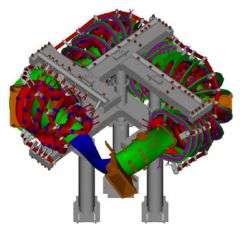
A picture of the helically symmetric experiment. Credit: HSX/University of Wisconsin-Madison

A project by University of Wisconsin-Madison researchers has come one step closer to making fusion energy possible.

The research team, headed by electrical and computer engineering Professor David Anderson and research assistant John Canik, recently proved that the Helically Symmetric eXperiment (HSX), an odd-looking magnetic plasma chamber called a stellarator, can overcome a major barrier in plasma research, in which stellarators lose too much energy to reach the high temperatures needed for fusion.

Published in a recent issue of Physical Review Letters, the new results show that the unique design of the HSX in fact loses less energy, meaning that fusion in this type of stellarator could be possible.

Plasma is very hot, ionized gas that can conduct electricity - essentially, it's what stars are made of. If heated to the point of ignition, hydrogen ions could fuse into helium, the same reaction that powers the sun. This fusion could be a clean, sustainable and limitless energy source.

Current plasma research builds on two types of magnetic plasma confinement devices, tokamaks and stellarators. The HSX aims to merge the best properties of both by giving a more stable stellarator the confinement of a more energetically efficient tokamak. "The slower energy comes out, the less power you have to put in, and the more economical the reactor is," says Canik.

Tokamaks, the current leader in the fusion race, are powered by plasma currents, which provide part of the magnetic field that confines the plasma. However, they are prone to "disruptions."

"The problem is you need very large plasma currents and it's not clear whether we'll be able to drive that large of a current in a reactor-sized machine, or control it. It may blow itself apart," says Canik.

Stellarators do not have currents, and therefore no disruptions, but they tend to lose energy at a high rate, known as transport. The external magnetic coils used to generate the plasma-confining field are partially responsible for the high transport rates in conventional stellarators. The coils add some ripple to the magnetic field, and the plasma can get trapped in the ripple and lost.

The HSX is the first stellarator to use a quasi-symmetric magnetic field. The reactor itself looks futuristic: Twisted magnetic coils wrap around the warped doughnut-shaped chamber, with instruments and sensors protruding at odd angles. But the semi-helical coils that give the HSX its unique shape also direct the strength of the magnetic field, confining the plasma in a way that helps it retain energy.

The team designed and built the HSX with the prediction that quasisymmetry would reduce transport. As the team's latest research shows, that's exactly what it does. "This is the first demonstration that quasisymmetry works, and you can actually measure the reduction in transport that you get," says Canik.

These results excited and relieved the researchers who have spent years working on the project. "We all thought the machine would do what it's turning out to do, but there are a million reasons why it might not: the theory might be wrong, (or) we might have built it badly," says Anderson. "But everything is panning out and supporting the fact that the ideas on which it was based were correct, and really points the way of the future for the stellarator."

The next step for the project is to establish how much symmetry in the coils is necessary to achieve low transport rates. They hope to make the coils easier to engineer, with the mindset that the principles used in the HSX could someday be incorporated into fusion generators, the reason that Anderson and his team began designing the HSX 17 years ago.

"It's an exciting field. It's something where one can contribute positively to mankind with an energy source that's completely sustainable, doesn't involve nuclear proliferation or radioactive waste, with a limitless fuel supply," says Anderson. "Plus, the machines look cool."

Link: Helically Symmetric eXperiment (HSX) -- http://www.hsx.wisc.edu/

Source: University of Wisconsin-Madison


print this article email this article download pdf blog this article bookmark this article     Digg this Stumble it share on Facebook share on Reddit add to delicious save to Yahoo! bookmarks
4.8/5 after 65 votes


March 9th, 2007 all stories
Physics / Plasma Physics

Comments: 0
Rank: 4.8/5 after 65 votes

  • Stumble this up

  • Digg this

  • Share it:
  • share on Facebook
  • share on MySpace
  • share on Slashdot
  • rss-newsfeed
  • share on Google
  • share on Reddit
  • add to delicious
  • save to Yahoo! bookmarks
  • share on Windows Live
  • Add to Mixx!
Rating: 4.8/5 after 65 votes

  • Related Stories

  • $12.5 Million in Subcontracts Awarded for Fusion Experiment
    created Oct 06, 2004 | popularity not rated yet | comments 0
  • Research explores interactions between nanomaterials, biological systems
    created Jun 19, 2009 | popularity not rated yet | comments 0
  • Nuclear fusion power project to start in 2018: official
    created Jun 18, 2009 | popularity not rated yet | comments 0
  • Sunspots revealed in striking detail by supercomputers
    created Jun 18, 2009 | popularity not rated yet | comments 0
  • IBEX spacecraft detects fast neutral hydrogen coming from the moon
    created Jun 18, 2009 | popularity not rated yet | comments 0

Tags


  • Physicists Demonstrate Quantum Memory with Matter Qubits
    Physicists Demonstrate Quantum Memory with Matter Qubits
    Physics / General Physics
    created Jul 03, 2009 | popularity 4.4 / 5 (17) | comments 1
  • 'Holey' Nanosheets for Wastewater Dye Removal
    Nanotechnology / Nanomaterials
    created Jul 01, 2009 | popularity 5 / 5 (5) | comments 1
  • Jellyfish Robot Swims Like its Biological Counterpart
    Jellyfish Robot Swims Like its Biological Counterpart
    Electronics / Robotics
    created Jun 26, 2009 | popularity 4.4 / 5 (8) | comments 1
  • Could Maxwell's Demon Exist in Nanoscale Systems?
    Could Maxwell's Demon Exist in Nanoscale Systems?
    Physics / General Physics
    created Jun 24, 2009 | popularity 4.4 / 5 (18) | comments 29
  • Living Safely with Robots, Beyond Asimov's Laws
    Living Safely with Robots, Beyond Asimov's Laws
    Electronics / Robotics
    created Jun 22, 2009 | popularity 4.6 / 5 (52) | comments 40
  • Other News

    Scientists create first electronic quantum processor

    Scientists create first electronic quantum processor

    Physics / General Physics

    created Jun 28, 2009 | popularity 4.8 / 5 (53) | comments 40

    A team led by Yale University researchers has created the first rudimentary solid-state quantum processor, taking another step toward the ultimate dream of building a quantum computer.


    Science journals

    How to Spot an Influential Paper Based on its Citations

    Physics / General Physics

    created Jul 04, 2009 | popularity 4 / 5 (9) | comments 5

    (PhysOrg.com) -- At first it may seem that the number of citations received by a published scientific paper is directly related to that paper's quality of content. The higher the quality, the more people read ...


    Fermilab's CDF observes Omega-sub-b baryon

    Fermilab's CDF observes Omega-sub-b baryon

    Physics / General Physics

    created Jun 29, 2009 | popularity 4.7 / 5 (17) | comments 7

    (PhysOrg.com) -- At a recent physics seminar at the Department of Energy’s Fermi National Accelerator Laboratory, Fermilab physicist Pat Lukens of the CDF experiment announced the observation of a new particle, ...


    New insights, and a new angle, on high-temperature superconductivity

    New insights, and a new angle, on high-temperature superconductivity

    Physics / Superconductivity

    created Jun 29, 2009 | popularity 4.8 / 5 (13) | comments 6

    (PhysOrg.com) -- A Princeton-led research team has revealed surprising information about how electron behavior influences the conduction of electricity in a class of high-temperature superconductors. An increased ...


    The art of invisibility and the perfect cat's eye

    The art of invisibility and the perfect cat's eye

    Physics / Optics & Photonics

    created Jun 30, 2009 | popularity 4 / 5 (8) | comments 6

    (PhysOrg.com) -- In recent years scientists have explored the impossible by developing invisibility or 'cloaking' devices, but can the same technology also help make things more visible?