Gold nanorods assemble themselves into rings
March 9, 2007 Hybrid Nanorods

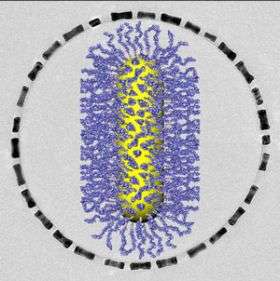
Transmission electron microscopy (TEM) image of a circular superstructure of hybrid nanorods templated by a water microdroplet. Credit: Bishnu Khanal

Rice University chemists have discovered that tiny building blocks known as gold nanorods spontaneously assemble themselves into ring-like superstructures.

This finding, which will be published as the inside cover article of the March 19 international edition of the chemistry journal Angewandte Chemie, could potentially lead to the development of novel nanodevices like highly sensitive optical sensors, superlenses, and even invisible objects for use in the military.

"Finding new ways to assemble nano-objects into superstructures is an important task because at the nanoscale, the properties of those objects depend on the arrangement of individual building blocks," said principal investigator Eugene Zubarev, the Norman Hackerman-Welch Young Investigator and assistant professor of chemistry at Rice.

Although ring-like assemblies have been observed in spherical nanoparticles and other symmetrical molecules, until now such structures had not been documented with rod-shaped nanostructures.

Like many nanoscale objects, gold nanorods are several billionths of a meter, or 1,000 times smaller than a human hair. Zubarev used hybrid nanorods for this research because attached to their surface are thousands of polymer molecules, which are flexible chainlike structures. The central core of the nanorods is an inorganic crystal, but the polymers attached to the outside are organic species. The combination of the inorganic and organic features resulted in a hybrid structure that proved to be critical to the study.

Working with Rice graduate student Bishnu Khanal, Zubarev placed the nanorods in a solution of organic solvent called chloroform. As the chloroform evaporated, its surface temperature dropped low enough to cause condensation of water droplets from the air, much like how dew forms. As thousands and thousands of microdroplets of water formed on the surface of the liquid chloroform, the nanorods that had been suspended in the solution started to press up against the round droplets and form rings around them. The polymer coating prevented the rods from being absorbed into the droplets because it is insoluble in water.

After the droplets evaporated, the nanorods remained in their ring formation.

"When nanorods are organized into a ring, significant changes in their optical and electromagnetic properties occur," Zubarev said. "These can have technological applications in the area of metamaterials, which have enormous potential in opto-electronics, communications and military applications." Zubarev said thousands of well-defined rings can be produced in a matter of seconds using the approach from his study. "This method is surprisingly simple and can be used for organizing nanocrystals of various shapes, size and chemical composition into circular arrays."

Source: Rice University


print this article email this article download pdf blog this article bookmark this article     Stumble it Digg this share on Facebook retweet share on Reddit add to delicious
Rate this story - 4.6 /5 (42 votes)


March 9, 2007 all stories

Comments: 0

4.6 /5 (42 votes)
  • Stumble this up

  • Digg this

  • share this

  • hide
  • Related Stories

  • Platinum nanocatalyst could aid drugmakers
    created Aug 31, 2009 | popularity not rated yet | comments 0
  • Purifying nanorods: Big success with tiny cleanup
    created Sep 22, 2008 | popularity not rated yet | comments 0
  • Gold solution for enhancing nanocrystal electrical conductance
    created Sep 10, 2009 | popularity not rated yet | comments 0
  • A safe approach to nanotechnology: Boiling up zinc oxide nanorods without toxic solvents
    created Aug 19, 2009 | popularity not rated yet | comments 0
  • Computer-Guided Nanoparticle Therapy Destroys Tumors
    created Jun 29, 2009 | popularity not rated yet | comments 0


  • hide
  • Relevant PhysicsForums posts

Other News

Nanoparticles used in common household items caused genetic damage in mice

Nanotechnology / Bio & Medicine

created Nov 16, 2009 | popularity 4.8 / 5 (24) | comments 11

Titanium dioxide (TiO2) nanoparticles, found in everything from cosmetics to sunscreen to paint to vitamins, caused systemic genetic damage in mice, according to a comprehensive study conducted by researchers at UCLA's Jonsson ...


Nanotube defects equal better energy and storage systems

Nanotube defects equal better energy and storage systems

Nanotechnology / Nanomaterials

created Nov 19, 2009 | popularity 4.4 / 5 (10) | comments 2

(PhysOrg.com) -- Most people would like to be able to charge their cell phones and other personal electronics quickly and not too often. A recent discovery made by UC San Diego engineers could lead to carbon ...


Using superconducting probes to get a picture of what it's like inside CNTs

Nanotechnology / Nanophysics

created Nov 20, 2009 | popularity 4.9 / 5 (8) | comments 0

(PhysOrg.com) -- "Carbon nanotubes are exciting for fundamental physics, and for potential technological applications," Nadya Mason tells PhysOrg.com. "However, we are generally limited in the way that we can study them. ...


New study confirms exotic electric properties of graphene

New study confirms exotic electric properties of graphene

Nanotechnology / Nanomaterials

created Nov 17, 2009 | popularity 4.8 / 5 (23) | comments 1

(PhysOrg.com) -- First, it was the soccer-ball-shaped molecules dubbed buckyballs. Then it was the cylindrically shaped nanotubes. Now, the hottest new material in physics and nanotechnology is graphene: ...


Small optical force can budge nanoscale objects

Small optical force can budge nanoscale objects

Nanotechnology / Nanophysics

created Nov 17, 2009 | popularity 4.8 / 5 (12) | comments 0

(PhysOrg.com) -- Engineering researchers have used a very tiny beam of light with as little as 1 milliwatt of power to move a silicon structure up to 12 nanometers.