New Panorama Reveals More Than a Thousand Black Holes
March 12, 2007
New panorama reveals more than a thousand black holes

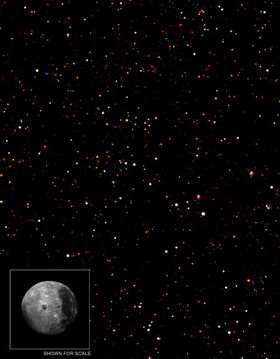
A new wide-field panorama reveals more than a thousand supermassive black holes in the centers of galaxies, some up to several billion times more massive than the sun. This survey, taken in a region of the Bootes constellation, involved 126 separate Chandra exposures of 5,000-seconds each, making it the largest contiguous field ever obtained by the observatory. At 9.3 square degrees, it is over 40 times larger than the full moon seen on the night sky, which is also shown in this graphic for scale. In this image, the red represents low-energy X-rays, green shows the medium range, and blue the higher energy X-rays. Credit: X-ray: NASA/CXC/CfA/R.Hickox et al.; Moon: NASA/JPL

By casting a wide net, astronomers have captured an image of more than a thousand supermassive black holes. These results give astronomers a snapshot of a crucial period when these monster black holes are growing, and provide insight into the environments in which they occur.

The new black hole panorama was made with data from NASA's Chandra X-ray Observatory, the Spitzer Space Telescope and ground-based optical telescopes. The black holes in the image are hundreds of millions to several billion times more massive than the sun and lie in the centers of galaxies.

Material falling into these black holes at high rates generates huge amounts of light that can be detected in different wavelengths. These systems are known as active galactic nuclei, or AGN.

"We're trying to get a complete census across the universe of black holes and their habits," said Ryan Hickox of the Harvard-Smithsonian Center for Astrophysics (CfA) in Cambridge, Mass. "We used special tactics to hunt down the very biggest black holes."

Instead of staring at one relatively small part of the sky for a long time, as with the Chandra Deep Fields -- two of the longest exposures obtained with the observatory -- and other concentrated surveys, this team scanned a much bigger portion with shorter exposures. Since the biggest black holes power the brightest AGN, they can be spotted at vast distances, even with short exposures.

"With this approach, we found well over a thousand of these monsters, and have started using them to test our understanding of these powerful objects," said co-investigator Christine Jones, also of the CfA.

The new survey raises doubts about a popular current model in which a supermassive black hole is surrounded by a doughnut-shaped region, or torus, of gas. An observer from Earth would have their view blocked by this torus by different amounts, depending on the orientation of the torus.

According to this model, astronomers would expect a large sample of black holes to show a range of absorption of the radiation from the nuclei. This absorption should range from completely exposed to completely obscured, with most in-between. Nuclei that are completely obscured are not detectable, but heavily obscured ones are.

"Instead of finding a whole range, we found nearly all of the black holes are either naked or covered by a dense veil of gas," said Hickox. "Very few are in between, which makes us question how well we know the environment around these black holes."

This study found more than 600 obscured and 700 unobscured AGN, located between about six and 11 billion light years from Earth. They were found using an early application of a new search method. By looking at the infrared colors of objects with Spitzer, AGN can be separated from stars and galaxies. The Chandra and optical observations then verify these objects are AGN. This multi-wavelength method is especially efficient at finding obscured AGN.

"These results are very exciting, using two NASA Great Observatories to find and understand the largest sample of supermassive black holes ever found in the distant universe", said co-investigator Daniel Stern, of NASA’s Jet Propulsion Laboratory in Pasadena, Calif.

The Chandra image is the largest contiguous field ever obtained by the observatory. At 9.3 square degrees, it is over 40 times larger than the full moon seen on the night sky and over 80 times larger than either of the Chandra Deep Fields. This survey, taken in a region of the constellation Bootes, involved 126 separate pointings of 5,000-second Chandra exposures each. The researchers combined this with infrared data obtained from Spitzer, and optical data from Kitt Peak's 4-meter Mayall Telescope and the MMT 6.5-meter optical telescopes, both located outside Tuscon, Ariz., for the same patch of sky.

Source: Chandra X-ray Center

4.4 /5 (39 votes)  

Rank 4.4 /5 (39 votes)
Tags

Related Stories
Relevant PhysicsForums posts
  • Never ending outer space.....
    created2 hours ago
  • Neutron Star fragments?
    created4 hours ago
  • stationary or not?
    created8 hours ago
  • Scale of the Universe
    createdFeb 10, 2012
  • Titan's lack of impact craters
    createdFeb 09, 2012
  • Real pictures of black hole eating a star?
    createdFeb 08, 2012
  • More from Physics Forums - General Astronomy

More news stories

Europe stakes billion-dollar bet on new rocket

A pencil-slim rocket is scheduled to lift into space from South America on Monday, carrying a billion-dollar bet that Europe can grab a juicy slice of the market to place satellites in low orbit.

Space & Earth / Space Exploration

created 15 hours ago | popularity 3.5 / 5 (2) | comments 0

Political leaders play key role in how worried Americans are by climate change: study

More than extreme weather events and the work of scientists, it is national political leaders who influence how much Americans worry about the threat of climate change, new research finds.

Space & Earth / Environment

created Feb 06, 2012 | popularity 5 / 5 (6) | comments 72

NASA budget will axe Mars deal with Europe: scientists

US President Barack Obama's budget proposal to be submitted next week for 2013 will cut NASA's budget by 20 percent and eliminate a major partnership with Europe on Mars exploration, scientists said Thursday.

Space & Earth / Space Exploration

created Feb 10, 2012 | popularity 5 / 5 (3) | comments 48

Humans may have helped the decline of African rainforests 3000 years ago

(PhysOrg.com) -- Large areas of rainforests in Central Africa mysteriously disappeared over three thousand years ago, to be replaced by savannas. The prevailing theory has been that the cause was a change ...

Space & Earth / Environment

created Feb 10, 2012 | popularity 4.1 / 5 (14) | comments 19 | with audio podcast report

Could Venus be shifting gear?

(PhysOrg.com) -- ESA’s Venus Express spacecraft has discovered that our cloud-covered neighbour spins a little slower than previously measured. Peering through the dense atmosphere in the infrared, the ...

Space & Earth / Space Exploration

created Feb 10, 2012 | popularity 5 / 5 (8) | comments 10 | with audio podcast


Walney offshore wind farm is world's biggest (for now)

(PhysOrg.com) -- The Walney wind farm on the Irish Sea--characterized by high tides, waves and windy weather--officially opened this week. The farm is treated in the press as a very big deal as the Walney ...

GPS court ruling leaves US phone tracking unclear

A US Supreme Court decision requiring a warrant to place a GPS device on the car of a criminal suspect leaves unresolved the bigger issue of police tracking using mobile phones, legal experts say.

Europeans protest controversial Internet pact

Tens of thousands of people marched in protests in more than a dozen European cities Saturday against a controversial anti-online piracy pact that critics say could curtail Internet freedom.

Study finds that anti-diabetic medication can prevent the long-term effects of maternal obesity

In a study to be presented today at the Society for Maternal-Fetal Medicine's annual meeting, The Pregnancy Meeting, in Dallas, Texas, researchers will report findings that show that short therapy with the anti-diabetic medication ...

Netflix settlement trims 14 pct off 4Q earnings

(AP) -- Netflix pressed the rewind button on its fourth-quarter earnings after settling allegations that the video subscription service violated a consumer-privacy law.

Navy to begin tests on electromagnetic railgun prototype launcher

The Office of Naval Research (ONR)'s Electromagnetic (EM) Railgun program will take an important step forward in the coming weeks when the first industry railgun prototype launcher is tested at a facility ...