Cluster opens a new window on 'magnetic reconnection' in the near-Earth space
March 12, 2007 Cluster opens a new window on 'magnetic reconnection' in the near-Earth space

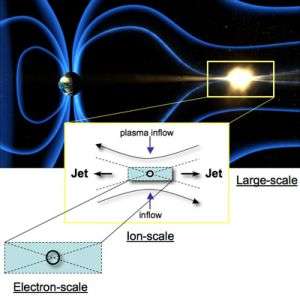
This sketch illustrate the different scales relevant to the ‘magnetic reconnection’ process. The Earth’s magnetic field creates a buffer zone, the magnetosphere, between our planet’s atmosphere and the particles released during these eruptions. The Sun also releases a steadier flow of charged particles called the solar wind. On the large-scale, any heading this way buffet the magnetosphere, and are deflected by it. Plasma physicists describe this behaviour with a theory called ‘magneto-hydrodynamics’ (MHD). On smaller scales, however, the picture becomes rather more complicated. The particles can actually flow across the magnetic field lines. First to misbehave are the ions (positively charged particles). These break away from simple MHD on scales of less than a few hundred kilometres. On even smaller scales, less than 10 kilometres, the electrons (negatively charged particles) begin playing by other rules, too. Credits: ESA

Plasma physicists have made an unprecedented measurement in their study of the Earth's magnetic field. Thanks to ESA's Cluster satellites they detected an electric field thought to be a key element in the process of 'magnetic reconnection'.

Thanks to these measurements, obtained by the eight PEACE electron sensors onboard the four spacecraft, scientists now have their first insight into magnetic reconnection's detailed behaviour.
Magnetic reconnection is a process that can occur almost anywhere that a magnetic field is found. In a reconnection event, the magnetic field lines are squeezed together somehow and spontaneously reconfigure themselves. This releases energy. When it occurs near the surface of the Sun, such an event powers giant solar flares that can release thousands of millions of tonnes of electrically charged particles into space.

The Earth's magnetic field creates a buffer zone, the magnetosphere, between our planet's atmosphere and the particles released during these eruptions. The Sun also releases a steadier flow of charged particles called the solar wind. On the large-scale, any heading this way buffet the magnetosphere, and are deflected by it. Plasma physicists describe this behaviour with a theory called 'magneto-hydrodynamics' (MHD).

On smaller scales, however, the picture becomes rather more complicated. The particles can actually flow across the magnetic field lines.This makes the mathematics of the behaviour more difficult. First to misbehave are the ions (positively charged particles). These break away from simple MHD on scales of less than a few hundred kilometres. On even smaller scales, less than 10 kilometres, the electrons (negatively charged particles) begin playing by other rules, too.

The new Cluster measurements reveal the electric field on the scale of a few hundred kilometres. "This is the first ever measurement of this term," says Paul Henderson, from University College London's Mullard Space Science Laboratory, UK, who led the investigation.

On 17 August 2003, Cluster was flying high above the night-time hemisphere of the Earth with an average separation of 200 kilometres between spacecraft. Data from several instruments shows that at 18:00 CET, a reconnection event took place and swept across the spacecraft.

Using data from Cluster's Plasma Electron and Current Experiment (PEACE) Henderson and collaborators calculated the pressure of electrons at each spacecraft and then calculated the difference between them and the variation with time. Using these quantities they calculated the electric field present near a reconnection site.

"This is an impossible calculation to make without four spacecraft," says Henderson. Now that the scientists can calculate the electric field in such a way, they have a new window into the process of magnetic reconnection.

Magnetic reconnection within Earth's magnetosphere regularly takes place on the night-time side of our planet, where the flow of the solar wind stretches out the magnetic field into a long tail. When the field reconnects in this region, it triggers jets of energetic particles that can cause auroral lights but can also damage satellites.

This new Cluster result takes scientists a step closer to seeing the precise details of magnetic reconnection. "When you think that the magnetosphere stretches over a million kilometres through space, we are actually looking at a minuscule part of it," says Henderson.

And that's exactly what plasma scientists want – the microphysics.

Source: European Space Agency


print this article email this article download pdf blog this article bookmark this article     Stumble it Digg this share on Facebook retweet share on Reddit add to delicious
Rate this story - 4.8 /5 (8 votes)


March 12, 2007 all stories

Comments: 0

4.8 /5 (8 votes)
  • Stumble this up

  • Digg this

  • share this

  • hide
  • Related Stories


  • hide
  • Relevant PhysicsForums posts

  • Find velocity of a pulley system
    created 1hour ago
  • Please help me guys...
    created 3 hours ago
  • Relativity and Spatial Dimension
    created 3 hours ago
  • .75c .75c
    created 6 hours ago
  • More from Physics Forums - General Physics

Other News

A mathematical model of a simple circuit in a chicken brain raises fundamental questions about our understanding of neural circu

Mathematical model of a simple circuit in a chicken brain raises fundamental questions

Physics / General Physics

created Dec 01, 2009 | popularity 4.8 / 5 (26) | comments 18

(PhysOrg.com) -- The Web site Neuroanthropology asks visitors to complete this quote, "One of the difficulties in understanding the brain is ...". In addition to the typical facetious remarks, such as "so ...


LHC sets new world record

Large Hadron Collider sets new power world record

Physics / General Physics

created Nov 30, 2009 | popularity 4.7 / 5 (25) | comments 14

(PhysOrg.com) -- CERN's Large Hadron Collider has today become the world's highest energy particle accelerator, having accelerated its twin beams of protons to an energy of 1.18 TeV in the early hours of the ...


Physics Model Determines Dynamics of Friends and Enemies

Physics Model Determines Dynamics of Friends and Enemies

Physics / General Physics

created Dec 02, 2009 | popularity 4.4 / 5 (12) | comments 5

(PhysOrg.com) -- Sometimes friends can become enemies and enemies become friends, and it’s difficult to understand exactly how or why the changes took place. A new study shows that when the shifting of alliances ...


Turbulence around heat transport

Turbulence around heat transport

Physics / General Physics

created Dec 03, 2009 | popularity 5 / 5 (6) | comments 4

(PhysOrg.com) -- Heat transport in the earth's mantle and in the atmosphere is probably not as effective as previously thought.


Scientists take theoretical research on 'nasty' molecule to next level

Scientists take theoretical research on 'nasty' molecule to next level

Physics / General Physics

created Dec 04, 2009 | popularity 4.4 / 5 (12) | comments 3

(PhysOrg.com) -- Some atoms don't always follow the rules. Take the beryllium dimer, a seemingly simple molecule made up of two atoms that University of Delaware physicists Krzysztof Szalewicz and Konrad Patkowski ...