A Hot Start Might Explain Geysers on Enceladus
March 12th, 2007 A Hot Start Might Explain Geysers on Enceladus

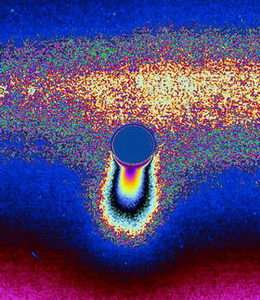
The ice jets of Enceladus send particles streaming into space hundreds of kilometers above the south pole of this spectacularly active moon. Image credit: NASA/JPL/Space Science Institute

A hot start billions of years ago might have set into motion the forces that power geysers on Saturn's moon Enceladus.

"Deep inside Enceladus, our model indicates we've got an organic brew, a heat source and liquid water, all key ingredients for life," said Dr. Dennis Matson, Cassini project scientist at NASA's Jet Propulsion Laboratory, Pasadena, Calif. "And while no one is claiming that we have found life by any means, we probably have evidence for a place that might be hospitable to life."

Since NASA's Voyager spacecraft first returned images of the moon's snowy white surface, scientists have suspected Enceladus had to have something unusual happening within that shell. Cameras on NASA's Cassini orbiter seemed to confirm that suspicion in 2005 when they spotted geysers on Enceladus ejecting water vapor and ice crystals from its south polar region. The challenge for researchers has been to figure out how this small ice ball could produce the levels of heat needed to fuel such eruptions.

A new model suggests the rapid decay of radioactive elements within Enceladus shortly after it formed may have jump-started the long-term heating of the moon's interior that continues today. The model provides support for another recent, related finding, which indicates that Enceladus' icy plumes contain molecules that require elevated temperatures to form.

"Enceladus is a very small body, and it's made almost entirely of ice and rock. The puzzle is how the moon developed a warm core," said Dr. Julie Castillo, the lead scientist developing the new model at JPL. "The only way to achieve such high temperatures at Enceladus is through the very rapid decay of some radioactive species."

The hot start model suggests Enceladus began as a mixed-up ball of ice and rock that contained rapidly decaying radioactive isotopes of aluminum and iron. The decomposition of those isotopes - over a period of about 7 million years - would produce enormous amounts of heat. This would result in the consolidation of rocky material at the core surrounded by a shell of ice. According to the theory, the remaining, more slowly decaying radioactivity in the core could continue to warm and melt the moon's interior for billions of years, along with tidal forces from Saturn's gravitational tug.

Scientists have also found the model helpful in explaining how Enceladus might have produced the chemicals in the plume, as measured by Cassini's ion and neutral mass spectrometer. Matson is lead author of a new study of the plume's composition, which appears in the April issue of the journal Icarus. Although the plume is predominantly made up of water vapor, the spectrometer also detected within the plume minor amounts of gaseous nitrogen, methane, carbon dioxide, propane and acetylene.

Scientists were particularly surprised by the nitrogen because they don't think it could have been part of Enceladus' original makeup. Instead, Matson's team suggests it is the product of the decomposition of ammonia deep within the moon, where the warm core and surrounding liquid water meet.

The thermal decomposition of ammonia would require temperatures as high as 577 degrees Celsius (1070 degrees Fahrenheit), depending on whether catalysts such as clay minerals are present. And while the long-term decay of radioactive species and current tidal forces alone cannot account for such high temperatures, with the help of the hot start model, they can.

The scalding conditions are also favorable for the formation of simple hydrocarbon chains, basic building blocks of life, which Cassini's spectrometer detected in small amounts within Enceladus' plume. The team concludes that so far, all the findings and the hot start model indicate that a warm, organic-rich mixture was produced below the surface of Enceladus and might still be present today, making the moon a promising kitchen for the cooking of primordial soup.

To gather more information about the chemistry within Enceladus, the team plans to directly measure the gas emanating from the plume during a flyby scheduled for March 2008.

Source: NASA


print this article email this article download pdf blog this article bookmark this article     Digg this Stumble it share on Facebook share on Reddit add to delicious save to Yahoo! bookmarks
4.3/5 after 6 votes


March 12th, 2007 all stories
Space & Earth / Astronomy

Comments: 0
Rank: 4.3/5 after 6 votes

  • Stumble this up

  • Digg this

  • Share it:
  • share on Facebook
  • share on MySpace
  • share on Slashdot
  • rss-newsfeed
  • share on Google
  • share on Reddit
  • add to delicious
  • save to Yahoo! bookmarks
  • share on Windows Live
  • Add to Mixx!
Rating: 4.3/5 after 6 votes

  • Related Stories

  • Source of geysers on Saturn's moon may be underground water
    created Nov 26, 2008 | popularity not rated yet | comments 0
  • Mars radar opens up a planet’s third dimension
    created Apr 17, 2008 | popularity not rated yet | comments 0
  • Return to Europa: A closer look is possible
    created Dec 14, 2007 | popularity not rated yet | comments 0
  • Hot spot on Enceladus causes plumes
    created Dec 10, 2007 | popularity not rated yet | comments 0
  • Cosmic Vision 2015-2025: and the candidate missions are...
    created Oct 19, 2007 | popularity not rated yet | comments 0

Tags


  • Physicists Demonstrate Quantum Memory with Matter Qubits
    Physicists Demonstrate Quantum Memory with Matter Qubits
    Physics / General Physics
    created Jul 03, 2009 | popularity 4.4 / 5 (17) | comments 1
  • 'Holey' Nanosheets for Wastewater Dye Removal
    Nanotechnology / Nanomaterials
    created Jul 01, 2009 | popularity 5 / 5 (5) | comments 1
  • Jellyfish Robot Swims Like its Biological Counterpart
    Jellyfish Robot Swims Like its Biological Counterpart
    Electronics / Robotics
    created Jun 26, 2009 | popularity 4.4 / 5 (8) | comments 1
  • Could Maxwell's Demon Exist in Nanoscale Systems?
    Could Maxwell's Demon Exist in Nanoscale Systems?
    Physics / General Physics
    created Jun 24, 2009 | popularity 4.4 / 5 (18) | comments 29
  • Living Safely with Robots, Beyond Asimov's Laws
    Living Safely with Robots, Beyond Asimov's Laws
    Electronics / Robotics
    created Jun 22, 2009 | popularity 4.6 / 5 (54) | comments 40
  • Other News

    China environmental phenomena monitored from space

    Space & Earth / Earth Sciences

    created 2 hours ago | popularity not rated yet | comments 0

    China is in a very seismically active area and has had many catastrophic earthquakes during its history. A joint European-Chinese team is using satellite radar data to monitor ground deformation across major continental faults ...


    California to require sun-blocking car windows

    Space & Earth / Environment

    created 4 hours ago | popularity 2 / 5 (4) | comments 6

    New cars sold in California must include windshields that block or absorb the sun's rays beginning in 2012, the state's Air Resources Board recently ruled.


    Steam billows from the cooling towers at a nuclear power generating station in Byron

    Tropical zone expanding due to climate change: study

    Space & Earth / Earth Sciences

    created 7 hours ago | popularity 3.6 / 5 (7) | comments 3

    Climate change is rapidly expanding the size of the world's tropical zone, threatening to bring disease and drought to heavily populated areas, an Australian study has found.


    Scientists: Silent tremors may foretell next Big One

    Space & Earth / Earth Sciences

    created 4 hours ago | popularity 5 / 5 (1) | comments 0

    The seismometer is snugged in its hole and tamped over with dirt. Now it's time for the stomp test.


    The least sea ice in 800 years

    The least sea ice in 800 years

    Space & Earth / Earth Sciences

    created Jul 01, 2009 | popularity 4.1 / 5 (65) | comments 61

    New research, which reconstructs the extent of ice in the sea between Greenland and Svalbard from the 13th century to the present indicates that there has never been so little sea ice as there is now. The ...