Ultracold test produces long-sought quantum mix
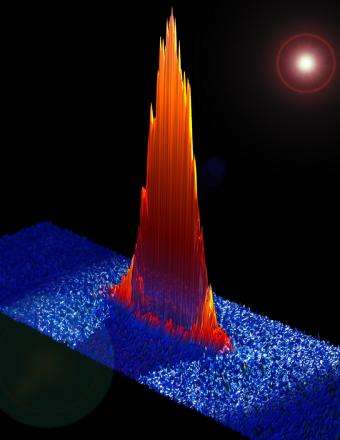
Unbalanced superfluid could be akin to exotic matter found in quark star
In the bizarre and rule-bound world of quantum physics, every tiny spec of matter has something called "spin" - an intrinsic trait like eye color - that cannot be changed and which dictates, very specifically, what other bits of matter the spec can share quantum space with. When fermions, the most antisocial type of quantum particle, do get together, they pair up in a wondrous dance that enables such things as superconductivity.
For the first time, researchers at Rice University have succeeded in creating and observing an elusive and long-sought quantum state - a superfluid of fermions with mismatched numbers of dance partners. Despite more than 40 years of theoretical musings about what would occur in such a case, the result - a cluster of matched pairs surrounded by a cloud of would-be dance partners - was largely unexpected.
The research, which appears online this week, is slated to appear in an upcoming issue of the journal Science, together with a paper from MIT reporting related results. The experiments offer physicists a new window into two of the least understood and most intriguing phenomena in physics - superconductivity and superfluidity.
Both phenomena result from a change in the phase of matter. Anyone who has seen ice melt has seen matter change phases, and when electrons, atoms and other specs of matter change quantum phases, they behave just as differently as do ice and water in a glass.
Superconducting and superfluid phases of matter occur in fermions - the antisocial particles that can't share quantum space - only when quantum forces become dominant. Because thermodynamic forces are typically so powerful that they overwhelm quantum interactions - like loud music overwhelms the whisper of someone nearby - superconductivity and superfluidity only occur in extreme cold.
In the Rice experiment, when temperatures drop to within a few billionths of a degree of absolute zero, fermions with equal but opposite spin become attracted to one another and behave, in some respects, like one particle. Like a couple on the dance floor, they don't technically share space, but they move in unison. In superconductors, these dancing pairs allow electrical current to flow through the material without any resistance at all, a property that engineers have long dreamed of harnessing to eliminate "leakage" in power cables, something that costs billions of dollars per year in the U.S. alone.
The superconducting and superfluid phases are analogous except that superconductivity happens with particles carrying an electrical charge and superfluidity occurs in electrically neutral particles. In superfluids, fermionic pairing leads to a complete absence of viscosity - like a wave rippling back and forth in a swimming pool without ever diminishing.
"Conventional theory tells us superconductivity or superfluidity occurs only in the presence of an equal number of spin-up and spin-down particles," said lead researcher Randy Hulet, the Fayez Sarofim Professor of Physics and Astronomy. "Physicists have speculated for almost 50 years about what would happen if this condition were not met.
"Because of the pristine and controlled nature of our ultracold atoms, we're able to offer definitive evidence of what happens with mismatched numbers of spin-up and spin-down particles."
Ultracold experiments at temperatures just a few billionths of a degree above absolute zero are Hulet's specialty. It's only been technically possible to chill atoms to these temperatures for the past 10 years, but in that time, this ability has proved remarkably useful for testing the predictions of quantum mechanics and for exploring the properties of what physicists call "many-body phenomena," including superconductivity and superfluidity.
In the latest experiments, Hulet's team - which includes graduate students Guthrie Partridge, Ramsey Kamar and Yean-an Liao and postdoctoral researcher Wenhui Li - cooled a mixture of fermionic lithium-6 atoms to about 30-billionths of a degree above absolute zero. That's far colder than any temperature in nature - even in deepest interstellar space - and it's sufficient to quell virtually all thermodynamic interaction in the atoms, leaving them subject to superfluid quantum pairing.
Using radio waves, Hulet's team altered the ratio of spin-up and spin-down atoms in the cooled atoms with great precision. They found that the superfluid was able to tolerate an excess of up to 10 percent unpaired fermions with no detrimental effects.
Hulet's team found that increasing the ratio of spin-up to spin-down atoms eventually caused a phase change. When unpaired spin-up atoms rose above 10 percent of the total sample, the unpaired loners were suddenly expelled, leaving a core of superfluid pairs surrounded by a shell of excess spin-up atoms.
It is the unbalanced yet seemingly unaffected superfluid, however, that is capturing most of the scientific attention at the moment.
"The gas behaves as if it is still perfectly paired, which is quite remarkable given the excess of spin-up atoms," Hulet said. "This was unexpected, and it could signal a new, exotic form of superfluidity that may be akin to the electron pairings in unconventional superconductors or to the quark soup that's predicted to exist at the heart of the densest neutron stars."
In the largest neutron stars - known as "quark stars" - a mass about five times greater than the sun is pressed into a space smaller than the island of Manhattan. Some physics theorists believe gravity is so strong at the heart of these stars that it creates something called a "strange matter," a dense superfluid of up quarks, down quarks and strange quarks.
Source: Rice University


