Fossil shows human growth at least 160,000 years ago
March 13, 2007 How long is a child a child?

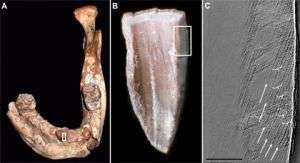
A) The North African juvenile fossil mandible showing the location of the incisor tooth enamel (white box) sampled with the Grenoble synchrotron. B) Close up of enamel fragment, with the area of interest (on right) shown in the white box. C) Synchrotron image showing growth lines (white arrows) with 10 daily lines between them (white brackets). The scale bar is 200 microns, or 0.2 mm. Image: PNAS

With an innovative combination of a novel application of synchrotron imaging, high-resolution microtomography, and developmental analysis, the team reconstructed tooth growth and determined the age at death of a fossil juvenile from Jebel Irhoud, Morocco. This study represents the first non-destructive approach to characterize dental development with a high degree of precision, as synchrotron images reveal microscopic internal growth lines without damage to the specimen.

The team found that the Moroccan fossil child showed an equivalent degree of tooth development to living human children at the same age. These findings and other evidence suggest that modern biological, behavioural, and cultural characteristics appeared relatively late in the past six million years of human evolution.

Modern human origins continues to be one of the most hotly debated topics among anthropologists, and there is little consensus about where and when the first members of our species, Homo sapiens, became fully modern. While fossil evidence tells a complex tale of mosaic change during the African Stone Age, almost nothing is known about changes in human ‘life history,’ or the timing of development, reproductive scheduling, and lifespan.

Tooth growth, and most importantly molar tooth eruption age, represents one of the most powerful clues to reconstruct growth processes in fossil humans. By using incremental growth lines in teeth, similar to annual rings in trees, developmental rate and time may be accurately established millions of years after death. Research during the past two decades has shown that early fossil humans (australopithecines and early Homo) possessed short growth periods, which were more similar to chimpanzees than to living humans. However, it unclear when, in and which group of fossil humans, the modern condition of a relatively long childhood arose.

In this study, tooth growth and eruption was examined in one of the earliest representatives of Homo sapiens, found in Jebel Irhoud, Morocco and dated to approximately 160,000 years ago. The novel application of high-resolution propagation phase contrast X-ray synchrotron microtomography, developed by Paul Tafforeau during his PhD studies, permits previously inaccessible developmental features to be revealed non-destructively. Information on tooth growth in the Moroccan child was compared with other fossil and living human populations to determine if the modern condition of prolonged dental development was present. The results suggest that the Moroccan child, at almost 8 years of age, is currently the oldest member of the genus Homo to show a modern human life history profile. The team suggests that an extended period of development, and by implication childhood, may be linked to the origins of social, biological and cultural changes needed to support dependent children with greater opportunities for early childhood learning.

Citation: Tanya M. Smith, Paul Tafforeau, Donald J. Reid, Rainer Grün, Stephen Eggins, Mohamed Boutakiout, Jean-Jacques Hublin, Earliest Evidence of Modern Human Life History in North African Early Homo sapiens, PNAS, March 2007

Source: Max-Planck-Gesellschaft


print this article email this article download pdf blog this article bookmark this article     Stumble it Digg this share on Facebook retweet share on Reddit add to delicious
Rate this story - 3.7 /5 (24 votes)


March 13, 2007 all stories

Comments: 0

3.7 /5 (24 votes)
  • Stumble this up

  • Digg this

  • share this

  • hide
  • Related Stories

  • Oceans' uptake of manmade carbon may be slowing
    created Nov 18, 2009 | popularity not rated yet | comments 0
  • Fossil fuel CO2 emissions up by 29 percent since 2000
    created Nov 17, 2009 | popularity not rated yet | comments 0
  • New methods are changing old materials
    created Oct 28, 2009 | popularity not rated yet | comments 0
  • Like a hungry teen, life on Earth had big growth spurts
    created Oct 27, 2009 | popularity not rated yet | comments 0
  • Ocean acidification may contribute to global shellfish decline
    created Oct 26, 2009 | popularity not rated yet | comments 0


  • hide
  • Relevant PhysicsForums posts

  • Human Leukocyte Antigen (HLA) typing
    created 2 hours ago
  • Breeding program
    created Nov 20, 2009
  • How does a concentration gradient provide energy?
    created Nov 20, 2009
  • Eyesight and Neural Damage from Electronics
    created Nov 19, 2009
  • More from Physics Forums - Biology

Other News

Museum: Galileo's fingers, tooth are found (AP)

Museum: Galileo's fingers, tooth are found

Other Sciences / Archaeology & Fossils

created 13 hours ago | popularity not rated yet | comments 5

(AP) -- Two fingers and a tooth removed from Galileo Galilei's corpse in a Florentine basilica in the 18th century and given up for lost have been found again and will soon be put on display, an Italian museum ...


Measure to change U. of Neb. stem-cell rule fails (AP)

Measure to change U. of Neb. stem-cell rule fails (Update 2)

Other Sciences / Other

created 13 hours ago | popularity 5 / 5 (1) | comments 0

(AP) -- The University of Nebraska's governing board on Friday voted not to place tighter restrictions on embryonic stem cell research than those outlined under federal guidelines, which were expanded after ...


Researcher: Faint writing seen on Shroud of Turin (AP)

Researcher: Faint writing seen on Shroud of Turin (Update)

Other Sciences / Archaeology & Fossils

created Nov 20, 2009 | popularity 1.7 / 5 (22) | comments 23

(AP) -- A Vatican researcher has rekindled the age-old debate over the Shroud of Turin, saying that faint writing on the linen proves it was the burial cloth of Jesus. Experts say the historian may be reading ...


Three of a kind

Three of a kind: Revealing language’s universal essence

Other Sciences / Social Sciences

created Nov 20, 2009 | popularity 3.5 / 5 (8) | comments 6

(PhysOrg.com) -- On the surface, English, Japanese, and Kinande, a member of the Bantu family of languages spoken in the Democratic Republic of Congo, have little in common. It is not just that the vocabularies ...


Maya

New insights into the life of the Maya

Other Sciences / Archaeology & Fossils

created Nov 16, 2009 | popularity 4.6 / 5 (15) | comments 7

(PhysOrg.com) -- Ancient artifacts are almost always concerned with rich and powerful religious and political leaders, but new excavations of an ancient Maya site have unearthed a pyramid decorated with murals ...