Study shows how blood cells change shape
March 13, 2007 By Anne Trafton
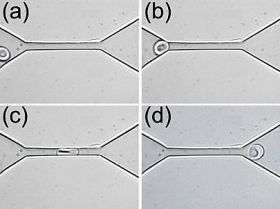
An experimental in vitro demonstration of the "fluidization" of a healthy human red blood cell through a microfliuidic channel at room temperature. The series of images shows how the shape of a red blood cell changes as it is squeezed through a 4 micron by 4 micron channel. Photo / David J. Quinn
Millions of times during their four-month lifespan, human red blood cells must squeeze through tiny capillaries to deliver their payload of oxygen and pick up waste carbon dioxide-functions essential to life.
Now, for the first time, MIT researchers have developed a dynamic, molecular-level model that describes how the cells deform their normal disc shape to pass through vessels that are often much narrower than the cells themselves.
Blood cells must rearrange components of their internal scaffolding (so-called cytoskeleton), allowing the cells to become almost liquid-like, in order to squeeze through the narrowest capillaries found in the body, the researchers report in a paper to be published in the March 12 online edition of the Proceedings of the National Academy of Sciences.
Studying the mechanics of how a blood cell can transform from a soft object to an almost fluid-like state will help researchers better understand several types of blood disorders, said Subra Suresh, senior author of the paper and the Ford Professor of Engineering with joint appointments in materials science and engineering, biological engineering, mechanical engineering and health sciences and technology.
"Now we can study how molecular structure affects the shape, which affects the mechanical properties, and both of which affect mobility," he said.
Mobility is a key factor in diseases like malaria and the genetic disorder sickle cell anemia, both of which render red blood cells unable to flow through narrow capillaries.
Red blood cells have a diameter of about eight microns, or millionths of a meter. As they flow through the body, they often encounter blood vessels, such as those in the brain, with a diameter of only about two microns. Each time the cells reach such a vessel, they must stretch into a bullet-like shape to squeeze through and then return to their original disc shape upon exiting the vessel.
The researchers' model shows that reorganization of the cytoskeleton could account for such deformation. Every red blood cell has a cytoskeleton, a sort of scaffolding made of protein molecules called spectrin, attached to the inside of its cell membrane in a brush-like network.
When the bonds within that protein network or between the network and the cell membrane are broken, holes open up in the cytoskeleton, allowing the cell to become more fluidic and squeeze through narrow passages. The researchers show that such a transformation can be achieved by breaking either of two types of cytoskeletal bonds-bonds between two molecules of spectrin or bonds between spectrin and another protein called actin, which is embedded in the cell membrane.
An input of either mechanical energy (such as squeezing or shearing) or chemical energy (such as ATP, an energy carrier used by cells), is enough to break those bonds and cause the necessary cytoskeleton deformation, according to Suresh. In the future, the researchers plan to study how the interplay of those types of energy inputs affects the cells.
The new model could also be used to study several types of blood disorders, including malaria, as the cell membrane and cytoskeleton are altered by the presence of the parasite inside the cell.
In earlier work, Suresh and colleagues showed that as malaria infection progresses, red blood cells become less deformable, which explains why it is harder for them to squeeze through narrow vessels. Using the new model, researchers can study how the infection affects the blood cells on a molecular level to make them less deformable.
Other diseases that could be studied are the genetic disorders sickle cell anemia and spherocytosis. In patients with sickle cell anemia, red blood cells take on a sickle shape that prevents them from flowing through blood vessels. Spherocytosis causes red blood cells to become spherical so they can't deform properly to get through small capillaries.
The lead author on the PNAS paper is Ju Li, a former MIT graduate student and assistant professor at Ohio State University. Other authors are George Lykotrafitis, a postdoctoral associate in MIT's Department of Materials Science and Engineering (MSE), and Ming Dao, an MIT research scientist in MSE.
Source: MIT
-
Australians risking skin cancer to avoid nanoparticles
2 hours ago |
5 / 5 (1) |
0
-
Rothman at Jefferson research suggests abandon convention in diagnosing periprosthetic joint infection
Feb 08, 2012 |
not rated yet |
0
-
US begins stem cell trial for hearing loss
Feb 08, 2012 |
not rated yet |
1
-
Short fasting cycles work as well as chemotherapy in mice
21 hours ago |
4.7 / 5 (13) |
2
-
New therapy combination prolongs survival in dogs with lymphoma
Feb 07, 2012 |
5 / 5 (2) |
0
-
Engineers build first sub-10-nm carbon nanotube transistor
Feb 01, 2012 |
4.9 / 5 (31) |
30
-
Something old, something new: Evolution and the structural divergence of duplicate genes
Jan 31, 2012 |
4.6 / 5 (7) |
1
-
The hidden nanoworld of ice crystals: Revealing the dynamic behavior of quasi-liquid layers
Jan 30, 2012 |
5 / 5 (3) |
1
-
Stock market network reveals investor clustering
Jan 27, 2012 |
3.9 / 5 (23) |
8
-
Of microchemistry and molecules: Electronic microfluidic device synthesizes biocompatible probes
Jan 26, 2012 |
5 / 5 (1) |
0
More news stories
Entire genome of extinct human decoded from fossil
(PhysOrg.com) -- In 2010, Svante Pääbo and his colleagues presented a draft version of the genome from a small fragment of a human finger bone discovered in Denisova Cave in southern Siberia. The ...
Feb 07, 2012 |
4.7 / 5 (58) |
44
|
Why are there so few fish in the Earth's oceans?
(PhysOrg.com) -- A Stony Brook University researcher has found that, contrary to popular belief, there are not plenty of fish in the sea.
Feb 08, 2012 |
4.3 / 5 (17) |
25
|
Miami battling invasion of giant African snails
No one knows how they got there. But an invasion of African giant snails has southern Florida in a panic over potential crop damage, disease and general yuckiness surrounding the slimy gastropods.
Feb 10, 2012 |
4.5 / 5 (2) |
5
The power of estrogen -- male snakes attract other males
A new study has shown that boosting the estrogen levels of male garter snakes causes them to secrete the same pheromones that females use to attract suitors, and turned the males into just about the sexiest ...
Feb 10, 2012 |
4.8 / 5 (6) |
2
|
Deciding to go left or right: Researchers use device to determine that lower animals can navigate too
For decades, scientists have associated binary decision making opting to go left or right with higher-ranking animals, including humans. A team of Harvard researchers, however, is rewriting that ...
Feb 09, 2012 |
4 / 5 (1) |
4
|
Walney offshore wind farm is world's biggest (for now)
(PhysOrg.com) -- The Walney wind farm on the Irish Sea--characterized by high tides, waves and windy weather--officially opened this week. The farm is treated in the press as a very big deal as the Walney ...
GPS court ruling leaves US phone tracking unclear
A US Supreme Court decision requiring a warrant to place a GPS device on the car of a criminal suspect leaves unresolved the bigger issue of police tracking using mobile phones, legal experts say.
Europeans protest controversial Internet pact
Tens of thousands of people marched in protests in more than a dozen European cities Saturday against a controversial anti-online piracy pact that critics say could curtail Internet freedom.
Europe stakes billion-dollar bet on new rocket
A pencil-slim rocket is scheduled to lift into space from South America on Monday, carrying a billion-dollar bet that Europe can grab a juicy slice of the market to place satellites in low orbit.
Study finds that anti-diabetic medication can prevent the long-term effects of maternal obesity
In a study to be presented today at the Society for Maternal-Fetal Medicine's annual meeting, The Pregnancy Meeting, in Dallas, Texas, researchers will report findings that show that short therapy with the anti-diabetic medication ...
Netflix settlement trims 14 pct off 4Q earnings
(AP) -- Netflix pressed the rewind button on its fourth-quarter earnings after settling allegations that the video subscription service violated a consumer-privacy law.