Bigger brain size matters for intellectual ability
December 22, 2005 Brain

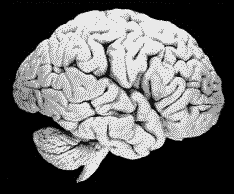
Brain size matters for intellectual ability and bigger is better, McMaster University researchers have found.

The study, led by neuroscientist Sandra Witelson, a professor in the Michael G. DeGroote School of Medicine, and published in the December issue of the journal Brain, has provided some of the clearest evidence on the underlying basis of differences in intelligence.

The study involved testing of intelligence in 100 neurologically normal, terminally ill volunteers, who agreed that their brains be measured after death.

It found bigger is better, but there are differences between women and men.

In women, verbal intelligence was clearly correlated with brain size, accounting for 36 percent of the verbal IQ score. In men, this was true for right-handers only, indicating that brain asymmetry is a factor in men.

Spatial intelligence was also correlated with brain size in women, but less strongly. In men, spatial ability was not related to overall brain size. These results suggest that women may use verbal strategies in spatial thinking, but that in men, verbal and spatial thinking are more distinct.

It may be that the size or structure of the localized brain regions which underlie spatial skills in men is related to spatial intelligence, as was shown in previous research in Witelson's lab on the brain of Albert Einstein.

In a further sex difference, brain size decreased with age in men over the age span of 25 to 80 years, but age hardly affected brain size in women. It is not known what protective factors, which could be genetic, hormonal or environmental, operate in women.

It remains to be determined what the contribution of nature and nurture are to this cerebral size relationship with intelligence, Witelson said. She added that the results point to the need for responsibility in considering the likely future use of magnetic imaging (or MRIs) of brain structure as a measure of ability in student and workforce settings.

"We're going to need to be careful if, in the future, we use MRI brain scans as a measure of ability in any selection process," she said.

Source: McMaster University


print this article email this article download pdf blog this article bookmark this article     Stumble it Digg this share on Facebook retweet share on Reddit add to delicious
Rate this story - 4.4 /5 (15 votes)


December 22, 2005 all stories

Comments: 0

4.4 /5 (15 votes)
  • Stumble this up

  • Digg this

  • share this

  • hide
  • Related Stories

  • Birds in captivity lose hippocampal mass
    created Oct 12, 2009 | popularity not rated yet | comments 0
  • Our brain looks at eyes first to identify a face
    created Jul 20, 2009 | popularity not rated yet | comments 0
  • Primate archaeology, proposal of a new research field
    created Jul 16, 2009 | popularity not rated yet | comments 0
  • Dips and Swells of Your Brain May Reveal Early Mental Disorders
    created Jul 09, 2009 | popularity not rated yet | comments 0
  • New Features Found in Einstein's Brain
    created Apr 21, 2009 | popularity not rated yet | comments 0


Other News

Explained: The Discrete Fourier Transform

Explained: The Discrete Fourier Transform

Other Sciences / Mathematics

created 20 hours ago | popularity 4.2 / 5 (22) | comments 8

(PhysOrg.com) -- In 1811, Joseph Fourier, the 43-year-old prefect of the French district of Isčre, entered a competition in heat research sponsored by the French Academy of Sciences. The paper he submitted ...


Ancient Greek Temple

Houses of the rising sun: Research sheds new light on Ancient Greeks

Other Sciences / Archaeology & Fossils

created 17 hours ago | popularity 5 / 5 (1) | comments 3

New research at the University of Leicester has identified scores of Sicilian temples built to face the rising Sun, shedding light on the practices of the Ancient Greeks.


Biology, training and profit sharing make best traders

Biology, training and profit sharing make best traders

Other Sciences / Mathematics

created 20 hours ago | popularity 5 / 5 (1) | comments 1

(PhysOrg.com) -- Cambridge researchers have identified a group of traders consistently able to outperform the market, even during the credit crisis.


Study: Race, class and gender shape religion's effect on American voters

Other Sciences / Social Sciences

created 12 hours ago | popularity not rated yet | comments 0

(PhysOrg.com) -- How Americans vote is strongly linked to their religious identities, but it is not an independent influence that transcends race, socio-economic class and gender, reports a new Cornell study.


UQ archaeology digs into the life behind Pompeii

Other Sciences / Archaeology & Fossils

created 12 hours ago | popularity 3.3 / 5 (3) | comments 0

(PhysOrg.com) -- Brisbane may be 2000 years and half-a-world away from Pompeii, but it hasn’t stopped a UQ archaeologist from digging up some hidden treasures.