March 14, 2007 feature
Solar Plane to Fly Continuously Around Mars
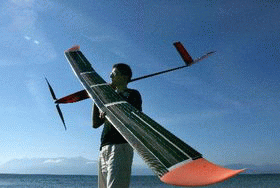
Sky-Sailor, the working dream of a solar-powered, autonomously-controlled microairplane, has exciting implications in two areas: one on the technological advances of unmanned air vehicles (UAVs); and another on exploring the lower atmosphere of Mars. Scientists André Noth, Walter Engel and Roland Siegwart of the Institute of Robotics and Intelligent Systems in Switzerland believe that Sky-Sailor will reach the inner orbit of Mars within a decade or two, depending on advancements in technology.
While other solar airplanes have been developed since the late 1970s, the scientists have defined loftier goals for Sky-Sailor. The group plans to have the airplane fly continuously for at least several months, all by itself, and all on solar power.
“Sky-Sailor is unique because it is designed to fly autonomously—not only during the day, but also during the entire night until the next morning, where a new cycle of charge and discharge of the battery can start,” Noth explained to PhysOrg.com.
The project began in late 2003 as part of a technology program for the European Space Agency to explore the gap between the areas covered by high-flying orbiters and land-rolling rovers. By early 2005, the scientists had built and tested an initial prototype, which was launched by hand and achieved a continuous flight time of five hours, with a 24-hour flight test planned for the summer of 2007. In a paper in IEEE Robotics and Automation Magazine, Noth, Engel and Siegwart reported on their most recent research.
“The benefit of having a solar airplane on Mars would be the ability to cover an extended area in a short period of time and on each location on the red planet,” Noth said. “Rovers have poor area coverage and satellites a predefined path, i.e. their orbit. Airplanes could be a complementary help for ground mission, giving information to a rover about the best path to reach a point of interest, and avoiding stones and ravines where it could get stuck. Moreover, an airplane could study the atmosphere (e.g. composition, winds, weather) and the magnetic field, which are topics which we have very little information on so far.”
In order for Sky-Sailor to navigate Mars, the group demonstrates, the plane must satisfy that planet’s flight conditions: a low atmospheric density, decreased solar energy, variable winds and below-freezing temperatures. At an altitude of 1500 m and an average velocity of 30 km/hr, Sky-Sailor’s top priorities include a low-weight structure to minimize energy needs, and a small enough volume to fit inside the shell which will transport the plane to Mars.
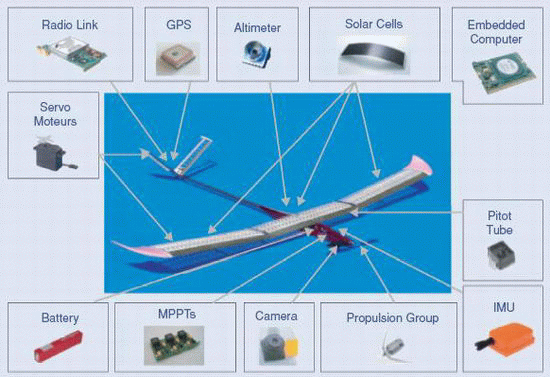
According to these constraints, the scientists demonstrate an optimal wingspan of about 3 m. Weight is a bit trickier, especially with the current battery densities which mean the batteries currently account for almost half of the plane’s total mass of 2.6 kg. The scientists’ goals, therefore, rely on improved battery technology in the future.
“Sky-Sailor was designed as a prototype flying on Earth to prove that continuous flight is feasible on Mars (by flying at altitude were air density is comparable, for example),” Noth explained. “In fact, many challenges remain, such as the fact that, at the very low temperature on Mars, the battery would have a highly reduced capacity if not heated and maintained at more than 0-10°C. Moreover, entry into the atmosphere of the red planet with the airplane folded in a shell would decelerate with the use of a parachute, which requires investigation. So whereas it is feasible now on Earth, it would require a huge amount of additional work to be sure that the airplane can safely travel all the distance to Mars, withstand the vibration during the entry in the Martian atmosphere, then deploy itself and work in an atmosphere where the temperature can decrease to -100°C.”
The current plane prototype, which the scientists constructed by hand, is made of rigid, low-weight materials including balsa wood and carbon fiber. The 216 flexible solar cells, with a 17% efficiency, enable the plane to retrieve more than 80 watts at optimal sun conditions. To maintain a leveled flight, Sky-Sailor requires around 16.25 watts—the excess energy is stored in a lithium-ion polymer battery for night use. With the storage capability, the scientists say that the plane can fly all night, plus several more hours during cloudy or foggy conditions.
For such a small, light-weight structure, the plane can do some high-tech things. Digital sensors can measure altitude and airspeed, allowing the plane to fly over targets such as coasts or canyons, while a CCD camera can image the ground. While the plane’s default is autopilot, a ground control station can also allow the scientists to monitor and give orders to the plane while in flight.
Based on these abilities, the group suggests that Sky-Sailor might have uses closer to home, as well. Because of its low-cost, long flight times and simplicity, the scientists list applications such as border surveillance, weather research, media imaging, and forest fire prevention—where the latter alone costs billions of dollars in damage each year.
“What is the most exciting is the global design methodology of such a system,” said Noth. “In fact, we are not developing new solar cells or new batteries for the prototype, but rather we are finding the best way to combine actual technologies in order to optimize characteristics like the autonomy, for example. For comparison, a good chef can cook you an exceptional meal with standard products, whereas an apprentice can miss it completely even using expensive products. The important knowledge lies in the recipe, and this is the same for the case of an engineer working on a multidisciplinary project.”
Citation: Noth, André, Engel, Walter, Siegwart, Roland. “Flying Solo and Solar to Mars: Global Design of a Solar Autonomous Airplane for Sustainable Flight.” IEEE Robotics & Automation Magazine. September 2006 pp. 44-52.
Copyright 2007 PhysOrg.com.
All rights reserved. This material may not be published, broadcast, rewritten or redistributed in whole or part without the express written permission of PhysOrg.com.


