Paleontologists Discover New Mammal from Mesozoic Era
March 14th, 2007 Paleontologists Discover New Mammal from Mesozoic Era

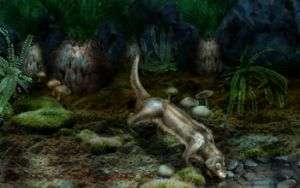
This artist's representation shows Yanoconodon, a 125-million-year-old mammal fossil found in China. Credit: Nicolle Rager Fuller, National Science Foundation

An international team of American and Chinese paleontologists has discovered a new species of mammal that lived 125 million years ago during the Mesozoic Era, in what is now the Hebei Province in China.

The new mammal, documented in the March 15 issue of the journal Nature, provides first-hand evidence of early evolution of the mammalian middle ear--one of the most important features for all modern mammals. The discovery was funded by the National Science Foundation (NSF).

"This early mammalian ear from China is a rosetta-stone type of discovery which reinforces the idea that development of complex body parts can be explained by evolution, using exquisitely preserved fossils," said H. Richard Lane, program director in NSF's Division of Earth Sciences, which co-funded the discovery with NSF's Division of Environmental Biology and its Assembling the Tree of Life (AToL) program.

Named Yanoconodon allini after the Yan Mountains in Hebei, the fossil was unearthed in the fossil-rich beds of the Yixian Formation and is the first Mesozoic mammal recovered from Hebei. The fossil site is about 300 kilometers outside of Beijing.

The researchers discovered that the skull of Yanoconodon revealed a middle ear structure that is an intermediate step between those of modern mammals and those of near relatives of mammals, also known as mammaliaforms.

"This new fossil offers a rare insight in the evolutionary origin of the mammalian ear structure," said Zhe-Xi Luo, a paleontologist at the Carnegie Museum of Natural History (CMNH) in Pittsburgh, Pa. "Evolution of the ear is important for understanding the origins of key mammalian adaptations."

Mammals have highly sensitive hearing, far better than the hearing capacity of all other vertebrates, scientists have found. Consequently, paleontologists and evolutionary biologists have been searching for more than a century for clues to the evolutionary origins of mammal ear structure.

Mammalian hearing adaptation is made possible by a sophisticated middle ear of three tiny bones, known as the hammer (malleus), the anvil (incus) and the stirrup (stapes), plus a bony ring for the eardrum (tympanic membrane).

The mammal middle ear bones evolved from the bones of the jaw hinge in their reptilian relatives. However, paleontologists long have attempted to understand the evolutionary pathway via which these precursor jaw bones became separated from the jaw and moved into the middle ear of modern mammals.

"Now we have a definitive piece of evidence, in a beautifully preserved fossil split on two rock slabs," said Luo. "Yanoconodon clearly shows an intermediate condition in the evolutionary process of how modern mammals acquired their middle ear structure."

Yanoconodon is about 5 inches (or 15 cm) long and estimated to weigh about 30 grams. Its teeth are notable for the three cusps in a straight line on molars (thus known as a triconodont) for feeding on insects and worms. It has a long body, short and sprawling limbs and claws that were ideal for either digging or living on the ground.

In addition to its unique ear structure, Yanoconodon also has a surprisingly high number of 26 thoracic ("chest") and lumbar ("waist") vertebrae, unlike most living and extinct terrestrial mammals that commonly have 19 or 20 thoracic and lumbar vertebrae. The extra vertebrae give Yanoconodon a more elongated body form, in contrast to its relatively shorter and very primitive limb and foot structures. The new mammal also has lumbar ribs, a rare feature among modern mammals.

"The discoveries of exquisitely preserved Mesozoic mammals from China have built the evidence such that biologists and paleontologists are able to make sense of how developmental mechanisms have impacted the morphological evolution of the earliest mammals," said Luo.

The article is authored by Luo and his collaborators, Peiji Chen and Gang Li of Nanjing Institute of Geology and Palaeontology, China, and graduate student Meng Chen of Nanjing University.

Source: NSF


print this article email this article download pdf blog this article bookmark this article     Digg this Stumble it share on Facebook share on Reddit add to delicious save to Yahoo! bookmarks
4.4/5 after 24 votes


March 14th, 2007 all stories
Other Sciences / Archaeology & Fossils

Comments: 0
Rank: 4.4/5 after 24 votes

  • Stumble this up

  • Digg this

  • Share it:
  • share on Facebook
  • share on MySpace
  • share on Slashdot
  • rss-newsfeed
  • share on Google
  • share on Reddit
  • add to delicious
  • save to Yahoo! bookmarks
  • share on Windows Live
  • Add to Mixx!
Rating: 4.4/5 after 24 votes

  • Related Stories

  • Missing link shows bats flew first, developed echolocation later
    created Feb 13, 2008 | popularity not rated yet | comments 0
  • Missing Link Between Whales and Four-Footed Ancestors Discovered
    created Dec 19, 2007 | popularity not rated yet | comments 0
  • How fish hear and make sounds at same time
    created Jul 04, 2005 | popularity not rated yet | comments 0
  • Manatees can probably hear which directions boats approach from
    created Jun 12, 2009 | popularity not rated yet | comments 0
  • Scientists discover ultrasonic communication among frogs
    created May 11, 2009 | popularity not rated yet | comments 0

Tags


  • Physicists Demonstrate Quantum Memory with Matter Qubits
    Physicists Demonstrate Quantum Memory with Matter Qubits
    Physics / General Physics
    created Jul 03, 2009 | popularity 4.4 / 5 (17) | comments 1
  • 'Holey' Nanosheets for Wastewater Dye Removal
    Nanotechnology / Nanomaterials
    created Jul 01, 2009 | popularity 5 / 5 (5) | comments 1
  • Jellyfish Robot Swims Like its Biological Counterpart
    Jellyfish Robot Swims Like its Biological Counterpart
    Electronics / Robotics
    created Jun 26, 2009 | popularity 4.4 / 5 (8) | comments 1
  • Could Maxwell's Demon Exist in Nanoscale Systems?
    Could Maxwell's Demon Exist in Nanoscale Systems?
    Physics / General Physics
    created Jun 24, 2009 | popularity 4.4 / 5 (18) | comments 29
  • Living Safely with Robots, Beyond Asimov's Laws
    Living Safely with Robots, Beyond Asimov's Laws
    Electronics / Robotics
    created Jun 22, 2009 | popularity 4.6 / 5 (52) | comments 40
  • Other News

    Creation Museum president Ken A. Ham

    Paleontologists brought to tears, laughter by Creation Museum

    Other Sciences / Other

    created Jun 30, 2009 | popularity 4.2 / 5 (43) | comments 123

    For a group of paleontologists, a tour of the Creation Museum seemed like a great tongue-in-cheek way to cap off a serious conference.


    Mummified dinosaur skin yields up new secrets

    Mummified dinosaur skin yields up new secrets

    Other Sciences / Archaeology & Fossils

    created Jul 01, 2009 | popularity 4.7 / 5 (15) | comments 10

    (PhysOrg.com) -- Scientists from The University of Manchester have identified preserved organic molecules in the skin of a dinosaur that died around 66-million years ago.


    Liberal? Conservative? Stanford study says mental nudge can make voters flip-flop

    Liberal? Conservative? Stanford study says mental nudge can make voters flip-flop

    Other Sciences / Social Sciences

    created Jul 02, 2009 | popularity 3.8 / 5 (5) | comments 4

    (PhysOrg.com) -- No doubt you’ve worked hard for your success. But chances are you’ve also had some help and lucky breaks along the way.


    Probing Question: How do Ponzi Schemes work?

    Other Sciences / Economics

    created Jul 02, 2009 | popularity 5 / 5 (2) | comments 2

    Imagine the shock, the horror, and the sheer panic that would come with learning that the financial plan you’d sunk your life savings into was a sham, the financial experts you trusted were crooks, and all your money was ...


    Tourists enjoy a "Pineapple Tour" in Costa Rica

    Costa Rica tops happiness, 'green living' poll

    Other Sciences / Social Sciences

    created Jul 04, 2009 | popularity 3 / 5 (3) | comments 0

    Costa Rica is the happiest place on earth, and one of the most environmentally friendly, according to a new survey by a British non-governmental group.