March 15, 2007 feature
'Plug and Play' Source of Single Photons
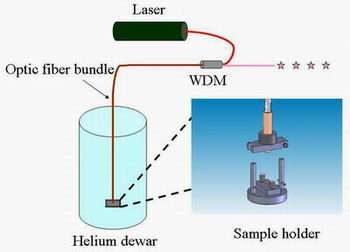
A research group in the UK has crafted a source of single photons – photons emitted one by one – with a convenience and ease of use they liken to “plug and play” computer hardware devices. This is a key step forward in single-photon production, which is essential to successful, secure quantum communication, the transmission of data using individual photons to carry bits of information.
The device's plug-and-play quality lies in its novel design. A bundle of optical fibers is coupled with – or “plugged into,” so to speak – a wafer patterned with quantum dots. Quantum dots are tiny atom clusters of a semiconducting material, such as silicon, that contain as few as a hundred atoms and play a key role in many single-photon-production schemes. In this case, they emit photons when excited with laser light.
“Pairing the optical fiber bundle and the quantum-dot wafer presents a way to implement real quantum communication that other single-photon sources do not have,” said lead researcher Xuilai Xu, a scientist at Hitachi Europe Ltd. in Cambridge, to PhysOrg.com. Xu and his colleagues at Hitachi performed the study in collaboration with researchers at the University of Cambridge.
The wafer is mounted onto a sample holder, immersed in liquid helium, and then excited with a laser. During this process, the dots' atoms absorb the laser photons and jump to a higher energy state, but almost instantly re-emit the photons and return to a lower-energy state. The emitted photons travel through the fiber bundle to a beamsplitter, which sends the emitted photons out one fiber and the residual laser photons out another.
Accurately determining if the source produced single photons was a tricky task. Xu and his colleagues had to use several devices to analyze the emitted photon signal. These included a spectrometer, which measured the intensity of the light, and two single-photon-counting “photodiodes,” semiconductor devices used to detect light. They also applied a filter to subtract out background photons, ensuring that the photons emitted from the quantum dots were not mixed with photons emitted from the wafer's “wetting layer,” a thin layer of residue formed on the surface of the dots as the wafer was created.
Analysis of the data produced by the measurement and detection devices showed that the photons tended not to be emitted in pairs. And, according to the researchers' calculations, the addition of the filter, when it was placed at the proper angle, greatly reduced the probability that photon counters would detect more than one photon at once – specifically, the likelihood of this was reduced 100-fold.
“This indicates a nearly ideal single-photon source,” said Xu.
To test the stability of their design, the group measured the photons emitted from 27 quantum dots, traveling through different optical fibers in the bundle, over a 24-day period. The results showed the photon source to be stable over a timescale of weeks, with no evidence that a considerably longer period would result in degradation.
Citation: Xiulai Xu, Ian Toft, Richard T. Phillips, Jonathan Mar, Kiyotaka Hammura, and David A. Williams, “'Plug and play' single-photon sources.” Appl. Phys. Lett. 90 061103 (2007)
Copyright 2007 PhysOrg.com.
All rights reserved. This material may not be published, broadcast, rewritten or redistributed in whole or part without the express written permission of PhysOrg.com.


