Mars Express radar gauges water quantity around Mars south pole
March 15, 2007
Mars Express radar gauges water quantity around Mars south pole

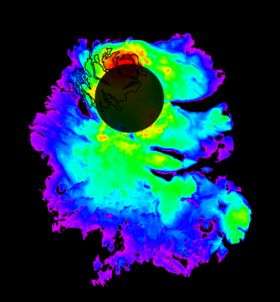
This map shows the thickness of the south polar layered deposits of Mars, an ice-rich geologic unit that was probed by the Mars Advanced Radar for Subsurface and Ionospheric Sounding (MARSIS) on board ESA’s Mars Express. The thickness of the layered deposits was determined by measuring the time delay between radar echoes from the surface and those from the lower boundary, or ‘bed’, of the deposits. The radar data indicate that the deposit, larger than than a big portion of Europe in area, is more than 3.7 kilometres thick in places, and that the material consists of nearly pure water ice with only a small component of dust. The map was generated by comparing the elevation of the bed as determined by MARSIS with the high-resolution map of surface topography obtained by the Mars Orbiter Laser Altimeter (MOLA) aboard NASA’s Mars Global Surveyor. The thickness of the layered deposits is shown by colors, with purple representing the thinnest areas, and red the thickest. The total volume of ice in the layered deposits is equivalent to a water layer 11 metres deep, if spread evenly across the planet. The boundary of the layered deposits was mapped by scientists from the U.S. Geological Survey. The dark circle in the upper center is the area pole-ward of 87 ° south latitude, where MARSIS data cannot be collected. The map covers an area 1670 by 1800 kilometres. Credits: NASA/JPL/ASI/ESA/Univ. of Rome/MOLA Science Team/USGS

The amount of water trapped in frozen layers over Mars' south polar region is equivalent to a liquid layer about 11 metres deep covering the planet.

This new estimate comes from mapping the thickness of the dusty ice by the Mars Express radar instrument that has made more than 300 virtual slices through layered deposits covering the pole. The radar sees through icy layers to the lower boundary, which in places is as deep as 3.7 kilometres below the surface.

"The south polar layered deposits of Mars cover an area as wide as a big portion of Europe. The amount of water they contain has been estimated before, but never with the level of confidence this radar makes possible," said Dr. Jeffrey Plaut of NASA's Jet Propulsion Laboratory, Pasadena (California), co-Principal Investigator for the radar and lead author of the study.

The instrument, named the Mars Advanced Radar for Subsurface and Ionospheric Sounding (MARSIS), is also mapping the thickness of similar layered deposits at the north pole of Mars.

“Our radar is doing its job extremely well,” said Prof. Giovanni Picardi of the University of Rome ‘La Sapienza,’ Principal Investigator for the instrument. “MARSIS is showing to be a very powerful tool to probe underneath the Martian surface, and it’s showing how our team’s goals – such as probing the polar layered deposits - are being successfully achieved,” he continued. “Not only MARSIS is providing us with the first ever views of Mars’ subsurface at those depths, but the details we are seeing are truly amazing. We are expecting even greater results when we will have concluded an on-going, sophisticated fine-tuning of our data processing methods. These should enable us to understand even better the surface and subsurface composition.”

Polar layered deposits hold most of the known water on modern Mars, though other areas of the planet appear to have been very wet at times in the past. Understanding the history and fate of water on Mars is a key to studying whether Mars has ever supported life, because all known life depends on liquid water.

Plaut, Picardi and 22 other researchers report analysis of the Mars Express radar instrument's south polar observations in the online edition of the journal Science this week.

The polar layered deposits extend beyond and beneath a polar cap of bright-white frozen carbon dioxide and water at Mars' south pole. Dust darkens many of the layers. However, the strength of the echo that the radar receives from the rocky surface underneath the layered deposits suggests the composition of the layered deposits is at least 90 percent frozen water. One area with an especially bright reflection from the base of the deposits puzzles researchers. It resembles what a thin layer of liquid water might look like to the radar instrument, but the conditions are so cold that the presence of melted water is deemed highly unlikely.

Detecting the shape of the ground surface beneath the ice deposits provides information about even deeper structure of Mars. "We didn't really know where the bottom of the deposit was," Plaut said. "We can see now that the crust has not been depressed by the weight of the ice as it would be on the Earth. The crust and upper mantle of Mars are stiffer than the Earth's, probably because the interior of Mars is so much colder."

The results appear in the 15 March 2007 issue of the Science magazine, in an article by J. Plaut, G. Picardi et al., titled: "Subsurface Radar Sounding of the South Polar Layered Deposits of Mars."

Source: European Space Agency

4.8 /5 (24 votes)  

Rank 4.8 /5 (24 votes)
Tags

Related Stories
Relevant PhysicsForums posts
  • Scale of the Universe
    created4 hours ago
  • Titan's lack of impact craters
    createdFeb 09, 2012
  • Real pictures of black hole eating a star?
    createdFeb 08, 2012
  • Hypothetical way to travel faster than light, but not technically exceed lightspeed
    createdFeb 06, 2012
  • How do scientists monitor the Sun's activity?
    createdFeb 05, 2012
  • Search patterns in observational studies
    createdFeb 05, 2012
  • More from Physics Forums - General Astronomy

More news stories

Humans may have helped the decline of African rainforests 3000 years ago

(PhysOrg.com) -- Large areas of rainforests in Central Africa mysteriously disappeared over three thousand years ago, to be replaced by savannas. The prevailing theory has been that the cause was a change ...

Space & Earth / Environment

created 15 hours ago | popularity 4.2 / 5 (9) | comments 10 | with audio podcast report

NASA sees wide-eyed cyclone Jasmine

Cyclone Jasmine's eye has opened wider on NASA satellite imagery, as it moves through the Southern Pacific Ocean.

Space & Earth / Earth Sciences

created 3 hours ago | popularity not rated yet | comments 1

NASA sees Giovanna reach cyclone strength, threaten Madagascar

Tropical Storm 12S built up steam and became a cyclone on February 10, 2012 as NASA's Terra satellite passed overhead. Residents of east-central Madagascar should prepare for this cyclone to make landfall ...

Space & Earth / Earth Sciences

created 3 hours ago | popularity not rated yet | comments 0

Could Venus be shifting gear?

(PhysOrg.com) -- ESA’s Venus Express spacecraft has discovered that our cloud-covered neighbour spins a little slower than previously measured. Peering through the dense atmosphere in the infrared, the ...

Space & Earth / Space Exploration

created 11 hours ago | popularity 5 / 5 (7) | comments 7 | with audio podcast

Mars Science Laboratory computer issue resolved

(PhysOrg.com) -- Engineers have found the root cause of a computer reset that occurred two months ago on NASA's Mars Science Laboratory and have determined how to correct it.

Space & Earth / Space Exploration

created 12 hours ago | popularity 4.7 / 5 (6) | comments 3 | with audio podcast


Google users warned of threat to smartphone wallets

Users of Google smartphone wallets were being warned on Friday that there is a way to crack pass codes intended to thwart thieves from going on illicit shopping sprees.

Anonymous knocks CIA website offline (Update)

The website of the Central Intelligence Agency was inaccessible on Friday after the hacker group Anonymous claimed to have knocked it offline.

Complex wiring of the nervous system may rely on a just a handful of genes and proteins

Researchers at the Salk Institute have discovered a startling feature of early brain development that helps to explain how complex neuron wiring patterns are programmed using just a handful of critical genes. ...

New error-correcting codes guarantee the fastest possible rate of data transmission

Error-correcting codes are one of the triumphs of the digital age. They’re a way of encoding information so that it can be transmitted across a communication channel — such as an optical fiber o ...

The power of estrogen -- male snakes attract other males

A new study has shown that boosting the estrogen levels of male garter snakes causes them to secrete the same pheromones that females use to attract suitors, and turned the males into just about the sexiest ...

Putting the squeeze on planets outside our solar system

(PhysOrg.com) -- Using high-powered lasers, scientists at Lawrence Livermore National Laboratory and collaborators discovered that molten magnesium silicate undergoes a phase change in the liquid state, abruptly ...