Robotic Telescope unravels mystery of cosmic blasts
March 15, 2007 Robotic Telescope unravels mystery of cosmic blasts

Enlarge

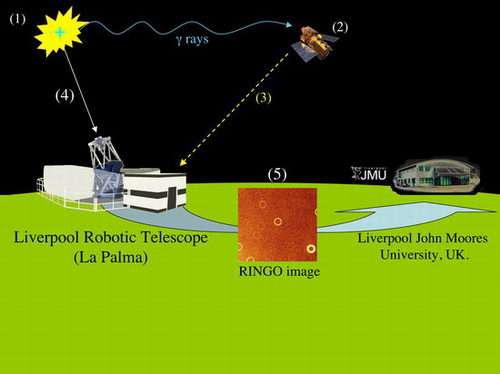
Figure showing the links between the gamma ray burst detection and follow up observations. (1) Gamma Ray Burst, GRB 060418, explodes and emits high-energy gamma rays. (2) and (3) Swift satellite detects gamma rays and sends notification of sky location to ground telescopes. (4) Liverpool Telescope (LT) on mountain top on Canary island of La Palma receives notification and immediately points to correct part of sky to begin to capture optical light from GRB afterglow. (5) Polarisation image taken with LT polarimeter, RINGO, is transmitted to the Astrophysics Institute at Liverpool John Moores University for analysis by scientists. Credit: Dr Carole Mundell, Liverpool John Moores University.

Scientists have used the world's largest robotic telescope to make the earliest-ever measurement of the optical polarisation of a Gamma Ray Burst (GRB) just 203 seconds after the start of the cosmic explosion. This finding, which provides new insight into GRB physics, is published in Science today.

The scientists from Liverpool John Moores University and colleagues in the UK, Italy, France and Slovenia used the Liverpool Telescope on the island of La Palma and its novel new polarimeter, RINGO, to perform the measurement following detection of the burst by NASA's Swift satellite.

Gamma Ray Bursts are the most instantaneously powerful explosions in the Universe and are identified as brief, intense and completely unpredictable flashes of high energy gamma rays on the sky. They are thought to be produced by the death throes of a massive star and signal the birth of a new black hole or neutron star (magnetar) and ejection of an ultra-high speed jet of plasma. Until now, the composition of the ejected material has remained a mystery and, in particular the importance of magnetic fields has been hotly debated by GRB scientists.

The Liverpool measurement was obtained nearly 100 times faster than any previously published optical polarisation measurement for a GRB afterglow and answers some fundamental questions about the presence of magnetic fields.

Principal author of the Science paper and GRB team leader Dr Carole Mundell of the Astrophysics Research Institute, Liverpool John Moores University, said "Our new measurements, made shortly after the Gamma Ray Burst, show that the level of polarisation in the afterglow is very low. Combined with our knowledge of how the light from this explosion faded, this rules-out the presence of strong magnetic fields in the emitting material flowing out from the explosion - a key element of some theories of GRBs."

The so-called optical afterglow is thought to originate from light emitted when this ejected material impacts the gas surrounding the star. In the first few minutes after the initial burst of gamma rays, the optical light carries important clues to the origin of these catastrophic explosions; capturing this light at the earliest possible opportunity and measuring its properties is ideally suited to the capabilities of large robotic telescopes like the Liverpool Telescope.

Lord Martin Rees, Astronomer Royal and President of the Royal Society said "We are still flummoxed about the underlying trigger' for gamma ray bursts, and why they sometimes emit bright flashes of light. Theorists have a lot of tentative ideas, and these observations narrow down the range of options."

Professor Keith Mason, Chief Executive of PPARC and UK lead investigator on Swift's Ultra Violet/Optical Telescope, said, "This result demonstrates well the effectiveness of Swift's rapid response alert system, allowing robotic telescopes, such as the Liverpool Telescope, to follow up gamma ray bursts within seconds, furthering our knowledge with each detection."

Source: PPARC


print this article email this article download pdf blog this article bookmark this article     Stumble it Digg this share on Facebook retweet share on Reddit add to delicious
Rate this story - 4.8 /5 (16 votes)


March 15, 2007 all stories

Comments: 0

4.8 /5 (16 votes)
  • Stumble this up

  • Digg this

  • share this

  • hide
  • Related Stories

  • 'Naked Eye' Gamma Ray Burst Was Aimed Squarely At Earth
    created Sep 10, 2008 | popularity not rated yet | comments 0
  • Death of massive star creates brightest burst ever seen
    created Mar 20, 2008 | popularity not rated yet | comments 0
  • Swift, Gemini probe mysterious explosion in the distant past
    created Jan 08, 2008 | popularity not rated yet | comments 0
  • New Kind of Cosmic Explosion Detected
    created Feb 27, 2006 | popularity not rated yet | comments 0
  • New experiment could reveal make-up of the Universe
    created Aug 06, 2009 | popularity not rated yet | comments 0


  • hide
  • Relevant PhysicsForums posts

  • Some help with a X-Ray astronomy question please!
    created 21 hours ago
  • Help with Images and Optical Instrument Question..
    created Nov 26, 2009
  • Redshift as a distance indicator
    created Nov 26, 2009
  • Question about 2-body gravity
    created Nov 24, 2009
  • More from Physics Forums - General Astronomy

Other News

Fermi Telescope Peers Deep into Microquasar

Fermi Telescope Peers Deep into Microquasar (w/ Video)

Space & Earth / Astronomy

created 15 hours ago | popularity 4.6 / 5 (7) | comments 0

(PhysOrg.com) -- NASA's Fermi Gamma-ray Space Telescope has made the first unambiguous detection of high-energy gamma-rays from an enigmatic binary system known as Cygnus X-3. The system pairs a hot, massive ...


The Energy Sources of Ultraluminous Galaxies

The Energy Sources of Ultraluminous Galaxies

Space & Earth / Astronomy

created 15 hours ago | popularity 4.4 / 5 (10) | comments 1

(PhysOrg.com) -- Ultraluminous infrared galaxies ((ULIRGs) are galaxies whose luminosity exceeds that of a trillion suns; for comparison, the Milky Way galaxy has a typical (and much more modest) luminosity ...


New climate targets may not change daily life much (AP)

New climate targets may not change daily life much

Space & Earth / Environment

created 19 hours ago | popularity 3.8 / 5 (10) | comments 4

(AP) -- Americans' day-to-day lives won't change noticeably if President Barack Obama achieves his newly announced goal of slashing carbon dioxide pollution by one-sixth in the next decade, experts say.


Space shuttle Atlantis, 7 astronauts back on Earth (AP)

Space shuttle Atlantis, 7 astronauts back on Earth

Space & Earth / Space Exploration

created 16 hours ago | popularity not rated yet | comments 0

(AP) -- Space shuttle Atlantis and its seven astronauts returned to Earth with a smooth touchdown Friday to end an 11-day flight that resupplied the International Space Station.


China is set to launch its second moon orbiter next October, state media have reported

China to launch second lunar probe: state media

Space & Earth / Space Exploration

created 20 hours ago | popularity 5 / 5 (4) | comments 0

China will launch its second moon orbiter next October, state media reported Friday, as it powers ahead with a space programme that has sparked concerns abroad.