DNA self-assembly used to mass-produce patterned nanostructures
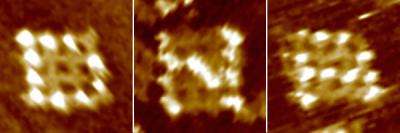
Duke University scientists have used the self-assembling properties of DNA to mass-produce nanometer-scale structures in the shape of a 4x4 grids, on which patterns of molecules can be specified. They said the achievement represents a step toward mass-producing electronic or optical circuits at a scale 10 times smaller than the smallest circuits now being manufactured.
Instead of using silicon as the platform for tiny circuits, as is done in the current manufacturing technique of photolithography, the Duke researchers used DNA strands to create grids less than one ten-millionth of a meter square. The smallest features on these square DNA lattices are approximately five to 10 billionths of a meter (nanometers), according to the scientists, compared with about 65 nanometers in silicon circuits created using photolithography.
To demonstrate their ability to mass-produce grids with infinitesimal patterns, the scientists created batches of trillions of separate grids with the letters "D," "N" and "A" written with a protein that can be seen through atomic force microscopy (AFM).
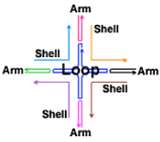
The scientists, members of the Triangle-area TROIKA collaboration to construct computing devices using DNA, were able to create the grids by using the binding properties of DNA to ensure that large numbers of DNA strands would assemble themselves in specified patterns.
The two corresponding authors on the paper were Thom LaBean, an associate research professor of computer science and an adjunct associate professor of the practice of chemistry at Duke, and Christopher Dwyer, an assistant professor of electrical and computer engineering and computer science. Their research is scheduled to be published in volume 45 of the journal Angewandte Chemie and released early online Dec. 23, 2005. It was funded by the National Science Foundation.
"The process we've described creates lattices -- with patterns we specify -- at least tenfold smaller than the best lithography being used right now," LaBean said. "Plus, because we're using DNA building blocks that assemble themselves, we can simultaneously make trillions of copies of a desired structure."
To create the tiny DNA grids, LaBean, Dwyer and their colleagues began with tiny building blocks they called "tiles." Each tile was made up of strands of DNA bent like pipe cleaners into the shape of a cross. In the middle of each cross was a loop of DNA that can be attached to another molecule that can in turn bind to a protein molecule to give the tile a tag visible by AFM. Each arm of the cross, about 10 nanometers long, had a pair of "sticky ends" where the DNA strand was made of up of unpaired bases that tend to bind with reciprocal bases. Tiles with complementary sticky ends link together when mixed.
The structure of the tiles created the molecular equivalent of puzzle pieces that would self-assemble only in a specific arrangement when mixed together, with the DNA loop loaded with a desired "cargo" molecule that would form the structure the researchers wished to create. In one experiment, the scientists specified 16 unique puzzle pieces that fit together as a 4x4 grid that formed a puzzle spelling the letter "D." Because each piece would only match up with its predetermined neighbors, the scientists could mix together a trillion of each type of tile in one batch to generate a trillion 4x4 grids.
Coming up with the specifications for each DNA strand in the tiles proved to be a complex mathematical problem. The challenge was to specify a sequence of bases for each pair of sticky ends at the end of each of the 16 tiles' four arms (a total of 128 sequences) that would bind a tile only with its intended neighbor and not with any other tiles or itself.
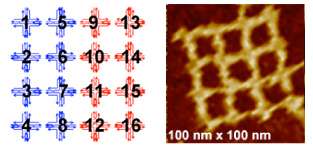
"It turns out there are a lot of combinations to consider," Dwyer said. "That meant running a lot of searches. We had to run three hundred computers for two weeks to get an answer."
The answer for the optimal base configurations for each DNA strand was disclosed to Duke's Office of Licensing and Ventures as a first step towards a potential patent.
The researchers have not yet produced a functional circuit on a grid. However, in future studies, they plan to generate grids larger than four tiles by four tiles and to populate the grids with molecules that can conduct electrons or light waves to form simple circuits. Based on the characteristics those circuits would have, Dwyer and colleagues have drawn up designs for computer chips.
The researchers also may explore how their method of assembling tiles can be used create biological structures that could act as tiny sensors.
Source: Duke University


