Combating Friction and Stiction
March 16, 2007 Combating Friction and Stiction

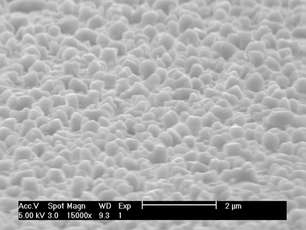
Nanoscale bumps.

Micro-electro-mechanical systems, popularly referred to as MEMS, in small electronic devices often fail because of adhesion and stiction – the attractive force between the surfaces of interacting parts. University of Arkansas researchers have developed a surface-topography engineering method that reduces these forces and will help microscopic parts interact and function smoothly.

“There are two approaches to address adhesion and stiction issues in MEMS devices,” said Min Zou, assistant professor of mechanical engineering. “One is chemistry – applying chemicals on surfaces to weaken the forces. The other is topography engineering. Our approach was simple – we engineered nanoscale bumps to reduce the contact area between surfaces.”
Combating Friction and Stiction

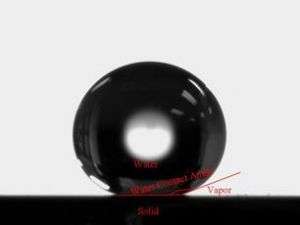
Water contact angle.

The goal of the project was to create a hydrophobic surface. Determined by a popular engineering benchmark known as the water-contact angle, hydrophobicity describes the process of water “beading up” or turning into a ball, such as rain does on an automobile windshield that has been treated with chemicals.

The water-contact angle is the measurement used to describe the extent to which water beads. A water-contact angle greater than 90 degrees is considered hydrophobic, and any angle greater than 150 degrees is considered superhydrophobic. With a water-contact angle of approximately 180 degrees, beads represent a near-perfect sphere with only minimal contact on surfaces.

Using only topography-engineering methods, Zou’s team achieved a water-contact angle as high as 137 degrees on silicon. No other researcher has achieved a higher water-contact angle without the use of chemicals. Zou’s team also conducted a study that combined the surface-topography engineering method with chemicals. That study achieved a water-contact angle greater than 150 degrees, and thus produced a superhydrophobic surface.

Zou’s team started with amorphous silicon – silicon that does not exhibit any crystalline form or shape. The researchers used aluminum to induce crystallization, which manifested as nano- or microcrystallites to form the textured surfaces. The researchers induced crystallization by annealing – a process of heating and cooling – the amorphous silicon in a conventional furnace.

“We demonstrated that the surface area covered by nanotextures can be controlled by changing annealing temperature and duration,” Zou said.

In addition to electronic devices, the research applies to biomedical devices. It also advances the understanding of tribology, which is the study of friction, wear and lubrication of interacting surfaces in relative motion, such as gears, bearings and head-disk interfaces in computer hard drives.

Zou presented the research findings in January at the International Conference on Integration and Commercialization of Micro and Nano-systems organized by the American Society of Mechanical Engineers. The research was awarded the conference’s best paper award.

Source: University of Arkansas, Fayetteville


print this article email this article download pdf blog this article bookmark this article     Stumble it Digg this share on Facebook retweet share on Reddit add to delicious
Rate this story - 4.3 /5 (25 votes)


March 16, 2007 all stories

Comments: 0

4.3 /5 (25 votes)
  • Stumble this up

  • Digg this

  • share this

  • hide
  • Related Stories

  • Mystery of the Solar Tsunami -- Solved (w/ Video)
    created Nov 19, 2009 | popularity not rated yet | comments 0
  • Gadgets: Digital photo gift ideas
    created Nov 19, 2009 | popularity not rated yet | comments 0
  • Discovery of a Retrograde or Highly Tilted Extrasolar Planet
    created Nov 18, 2009 | popularity not rated yet | comments 0
  • Fighting climate change by turning CO2 to stone
    created Nov 17, 2009 | popularity not rated yet | comments 0
  • Engineer Discovers Why Particles Like Flour Disperse on Liquids
    created Nov 16, 2009 | popularity not rated yet | comments 0


  • hide
  • Relevant PhysicsForums posts

  • photoconductivity of polymers
    created 8 hours ago
  • Heat pipe for high temperature
    created 20 hours ago
  • Robot built out of acrylic
    created Nov 24, 2009
  • Thickness or Ga. of Stainless steel water tank?
    created Nov 24, 2009
  • More from Physics Forums - Materials & Chemical Engineering

Other News

Fast, easy, and highly sensitive arsenic detection with gold nanoparticles

Nanotechnology / Nanomaterials

created 15 hours ago | popularity 5 / 5 (1) | comments 0

(PhysOrg.com) -- Mention of arsenic poisoning usually brings to mind underhanded murder. However, the danger of arsenic poisoning from contaminated drinking water is far greater. Low concentrations of arsenic are found in ...


Water droplets direct self-assembly process in thin-film materials

Nanotechnology / Nanomaterials

created Nov 23, 2009 | popularity 5 / 5 (4) | comments 2

You can think of it as origami - very high-tech origami. Researchers at the University of Illinois have developed a technique for fabricating three-dimensional, single-crystalline silicon structures from thin films by coupling ...


Nanotube defects equal better energy and storage systems

Nanotube defects equal better energy and storage systems

Nanotechnology / Nanomaterials

created Nov 19, 2009 | popularity 4.4 / 5 (10) | comments 2

(PhysOrg.com) -- Most people would like to be able to charge their cell phones and other personal electronics quickly and not too often. A recent discovery made by UC San Diego engineers could lead to carbon ...


Nanotech in Space: Experiment To Weather the Trials of Orbit

Nanotech in Space: Experiment To Weather the Trials of Orbit

Nanotechnology / Nanomaterials

created Nov 24, 2009 | popularity 4 / 5 (2) | comments 0

Novel nanomaterials developed at Rensselaer were sent into orbit on Nov. 16 aboard Space Shuttle Atlantis.


Peptides control crystal growth with 'switches, throttles and brakes'

Peptides control crystal growth with 'switches, throttles and brakes'

Nanotechnology / Bio & Medicine

created Nov 23, 2009 | popularity 5 / 5 (3) | comments 0

(PhysOrg.com) -- By producing some of the highest resolution images of peptides attaching to mineral surfaces, scientists have a deeper understanding how biomolecules manipulate the growth crystals. This research ...