New JILA apparatus measures fast nanoscale motions
March 16, 2007 New JILA apparatus measures fast nanoscale motions

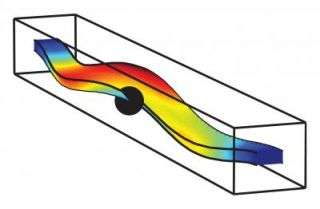
This slow-motion simulation of the JILA nanoscale motion detector shows the wiggling of a floppy metal beam, just 100 nanometers thick, as it is struck by an electric current at the dot. Red indicates the greatest change in position from the rest state. Credit: Credit: K. Lehnert/JILA

A new nanoscale apparatus developed at JILA — a tiny gold beam whose 40 million vibrations per second are measured by hopping electrons — offers the potential for a 500-fold increase in the speed of scanning tunneling microscopes (STM), perhaps paving the way for scientists to watch atoms vibrate in high definition in real time.

The new device measures the wiggling of the beam, or, more precisely, the space between it and an electrically conducting point just a single atom wide, based on the speed of electrons “tunneling” across the gap. The work is the first use of an “atomic point contact,” the business end of an STM, to sense a nanomechanical device oscillating at its “resonant” frequency, where it naturally vibrates like a tuning fork. JILA is a joint venture of the National Institute of Standards and Technology and the University of Colorado at Boulder.

Although the JILA technique, described in the March 2 issue of Physical Review Letters, is not necessarily as precise as more complex and much colder methods of measuring very fast motions of ultra-small devices, it incorporates several innovative attributes. These include the ability to minimize unwanted random electronic “noise” as well as to measure the random shaking of the beam caused by back-action or recoil (similar to what happens when a gun is fired). This level of sensitivity is possible because the atomic point contact acts as an amplifier for these otherwise imperceptible factors, and the gold beam is tiny and floppy enough—just 100 nanometers thick, and 5.6 micrometers long by 220 nm wide—to respond to single electrons.

The new method involves bringing the sharp point within one nanometer of the gold beam. A current is applied through the point across the gap, until an increase in resistance indicates that electrons are “tunneling” across the gap (a phenomenon observed only at atomic dimensions). The size of the gap is then monitored based on variations in the current. The beam’s undulations were measured with tens to hundreds of times greater precision than a typical STM result. That’s because the oscillations are measured using microwave electronics, which are much faster than the audio frequency technology typically used with STMs, thus enabling greater precision. The microwave measurement technique could potentially be applied to STMs.

Citation: N.E. Flowers-Jacobs, D.R. Smith and K.W. Lehnert. Intrinsic noise properties of atomic point contact displacement detectors. Physical Review Letters. 98, 096804 (2007).

Source: National Institute of Standards and Technology


Rate this story - 4.6 /5 (14 votes)


March 16, 2007 all stories

Comments: 0

4.6 /5 (14 votes)

  • hide
  • Related Stories

  • First germanium laser brings us closer to 'optical computers'
    created Feb 04, 2010 | popularity not rated yet | comments 0
  • A see-through surprise: Scientists make solid material transparent to terahertz waves
    created Dec 07, 2009 | popularity not rated yet | comments 0
  • Using lasers to cool and manipulate molecules
    created Dec 07, 2009 | popularity not rated yet | comments 0
  • Tapering a Free-Electron Laser to Extract More Juice
    created Nov 20, 2009 | popularity not rated yet | comments 0
  • Physicists create first atomic-scale map of quantum dots
    created Sep 29, 2009 | popularity not rated yet | comments 0


  • hide
  • Relevant PhysicsForums posts

  • Interception angle
    created 2 hours ago
  • Pressure created by clamping base and cover
    created 2 hours ago
  • How to find static friction
    created 8 hours ago
  • Calculating decible increases
    created 15 hours ago
  • More from Physics Forums - General Physics

Other News

Nanoscale Structures with Superior Mechanical Properties Developed

Nanoscale Structures with Superior Mechanical Properties Developed

Nanotechnology / Nanomaterials

created 16 hours ago | popularity 4.6 / 5 (9) | comments 1 | with audio podcast

(PhysOrg.com) -- Researchers at the California Institute of Technology have developed a way to make some notoriously brittle materials ductile -- yet stronger than ever -- simply by reducing their size.


Spray-on liquid glass

Spray-on liquid glass is about to revolutionize almost everything

Nanotechnology / Nanomaterials

created Feb 02, 2010 | popularity 4.7 / 5 (240) | comments 93 | with audio podcast report

(PhysOrg.com) -- Spray-on liquid glass is transparent, non-toxic, and can protect virtually any surface against almost any damage from hazards such as water, UV radiation, dirt, heat, and bacterial infections. ...


IBM Scientists Demonstrate World's Fastest Graphene Transistor

IBM Scientists Demonstrate World's Fastest Graphene Transistor

Nanotechnology / Nanophysics

created Feb 05, 2010 | popularity 4.9 / 5 (38) | comments 25 | with audio podcast

(PhysOrg.com) -- In a just-published paper in the magazine Science, IBM researchers demonstrated a radio-frequency graphene transistor with the highest cut-off frequency achieved so far for any graphene device ...


Conductive eTextiles: Stanford finds a new use for cloth

Conductive eTextiles: Researchers move from making batteries from paper to making batteries from cloth

Nanotechnology / Nanomaterials

created Feb 05, 2010 | popularity 4.3 / 5 (7) | comments 4 | with audio podcast

(PhysOrg.com) -- Stanford researchers have moved from making batteries from paper to making batteries from cloth. Your-T-shirt could become a lighted, moving display.


Carbon Based Chips May One Day Replace Silicon Transistors

Carbon Based Chips May One Day Replace Silicon Transistors

Nanotechnology / Nanomaterials

created Feb 03, 2010 | popularity 4.7 / 5 (18) | comments 3 | with audio podcast weblog

(PhysOrg.com) -- IBM researchers are hopeful that, over the next decade, silicon-based transistors will be replaced by carbon-based transistors. IBM has already laid out the ground work for carbon-based transistors.