Construction strategies to avoid progressive collapse
March 16, 2007 Construction strategies to avoid progressive collapse

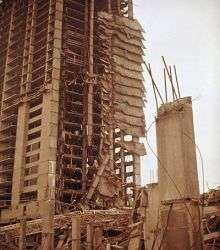
The Skyline Plaza Apartments in Fairfax County, Va after a 1973 progressive collapse that occured during construction of the 24th floor. The collapse involved the full height of the tower, and falling debris also caused the horizontal progressive collapse of an entire parking garage under construction adjacent to the tower. Fourteen workers were killed, 34 workers were injured. Credit: Hai S. Lew/NIST

The 1995 terrorist attack on the Oklahoma City Alfred P. Murrah Federal Building heightened concern on the vulnerability of multi-story buildings to “progressive collapse,” the spread of an initial local structural failure by chain reaction that results in the collapse of an entire structure or a disproportionately large part of it. The National Institute of Standards and Technology recently issued a guide to help owners, engineers and building officials avoid such collapses through prudent planning and design of structures. The guide also summarizes national and international best practices for designing buildings resistant to progressive collapse of buildings.

The report, Best Practices for Reducing the Potential for Progressive Collapse in Buildings, argues that although no building system can be engineered and constructed to be absolutely risk-free, risk-informed assessment and decision-making can reduce the risk of progressive collapse. According to the researchers, engineers must not simply work to the minimum requirements of the building code; they need to consider ways to improve structural integrity and robustness to accommodate local failures.

According to NIST engineers, hazards that increase the risk of local structural failures that, in turn, can lead to a partial or complete progressive collapse include design and construction errors, fire, gas explosion, the transport and storage of hazardous materials, vehicular collision, and bomb explosions.

The NIST report cites a lack of continuity of support within a building system, a lack of ductility in structural materials, members and connections, and lack of structural redundancy in providing alternate load paths as critical factors that limit structural integrity. The use of large-paneled or bearing wall construction, for example, can limit continuity and ductility. Such systems may be poorly suited to absorb or dissipate energy resulting from unforeseen events such as gas explosion and sabotage.

The guide catalogs a number of cost-effective engineering solutions for retrofitting existing structures.

The document summarizes “existing knowledge” for use by engineers in making risk-informed planning and design decisions. It is not intended to provide step-by-step guidance. Appendix A describes applicable design standards from around the world. Appendix B identifies research needs relevant to progressive collapse. Appendix C provides case studies of progressive collapse.

Source: National Institute of Standards and Technology


print this article email this article download pdf blog this article bookmark this article     Stumble it Digg this share on Facebook retweet share on Reddit add to delicious
Rate this story - 2.7 /5 (3 votes)


March 16, 2007 all stories

Comments: 0

2.7 /5 (3 votes)
  • Stumble this up

  • Digg this

  • share this

  • hide
  • Related Stories


  • hide
  • Relevant PhysicsForums posts

  • Distance and time required to stop a sliding unit?
    created 14 hours ago
  • Help understanding
    created Dec 04, 2009
  • TKPH rating calculation
    created Dec 02, 2009
  • How To Convert F to Q?
    created Dec 02, 2009
  • More from Physics Forums - General Engineering

Other News

Google said publishers could limit to five the number of articles people can access for free through Google

Google responds to newspaper critics

Technology / Internet

created 3 hours ago | popularity 5 / 5 (1) | comments 2

Faced with a steady drumbeat of criticism from a shrinking newspaper industry, Google is out to prove that it is friend not foe.


You've Got Freedom: AOL ends ties with Time Warner (AP)

You've Got Freedom: AOL ends ties with Time Warner

Technology / Business

created 4 hours ago | popularity not rated yet | comments 0

(AP) -- AOL is shaking loose from Time Warner Inc. and heading into the next decade the way it began this one, as an independent company. Unlike in the 1990s, though, when AOL got rich selling dial-up Internet ...


Dutch PhD student develops device to combat noise

Technology / Engineering

created Dec 01, 2009 | popularity 3.7 / 5 (13) | comments 15

Johan Wesselink of the University of Twente, The Netherlands, has developed a device to actively combat noise nuisance. This invention curtails sound waves and vibrations by producing anti-noise. The researcher is confident ...


Electromagnetic fields as cutting tools

Technology / Engineering

created Dec 01, 2009 | popularity 4.7 / 5 (18) | comments 11

(PhysOrg.com) -- The bodywork on motor vehicles must be sufficiently stable, but processing the high-strength steels involved -- for example punching holes in them -- can prove something of a challenge. A new steel-cutting ...


Media execs make case for online fees at FTC panel (AP)

Media execs make case for online fees at FTC panel

Technology / Internet

created Dec 01, 2009 | popularity 1.5 / 5 (6) | comments 11

(AP) -- Media companies need to deliver compelling information on a variety of electronic devices and overcome readers' resistance to paying for material online, news executives said Tuesday at a government-sponsored ...