New technique can detect biological, chemical and explosive agents
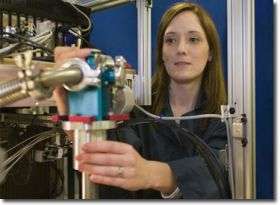
Airplane passengers and baggage might be screened one day by a machine under development at Lawrence Livermore National Laboratory (LLNL) that can detect explosive, chemical and biological agents all at the same time.
A team of LLNL researchers has conceptually proven that a three-in-one machine, or “universal point detection system,” can be achieved, said George Farquar, a postdoctoral fellow and physical chemist at the Lab’s Glenn T. Seaborg Institute.
The team’s latest advance, using its mass spectrometry system to detect the presence of minuscule particles of explosives, is described in the March 1 edition of Analytical Chemistry, a semi-monthly journal published by the American Chemical Society.
“We have found we can potentially detect an incredibly small quantity of material, as small as one dust-speck-sized particle weighing one trillionth of a gram, on an individual’s clothing or baggage,” Farquar said. “This is important because if a person handles explosives they are likely to have some remaining residue.”
Using a system they call Single-Particle Aerosol Mass Spectrometry, or SPAMS, the Livermore scientists already have developed and tested the technology for detecting chemical and biological agents.
The new research expands SPAMS’ capabilities to include several types of explosives that have been used worldwide in improvised explosive devices and other terrorist attacks.
“SPAMS is a sensitive, specific, potential option for airport and baggage screening,” Farquar said. “The ability of the SPAMS technology to determine the identity of a single particle could be a valuable asset when the target analyte is dangerous in small quantities or has no legal reason for being present in an environment.”
The team conducted its explosives tests under laboratory conditions at LLNL last summer.
“The tests went well. They show the potential to identify explosives in a field setting,” Farquar said.
Besides Farquar, other LLNL researchers on the explosives detection team included the paper’s lead author, Audrey Martin, an LLNL chemist and Michigan State University Ph.D. student, chemists Eric Gard and David Fergenson, and physicist Matthias Frank.
The early history of the three-in-one detection system started at LLNL in 1999 with the development of what is called the Bioaerosol Mass Spectrometry (BAMS) system. This system can detect airborne biological pathogens and sound a warning in less than one minute.
In late 2005, Livermore researchers started work to expand the capabilities of BAMS to include chemicals and explosives, setting the stage for the new machine now called SPAMS.
“While this instrument started as a biological detector, we saw that it had the potential to do much more by detecting other threat agents, such as chemicals and explosives,” Farquar said.
The biological detection system underwent field testing for background studies at San Francisco International Airport in late 2005. Farquar describes the biological detection technology “as very solid.”
In late 2005, the biological system underwent testing for several biological “surrogates” at the Applied Physics Laboratory at Johns Hopkins University. A second round of tests – with smaller releases and seven days of autonomous sampling – is planned for later this month.
Initial studies to test the performance of SPAMS with four chemical “simulants” were undertaken in 2006.
Future plans for SPAMS include a field test at a large public facility in the United States later this year, upgrading the technology for removing particles from luggage and clothing, and adding the capability of detecting narcotics, Farquar said.
Research funds to add the capabilities of detecting explosives and chemicals have been provided by the Defense Advanced Research Projects Agency, the U.S. Department of Homeland Security and LLNL’s Glenn T. Seaborg Institute, which is part of the Chemistry, Materials and Life Sciences directorate.
Source: Lawrence Livermore National Laboratory


