Clemson rocket launches test Alaskan auroras
March 16, 2007 Clemson rocket launches test Alaskan auroras

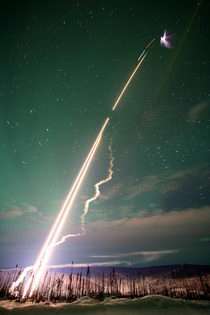
It may have been 40 degrees below zero at the Poker Flat Research Range in Alaska, but aurora and weather came together one recent winter night in a perfect match for Clemson University researchers and students who launched four rockets to study heat in the upper atmosphere.

Four 30- to 40-foot-long NASA suborbital sounding rockets were launched into the night sky within a period of 16 minutes as part of the HEX 2 project, a collaborative effort between the University of Alaska at Fairbanks and Clemson.

"We had absolutely ideal conditions for the launches," said Clemson physics professor Miguel Larsen. "We are interested in the auroral displays because they produce electrical currents that heat the atmosphere. Wind patterns become altered as the atmosphere heats up, and this can cause changes in satellite orbits and interference with radio communications."

The rockets carried chemical tracer experiments from Larsen and instruments from Clemson assistant physics professor Gerald Lehmacher. At 60 miles above the ground, the chemical tracer glows and can be tracked as it is carried by winds high up in the atmosphere. The instruments measured the changes in atmospheric pressure created by the heat.

The rocket range is located 30 miles north of Fairbanks. The data will be analyzed to yield a three-dimensional picture of the neutral winds and density changes that occur during auroral disturbances.

Source: Clemson University


print this article email this article download pdf blog this article bookmark this article     Stumble it Digg this share on Facebook retweet share on Reddit add to delicious
Rate this story - 4.1 /5 (8 votes)


March 16, 2007 all stories

Comments: 0

4.1 /5 (8 votes)
  • Stumble this up

  • Digg this

  • share this

  • hide
  • Related Stories

  • Killer algae a key player in mass extinctions
    created Oct 19, 2009 | popularity not rated yet | comments 0
  • Race for Superconductors Shrinks to Nanoscale
    created Oct 09, 2009 | popularity not rated yet | comments 0
  • Scientists pinpoint the 'edge of space'
    created Apr 09, 2009 | popularity not rated yet | comments 0
  • Scientists launch rockets to test atmospheric conditions
    created Feb 26, 2009 | popularity not rated yet | comments 0
  • Four rockets launch from Poker Flat Research Range
    created Feb 19, 2009 | popularity not rated yet | comments 0


  • hide
  • Relevant PhysicsForums posts

  • Need Book Recommendation
    created 55 minutes ago
  • Rocket Experiment Help
    created 3 hours ago
  • Coulomb's Law
    created 8 hours ago
  • Laser spots
    created 12 hours ago
  • More from Physics Forums - General Physics

Other News

Aquatic creatures mix ocean water

Physics / General Physics

created 14 hours ago | popularity 5 / 5 (3) | comments 0

Understanding mixing in the ocean is of fundamental importance to modeling climate change or predicting the effects of an El Niņo on our weather. Modern ocean models primarily incorporate the effects of winds and tides. However, ...


Generating electricity from air flow

Physics / General Physics

created 17 hours ago | popularity 3.9 / 5 (8) | comments 2

A group of researchers at the City College of New York is developing a new way to generate power for planes and automobiles based on materials known as piezoelectrics, which convert the kinetic energy of motion into electricity. ...


Nuclear weapons: Predicting the unthinkable

Physics / General Physics

created 17 hours ago | popularity 2.3 / 5 (4) | comments 1

If a nuclear weapon were detonated in a metropolitan area, how large would the affected area be? Where should first responders first go? According to physicist Fernando Grinstein, we have some initial understanding to address ...


Butterfly proboscis to sip cells

Physics / General Physics

created 14 hours ago | popularity not rated yet | comments 0

A butterfly's proboscis looks like a straw -- long, slender, and used for sipping -- but it works more like a paper towel, according to Konstantin Kornev of Clemson University. He hopes to borrow the tricks of this piece ...


Restored machine to explore mysteries of Big Bang (AP)

Restored machine to explore mysteries of Big Bang

Physics / General Physics

created Nov 21, 2009 | popularity 4.6 / 5 (18) | comments 19

(AP) -- Scientists are preparing the world's largest atom smasher to explore the depths of matter after successfully restarting the $10 billion machine following more than a year of repairs.