Snowflake Physicist's Photographs to Be Featured on 2006 Postage Stamps
Postage rates may keep going up, but when it comes to natural beauty and scientific wonder, one particular issue of stamps is going to be hard to lick.
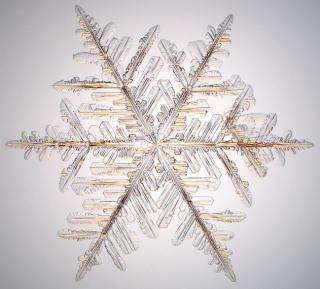
Beginning next October, the U.S. Postal Service will issue a set of four commemorative stamps featuring images of snowflakes furnished by that hotbed of snowflake research, the California Institute of Technology. The holiday snowflakes stamp set will display photographs taken by Caltech physics professor Kenneth Libbrecht.
For several years Libbrecht has been investigating the basic physics of how patterns are created during crystal growth and other simple physical processes. He has delved particularly deeply into a case study of the formation of snowflakes. His research is aimed at better understanding how structures arise in material systems, but it is also visually compelling and, from the start, has been a hit with the public.
"My snowflake website, www.snowcrystals.com , is getting about two million hits a year," says Libbrecht, "of course, with a big peak during the winter months."
Libbrecht attributes the site's popularity to its discussion of some very accessible science. "Snowflake patterns are well known, the snowflakes fall right out of the sky, and you don't necessarily need a science background to appreciate the science behind how these ice structures form. It's an especially good introduction to science for younger kids," he says.
Libbrecht began his research by growing synthetic snowflakes in his lab, where they can be created and studied under well-controlled conditions. Precision micro-photography was necessary for this work, and over several years Libbrecht developed some specialized techniques for capturing images of snow crystals. Starting in 2001, he expanded his range to photographing natural snowflakes as well. "A few years ago I mounted my microscope in a suitcase, so I now can take it out into the field," says Libbrecht. "Sometimes I arrange trips to visit colleagues in the frozen north, and other times I arrange extended ski vacations with my family. The most difficult part these days is getting this complex-looking instrument through airport security."
Libbrecht's camera rig is essentially a microscope with a camera attached. The entire apparatus was built on campus and designed specifically for snowflake photography. "Snowflakes are made of ice, which is mostly completely clear, so lighting is an important consideration in this whole business," he says. "I use different types of colored lights shining through the crystals, so the ice structures act like complex lenses to refract the light in different ways. The better the lighting, the more interesting is the final photograph." The structures of snowflakes are ephemeral, so speed is needed to get good photographs. Within minutes after falling, a snowflake will begin to degrade as its sharper features evaporate away. The complex structures are created as the crystals grow, and when they stop growing, the crystals soon become rounded and more blocky in appearance. "When photographing in the field, I first let the crystals fall onto a piece of cardboard," says Libbrecht. "Then I find one I like, pick it up using a small paintbrush, and place it on a microscope slide. I then put it under the microscope, adjust the focus and lighting, and take the shot. You need to search through a lot of snowflakes to find the most beautiful specimens." Libbrecht finds that observing natural snowflakes in the field is an important part of his research, and nicely complements his laboratory work. "I've learned a great deal about crystal growth by studying ice, and have gotten many insights from looking at natural crystals. Nature provides a wonderful variety of snow crystal types to look at, and the crystals that fall great distances are larger than what we can easily grow in the lab." So where does one find really nice snowflakes? Certainly not in Pasadena, where Caltech is located, but Libbrecht says that certain snowy places are better than others. The snowflakes chosen for the stamps were photographed in Fairbanks, Alaska, in the Upper Peninsula of Michigan, and in Libbrecht's favorite spot-Cochrane, Northern Ontario. "Northern Ontario provides some really excellent specimens to photograph," says Libbrecht. "The temperature is cold, but not too cold, and the weather brings light snow frequently.
"Fairbanks sometimes offers some unusual crystal types, because it's so cold. Warmer climates, for example, in New York State and the vicinity, tend to produce less spectacular crystals." As for the nitty-gritty of snowflake research, probably the question Libbrecht is asked the most is whether the old story about no two snowflakes being exactly alike is really true.
"The answer is basically yes, because there is such an incredibly large number of possible ways to make a complex snowflake," he says. "In many cases, there are very clear differences between snow crystals, but of course there are many similar crystals as well. In the lab we often produce very simple, hexagonal crystals, and these all look very similar."
Libbrecht can grow many different snowflake forms at will in his lab, but says there are still many subtle mysteries in crystal growth that are of interest to physicists who are trying to understand and control the formation of various materials. A real-world application of research on crystals is the growth of semiconductors for our electronic gadgets. These semiconductors are made possible in part by painstakingly controlling how certain substances condense into solid structures.
Lest anyone thinks that Libbrecht limits his life as a physicist to snowflakes, he is also involved in the Laser Interferometer Gravitational-Wave Observatory (LIGO), an NSF-funded project that seeks to confirm the existence of gravitational waves from exotic cosmic sources such as colliding black holes.
In LIGO, Libbrecht has lots of professional company; in fact, the field was essentially founded by Albert Einstein, who first predicted the existence of gravitational waves as a consequence of general relativity. Kip Thorne and Ron Drever at Caltech, along with Rai Weiss at MIT, were instrumental in initiating the LIGO project in the 1980s.
But in snowflake research, Libbrecht is pretty much a one-man show. And he says there's something about the exclusivity that he likes.
"It suits some of my hermit-like tendencies," comments Libbrecht. "As Daniel Boone once said, if you can smell the smoke of another person's fire, then it's time to move on. My research on snow crystal growth is the one thing I do that simply wouldn't get done otherwise."
Source: Caltech


