Sensational new discovery of Dodo bones on Mauritius
December 23, 2005
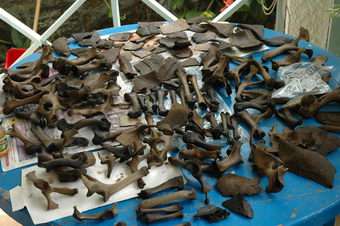
Image: © Peter Floore
On Friday, October 28, 2005, a Dutch-Mauritian research team discovered the very first intact layer of bones and botanical materials, including Dodo remains. The material's age is estimated at 2000 to 3000 years. This new find will allow for the first scientific research into and reconstruction of the world in which the Dodo (Raphus cucullatus) lived, before western man landed on Mauritius and wiped out the species.
The fossil material was excavated in an area of Mauritius called "Mare aux Songes", a low-lying swamp area in the dry southeastern part of the island, on land owned by MTMD. So far, approximately 80 sq. feet have been excavated and more than 700 bones have been recovered. All the bones were found in one layer, and, therefore suggest a mass grave.
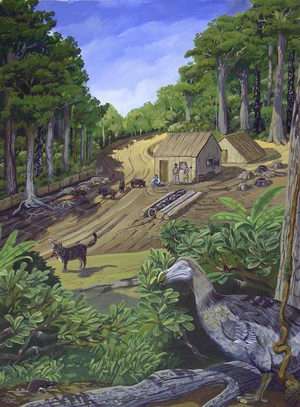
Image: © Julian Hume
The discovery yielded several Dodo bones, including remains of Dodo chicks and a very rare part of the bird's beak, only a few of which are known to exist in the entire world. In addition to the dodo remains, the find included bones of various other extinct bird species, indigenous giant tortoise species, and a baby giant tortoise, as well as a large number of seeds and remains of (partly) extinct trees and plants. The location of all bones in a single layer leads scientists to believe this is a mass grave.Although some Dodo bones were found in the 19th century in the Mare aux Songes, the site's geology and ecology have never been researched. This type of study is necessary to reconstruct the area's landscape, wildlife, and vegetation and to determine whether the animals may have perished en masse due to a natural disaster. In addition, it will enable scientists to research how such a massive collection of bones, seeds, and wood ended up in the swamp and how it has remained so well preserved.
Since Dodo bones were discovered here in 1920, there have been no subsequent finds. Thanks to geological research, this mass grave was found. Julian Hume recently re-examined the material already found in the Mare aux Songes, and discovered some bones of Dodo chicks as well. In case of future research on this site, the research team expects to discover some more remains of Dodo chicks.
The research team consists of Dutch scientists Kenneth F. Rijsdijk (geologist, TNO), Frans P.M. Bunnik (paleobotanist, TNO), and Pieter Floore (archeologist, Hollandia), Alan Grihault (a local dodo expert), and Christian Foo Kune, manager of the "Mon Trésor et Mon Désert" (MTMD) sugar cane plantation, which owns the area where the discovery was made. Julian Hume, a British paleontologist who is also a member of the research team, was able to more closely determine the bones' age and origin.
In order to allow for an accurate, systematic study of the site, an international team is being assembled. The study will be performed by local (botanical) specialists from Mauritius in close cooperation with leading European institutes including the Nationaal Natuurhistorisch Museum Naturalis from Leiden (The Netherlands), the London Natural History Museum and TNO's Geological Survey of the Netherlands.
Source: Naturalis
-
Hatchery fish mask the decline of wild salmon populations
10 hours ago |
5 / 5 (1) |
0
-
Mexico road project sets up fight over ruins
10 hours ago |
5 / 5 (1) |
0
-
New European pill works against uterine fibroids
Feb 02, 2012 |
5 / 5 (1) |
0
-
Professor documents cancer battle in online videos
Feb 02, 2012 |
5 / 5 (2) |
0
-
More than 7,500-year-old fish traps found in Russia
Jan 25, 2012 |
5 / 5 (1) |
0
-
Engineers build first sub-10-nm carbon nanotube transistor
Feb 01, 2012 |
4.9 / 5 (31) |
30
-
Something old, something new: Evolution and the structural divergence of duplicate genes
Jan 31, 2012 |
4.6 / 5 (7) |
1
-
The hidden nanoworld of ice crystals: Revealing the dynamic behavior of quasi-liquid layers
Jan 30, 2012 |
5 / 5 (3) |
1
-
Stock market network reveals investor clustering
Jan 27, 2012 |
3.9 / 5 (23) |
8
-
Of microchemistry and molecules: Electronic microfluidic device synthesizes biocompatible probes
Jan 26, 2012 |
5 / 5 (1) |
0
More news stories
Employers feel no love for unscrupulous practice of 'service sweethearting'
A new study led by two Florida State University marketing professors finds that some frontline service employees who are rewarded for hikes in customer loyalty and satisfaction also may engage in "service ...
Other Sciences / Economics & Business
8 hours ago |
4 / 5 (1) |
4
A frank discussion of the power law and linking correlation to causation
(PhysOrg.com) -- Michael Stumpf a mathematics professor at Imperial College in London, and Mason Porter a lecturer at Oxford have teamed together to write and publish a perspective piece in Science regarding the in ...
The question of life in the ancient world
Theres a general feeling that we dont get the Greeks ancient or modern. Many, including heads of state like Angela Merkel, visibly shake their head in exasperation, rightly or wrongly, at ...
Other Sciences / Archaeology & Fossils
13 hours ago |
1.3 / 5 (3) |
4
Sonic Cradle lands spot in TED exhibition
A Simon Fraser University graduate student project that melds music, meditation and modern technology has landed a rare spot as an exhibit at TEDActive 2012 in Palm Springs, California this month.
10 hours ago |
not rated yet |
0
Chilean miners' rescue capsule on show in London
The capsule used to rescue Chilean miners trapped underground for two months goes on display Saturday at the Science Museum in London -- the first time it has been seen in Europe.
12 hours ago |
not rated yet |
0
Google users warned of threat to smartphone wallets
Users of Google smartphone wallets were being warned on Friday that there is a way to crack pass codes intended to thwart thieves from going on illicit shopping sprees.
Anonymous knocks CIA website offline (Update)
The website of the Central Intelligence Agency was inaccessible on Friday after the hacker group Anonymous claimed to have knocked it offline.
Complex wiring of the nervous system may rely on a just a handful of genes and proteins
Researchers at the Salk Institute have discovered a startling feature of early brain development that helps to explain how complex neuron wiring patterns are programmed using just a handful of critical genes. ...
New error-correcting codes guarantee the fastest possible rate of data transmission
Error-correcting codes are one of the triumphs of the digital age. Theyre a way of encoding information so that it can be transmitted across a communication channel such as an optical fiber o ...
The power of estrogen -- male snakes attract other males
A new study has shown that boosting the estrogen levels of male garter snakes causes them to secrete the same pheromones that females use to attract suitors, and turned the males into just about the sexiest ...
Humans may have helped the decline of African rainforests 3000 years ago
(PhysOrg.com) -- Large areas of rainforests in Central Africa mysteriously disappeared over three thousand years ago, to be replaced by savannas. The prevailing theory has been that the cause was a change ...