New bird species found in Idaho
March 19, 2007
New bird species found in Idaho

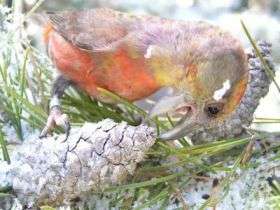
A male South Hills crossbill using its crossed mandibles to bite between lodgepole pine cone scales to access seeds. The decurved mandibles enable crossbills to exert strong biting forces at the tip of their bill. Credit: (photograph by Craig Benkman)

One does not expect to discover a bird species new to science while wandering around the continental United States. Nor does one expect that such a species would provide much insight into how coevolutionary arms races promote speciation. On both fronts a paper to appear in The American Naturalist proves otherwise.

Julie Smith, now at Pacific Lutheran University, and her former graduate advisor, Craig Benkman at the University of Wyoming, have uncovered strong evidence that coevolution has led to the formation of a species of bird new to science in the continental United States. Benkman discovered in 1996 what appears to be a new species restricted to two small mountain ranges in southern Idaho (the South Hills and Albion Mountains). This species is a morphologically and vocally distinct "call type" of red crossbill (Loxia curvirostra complex), which is a group of seed-eating finches specialized for extracting seeds from conifer cones.

Fieldwork by Smith has revealed some of the mechanisms that have contributed to the nearly complete cessation of interbreeding between this crossbill and other call types that move into the South Hills every year. Perhaps most remarkable is that this new crossbill evolved because of a coevolutionary arms race between crossbills and lodgepole pine (Pinus contorta) in the last five to seven thousands years.

As South Hills crossbills exerted selection on lodgepole pine for increased seed defenses, lodgepole pine in turn exerted selection on crossbills for larger bills to deal with these increased seed defenses. This coevolution has caused these crossbills to diverge substantially in bill morphology from other crossbills. Because the South Hills crossbill is adapted to remove seeds from the well-defended cones there, it is a superior competitor and thereby limits the less well adapted and nomadic call types to breeding at very low frequencies in the South Hills.

Such ecological differences lead to premating (i.e., before mating) reproductive isolation, which is nearly completed by strong assortative pairing among the different call types (>99% of South Hills crossbills pair with another South Hills crossbill). "This indicates that levels of reproductive isolation characteristic of recognized species can evolve rapidly even in the continued face of potential gene flow" says Benkman. It also shows that coevolution can be a potent force for rapidly generating biodiversity.

Credit: Julie W. Smith and Craig W. Benkman, "A coevolutionary arms race causes ecological speciation in crossbills" American Naturalist. 2007. 169:455-465.

Source: University of Chicago Press Journals

4.4 /5 (11 votes)  

Rank 4.4 /5 (11 votes)
Tags

Relevant PhysicsForums posts

More news stories

The power of estrogen -- male snakes attract other males

A new study has shown that boosting the estrogen levels of male garter snakes causes them to secrete the same pheromones that females use to attract suitors, and turned the males into just about the sexiest ...

Biology / Plants & Animals

created 20 hours ago | popularity 4.8 / 5 (6) | comments 2 | with audio podcast

Grass to gas: Researchers' genome map speeds biofuel development

Researchers at the University of Georgia have taken a major step in the ongoing effort to find sources of cleaner, renewable energy by mapping the genomes of two originator cells of Miscanthus x giganteus, a large perenn ...

Biology / Biotechnology

created 17 hours ago | popularity 3.8 / 5 (5) | comments 0 | with audio podcast

Experts reveal how plants don't get sunburn

(PhysOrg.com) -- Experts at the University of Glasgow have discovered how plants survive the harmful rays of the sun.

Biology / Cell & Microbiology

created 20 hours ago | popularity 4.8 / 5 (5) | comments 0 | with audio podcast

Entire genome of extinct human decoded from fossil

(PhysOrg.com) -- In 2010, Svante Pääbo and his colleagues presented a draft version of the genome from a small fragment of a human finger bone discovered in Denisova Cave in southern Siberia. The ...

Biology / Biotechnology

created Feb 07, 2012 | popularity 4.7 / 5 (56) | comments 42 | with audio podcast

Why are there so few fish in the Earth's oceans?

(PhysOrg.com) -- A Stony Brook University researcher has found that, contrary to popular belief, there are not plenty of fish in the sea.

Biology / Plants & Animals

created Feb 08, 2012 | popularity 4.3 / 5 (14) | comments 25 | with audio podcast


Anonymous knocks CIA website offline (Update)

The website of the Central Intelligence Agency was inaccessible on Friday after the hacker group Anonymous claimed to have knocked it offline.

New error-correcting codes guarantee the fastest possible rate of data transmission

Error-correcting codes are one of the triumphs of the digital age. They’re a way of encoding information so that it can be transmitted across a communication channel — such as an optical fiber o ...

Small modular reactor design could be a 'SUPERSTAR'

(PhysOrg.com) -- Though most of today's nuclear reactors are cooled by water, we've long known that there are alternatives; in fact, the world's first nuclear-powered electricity in 1951 came from a reactor ...

New power source discovered

(PhysOrg.com) -- Researchers at the Massachusetts Institute of Technology (MIT) and RMIT University have made a breakthrough in energy storage and power generation.

Advanced power-grid model finds low-cost, low-carbon future in West

(PhysOrg.com) -- The least expensive way for the Western U.S. to reduce greenhouse gas emissions enough to help prevent the worst consequences of global warming is to replace coal with renewable and other ...

Fool's gold may prove an unlikely alternative to overexploited catalytic materials

Catalytic materials, which lower the energy barriers for chemical reactions, are used in everything from the commercial production of chemicals to catalytic converters in car engines. However, with current catalytic materials ...