Neighbors gone, fruits gone, species gone
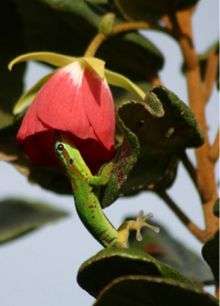
March 19th, 2007 Gecko Visiting Flower for Nector

Phelsuma cepediana visiting a Trochetia flower for nectar. Photograph by Dennis Hansen

Neighbors gone, sex gone, fruits gone, species gone. This is the ultra-short conclusion of the findings in a study by Dennis Hansen, Heine Kiesbüy, and Christine Müller from Zurich University, and Carl Jones from the Mauritian Wildlife Foundation, who found that an endangered plant in Mauritius depends on a neighboring plant to provide a safe home for its pollinator, a day-active gecko.

Trochetia blackburniana, a rare endemic Mauritian plant, produces large red flowers, that are pollinated by the endemic day gecko Phelsuma cepediana. Day geckos of the genus Phelsuma are inquisitive animals. However, they cannot move around freely all the time, if they want to avoid predators. Thus, the geckos spend a lot of time hiding. A favorite hideout of Phelsuma cepediana is the maze of spiky leaves offered by dense patches of Pandanus plants.

In an experiment carried out in 2003 and 2004 and reported in the April issue of the American Naturalist, Hansen and coworkers could show that Trochetia plants growing close to Pandanus patches had a higher chance of being pollinated and produce fruit than plants further away. Thus, Trochetia enters an indirect dependency with its neighbor Pandanus via the geckos.

"The case of Trochetia and its pollinator is only one of many examples of the complexity and fragility of island community interactions. When an island ecosystem is altered by humans, the outcome for both plants and animals are hard to predict. We need field experiments such as this one to understand the potentially disastrous effects," says Christine Müller. "There has been a long tradition of studying direct interactions in pollination biology," says Dennis Hansen, "but only little focus on indirect interactions, even though they often have large effects. Our study illustrates how important it is to know as much as possible about the community-level interactions of an endangered species before deciding on conservation management. Who would have thought that to conserve Trochetia blackburniana we would end up saying 'plant more patches of Pandanus'?"

Citation: Dennis M. Hansen, Heine C. Kiesbüy, Carl G. Jones, and Christine B. Müller, "Positive indirect interactions between neighbouring plant species via a lizard pollinator" The American Naturalist, volume 169 (2007), pages 534–542

Source: University of Chicago


print this article email this article download pdf blog this article bookmark this article     Digg this Stumble it share on Facebook share on Reddit add to delicious save to Yahoo! bookmarks
4.3/5 after 3 votes


March 19th, 2007 all stories
Biology /

Comments: 0
Rank: 4.3/5 after 3 votes

  • Stumble this up

  • Digg this

  • Share it:
  • share on Facebook
  • share on MySpace
  • share on Slashdot
  • rss-newsfeed
  • share on Google
  • share on Reddit
  • add to delicious
  • save to Yahoo! bookmarks
  • share on Windows Live
  • Add to Mixx!
Rating: 4.3/5 after 3 votes


Tags


  • Physicists Demonstrate Quantum Memory with Matter Qubits
    Physicists Demonstrate Quantum Memory with Matter Qubits
    Physics / General Physics
    created Jul 03, 2009 | popularity 4.4 / 5 (17) | comments 1
  • 'Holey' Nanosheets for Wastewater Dye Removal
    Nanotechnology / Nanomaterials
    created Jul 01, 2009 | popularity 5 / 5 (5) | comments 1
  • Jellyfish Robot Swims Like its Biological Counterpart
    Jellyfish Robot Swims Like its Biological Counterpart
    Electronics / Robotics
    created Jun 26, 2009 | popularity 4.4 / 5 (8) | comments 1
  • Could Maxwell's Demon Exist in Nanoscale Systems?
    Could Maxwell's Demon Exist in Nanoscale Systems?
    Physics / General Physics
    created Jun 24, 2009 | popularity 4.4 / 5 (18) | comments 29
  • Living Safely with Robots, Beyond Asimov's Laws
    Living Safely with Robots, Beyond Asimov's Laws
    Electronics / Robotics
    created Jun 22, 2009 | popularity 4.6 / 5 (52) | comments 40
  • Other News

    California water plan aims to save Puget Sound orcas

    Biology / Ecology

    created 13 hours ago | popularity not rated yet | comments 0

    A plan to restore salmon runs on California's Sacramento River also could help revive killer whale populations 700 miles to the north in Puget Sound, as federal scientists struggle to protect endangered species in a complex ...


    Scientists 'rebuild' giant moa using ancient DNA

    Biology / Plants & Animals

    created Jul 01, 2009 | popularity 5 / 5 (10) | comments 12

    (PhysOrg.com) -- Scientists have performed the first DNA-based reconstruction of the giant extinct moa bird, using prehistoric feathers recovered from caves and rock shelters in New Zealand.


    Pacific Giant Salamander (Dicamptodon tenebrosus)

    Salamanders, regenerative wonders, heal like mammals, people

    Biology / Microbiology

    created Jul 01, 2009 | popularity 5 / 5 (20) | comments 11

    The salamander is a superhero of regeneration, able to replace lost limbs, damaged lungs, sliced spinal cord -- even bits of lopped-off brain. But it turns out that remarkable ability isn't so mysterious after ...


    Genetically modified trees

    Anti-biotech groups obstruct forest biotechnology

    Biology / Biotechnology

    created Jun 30, 2009 | popularity 3.7 / 5 (7) | comments 5

    The potential of forest biotechnology to help address significant social and environmental issues is being "strangled at birth" by the rigid opposition of some groups and regulations that effectively preclude ...


    Super-sleepers could help super-sizers!

    Super-sleepers could help super-sizers!

    Biology / Plants & Animals

    created Jun 29, 2009 | popularity 5 / 5 (2) | comments 4

    Burrowing frogs can survive buried for several years without food or water. Scientists have discovered that the metabolism of their cells changes radically during the dormancy period allowing the frogs to ...