Scientists collaborate to study biologically assembled quantum electronic systems
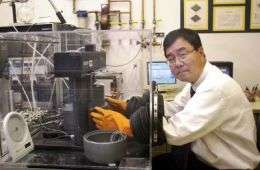
The U.S. Department of Defense is awarding a team of nine professors from six universities $6 million over five years to exploit precise biological assembly for the study of quantum physics in nanoparticle arrays. This research will help to produce a fundamental understanding of quantum electronic systems, which could impact the way future electronics are created.
The UCLA Henry Samueli School of Engineering and Applied Science is teaming up with leading researchers at the University of Minnesota, New York University, the University of Texas at Austin, the University of Pennsylvania and Columbia University to develop biological strategies combining DNA, proteins, and peptides with chemical synthesis techniques to construct arrays of nanoparticles. (A nanoparticle array consists of metal particles with a diameter of 0.5-5 nanometers. The interactions among them produce highly correlated behaviors.)
Joining biological to man-made materials is the first step to a whole new materials assembly technique that will operate on the nanoscale. Interactions between precisely arranged metallic nanoparticles could lead to new physics discoveries – as well as to new mechanisms for computing, signal processing, and sensing.
"Highly interacting and correlated systems will be extremely important in creating future robust nanoscale electronic devices," said UCLA Engineering's Kang Wang, one of the team members involved in the research.
Basic studies of such nanoparticle arrays have in the past been hampered by the need to fabricate test structures with extreme control and precision. Most semi conducting devices, such as computer chips, are made from the top down. Patterns are imposed on the material and etched into it. The biological assembly technique aims at building from the bottom up, atom by atom or molecule by molecule.
"By exploiting biology to precisely control size, spacing, composition, and coupling in the arrays, we will be able to examine the effects of electronic, magnetic, and optical interactions at much smaller dimensions than in the past. This will open a wide range of unbroken ground for exploring new physics," said electrical and computer engineering professor Richard A. Kiehl of the University of Minnesota, who is leading the effort. Kiehl has a wide-ranging experience in investigating the potential of novel fabrication techniques, physical structures, and architectures for electronics.
The team members from the six universities include two professors from the UCLA Henry Samueli School of Engineering and Applied Science, Yu Huang (materials science) and Kang L. Wang (electrical engineering), as well as UCLA professor Todd O. Yeates (biochemistry); New York University professors Andrew D. Kent (physics) and Nadrian C. Seeman (chemistry); University of Minnesota professor Richard A. Kiehl (electrical and computer engineering); University of Texas at Austin professor Allan H. MacDonald (physics); University of Pennsylvania professor Christopher B. Murray (chemistry); and Columbia University professor Colin Nuckolls (chemistry).
Kiehl and Seeman have previously collaborated in the first demonstration of metallic nanoparticle assembly by DNA scaffolding, which will be central to this project. Seeman will exploit DNA nanotechnology to construct 2D and 3D scaffolding for the nanoparticle arrays, while Huang and Yeates will use peptides and proteins to make nanoparticle clusters for assembly onto the scaffolding. Murray and Nuckolls will synthesize metallic and magnetic nanoparticles with organic shells that will self-assemble to the scaffolding and control the interparticle coupling. Kent, Kiehl, and Wang will carry out experiments to characterize the electronic, magnetic, and optical properties of the arrays. Kiehl and Wang also have been collaborating for the past four years at the Center on Functional Engineered Nano Architectonics (FENA), a multi-university center headquartered at the UCLA Henry Samueli School of Engineering and Applied Science. MacDonald will provide theoretical guidance for the studies and analysis of the experimental results.
"While our goal is to use biology to construct a 'nanoscale test vehicle' for the systematic study of basic physics today, this work could lead to a practical biological route for the assembly of quantum electronic systems in the future," said Kiehl.
Quantum electronic systems are strongly influenced by interactions both within and between nanoparticles, and hence are extremely sensitive to the quality and dimensions of the structure.
Source: University of California - Los Angeles


