No sex for 40 million years? No problem
March 20th, 2007 No sex for 40 million years? No problem

A group of organisms that has never had sex in over 40 million years of existence has nevertheless managed to evolve into distinct species, says new research published today. The study challenges the assumption that sex is necessary for organisms to diversify and provides scientists with new insight into why species evolve in the first place.

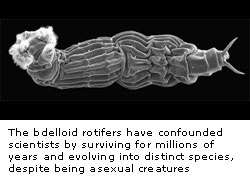
The research, published in PLoS Biology, focuses on the study of bdelloid rotifers, microscopic aquatic animals that live in watery or occasionally wet habitats including ponds, rivers, soils, and on mosses and lichens. These tiny asexual creatures multiply by producing eggs that are genetic clones of the mother – there are no males. Fossil records and molecular data show that bdelloid rotifers have been around for over 40 million years without sexually reproducing, and yet this new study has shown that they have evolved into distinct species.

Using a combination of DNA sequencing and jaw measurements taken using a scanning electron microscope, the research team examined bdelloid rotifers living in different aquatic environments across the UK, Italy and other parts of the world. They found genetic and jaw-shape evidence that the rotifers had evolved into distinct species by adapting to differences in their environment.

Dr Tim Barraclough from Imperial College London's Division of Biology explained: "We found evidence that different populations of these creatures have diverged into distinct species, not just because they become isolated in different places, but because of the differing selection pressures in different environments.

"One remarkable example is of two species living in close proximity on the body of another animal, a water louse. One lives around its legs, the other on its chest, yet they have diverged in body size and jaw shape to occupy these distinct ecological niches. Our results show that, over millions of years, natural selection has caused divergence into distinct entities equivalent to the species found in sexual organisms."

Previously, many scientists had thought that sexual reproduction was necessary for speciation because of the importance of interbreeding in explaining speciation in sexual organisms. Asexual creatures like the bdelloid rotifers were known not to be all identical, but it had been argued that the differences might arise solely through the chance build-up of random mutations that occur in the 'cloning' process when a new rotifer is born. The new study proves that these differences are not random and are the result of so-called 'divergent selection', a process well known to cause the origin of species in sexual organisms.

Dr Barraclough adds: "These really are amazing creatures, whose very existence calls into question scientific understanding, because it is generally thought that asexual creatures die out quickly, but these have been around for millions of years.

"Our proof that natural selection has driven their divergence into distinct species is another example of these miniscule creatures surprising scientists – and their ability to survive and adapt to change certainly raises interesting questions about our understanding of evolutionary processes."

Citation: 'Independently evolving species in asexual bdelloid rotifers', PLoS Biology, Monday 19 March 2007.

Source: Imperial College London


print this article email this article download pdf blog this article bookmark this article     Digg this Stumble it share on Facebook share on Reddit add to delicious save to Yahoo! bookmarks
4.4/5 after 59 votes


March 20th, 2007 all stories
Biology /

Comments: 0
Rank: 4.4/5 after 59 votes

  • Stumble this up

  • Digg this

  • Share it:
  • share on Facebook
  • share on MySpace
  • share on Slashdot
  • rss-newsfeed
  • share on Google
  • share on Reddit
  • add to delicious
  • save to Yahoo! bookmarks
  • share on Windows Live
  • Add to Mixx!
Rating: 4.4/5 after 59 votes


Tags


  • Physicists Demonstrate Quantum Memory with Matter Qubits
    Physicists Demonstrate Quantum Memory with Matter Qubits
    Physics / General Physics
    created Jul 03, 2009 | popularity 4.4 / 5 (16) | comments 1
  • 'Holey' Nanosheets for Wastewater Dye Removal
    Nanotechnology / Nanomaterials
    created Jul 01, 2009 | popularity 5 / 5 (5) | comments 1
  • Jellyfish Robot Swims Like its Biological Counterpart
    Jellyfish Robot Swims Like its Biological Counterpart
    Electronics / Robotics
    created Jun 26, 2009 | popularity 4.4 / 5 (7) | comments 1
  • Could Maxwell's Demon Exist in Nanoscale Systems?
    Could Maxwell's Demon Exist in Nanoscale Systems?
    Physics / General Physics
    created Jun 24, 2009 | popularity 4.4 / 5 (18) | comments 29
  • Living Safely with Robots, Beyond Asimov's Laws
    Living Safely with Robots, Beyond Asimov's Laws
    Electronics / Robotics
    created Jun 22, 2009 | popularity 4.6 / 5 (52) | comments 40
  • Other News

    Scientists 'rebuild' giant moa using ancient DNA

    Biology / Plants & Animals

    created Jul 01, 2009 | popularity 5 / 5 (10) | comments 12

    (PhysOrg.com) -- Scientists have performed the first DNA-based reconstruction of the giant extinct moa bird, using prehistoric feathers recovered from caves and rock shelters in New Zealand.


    Pacific Giant Salamander (Dicamptodon tenebrosus)

    Salamanders, regenerative wonders, heal like mammals, people

    Biology / Microbiology

    created Jul 01, 2009 | popularity 4.9 / 5 (19) | comments 10

    The salamander is a superhero of regeneration, able to replace lost limbs, damaged lungs, sliced spinal cord -- even bits of lopped-off brain. But it turns out that remarkable ability isn't so mysterious after ...


    Genetically modified trees

    Anti-biotech groups obstruct forest biotechnology

    Biology / Biotechnology

    created Jun 30, 2009 | popularity 3.7 / 5 (7) | comments 5

    The potential of forest biotechnology to help address significant social and environmental issues is being "strangled at birth" by the rigid opposition of some groups and regulations that effectively preclude ...


    Thai zoo's 1st baby panda goes on display (AP)

    Thai zoo's 1st baby panda goes on display

    Biology / Plants & Animals

    created 22 hours ago | popularity not rated yet | comments 0

    (AP) -- Thousands of excited visitors flocked Saturday to a zoo in northern Thailand for the first public viewing of a baby panda, which has been featured on Thai front pages almost every day since her birth ...


    Super-sleepers could help super-sizers!

    Super-sleepers could help super-sizers!

    Biology / Plants & Animals

    created Jun 29, 2009 | popularity 5 / 5 (2) | comments 4

    Burrowing frogs can survive buried for several years without food or water. Scientists have discovered that the metabolism of their cells changes radically during the dormancy period allowing the frogs to ...