Biologists produce global map of plant biodiversity
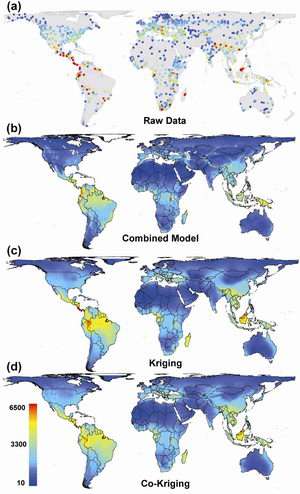
Biologists at the University of California, San Diego and the University of Bonn in Germany have produced a global map of estimated plant species richness. Covering several hundred thousand species, the scientists say their global map is the most extensive map of the distribution of biodiversity on Earth to date.
The map, which accompanies a study published in this week's early online issue of the journal Proceedings of the National Academy of Sciences, highlights areas of particular concern for conservation. It also, the scientists say, provides much needed assistance in gauging the likely impact of climate change on the services plants provide to humans.
Walter Jetz of UCSD and Holger Kreft of the University of Bonn sought in their study to determine how well the diversity, or the "richness," of plant species could be predicted from environmental conditions alone.
"Plants provide important services to humans—such as ornaments, structure, food and bio-molecules that can be used for the development of drugs or alternative fuels—that increase in value with their richness," says Jetz, an assistant professor of biology at UCSD and the senior author of the paper. "Tropical countries such as Ecuador or Colombia harbor by a factor 10 to 100 higher plant species richness than most parts of the United States or Europe. The question is, Why?"
While explorers to these tropical regions long ago recognized this increased diversity over more temperate regions, the general understanding among ecologists about this striking difference continues to be very limited.
"Given that we are far off from knowing the individual distributions of the world's 300,000 odd plant species," says Jetz. "Holger Kreft and I investigated how well the richness of plants can be predicted from environmental conditions alone."
Combining field-survey based species counts from over a thousand regions worldwide with high-resolution environmental data, the scientists were able to accurately capture the factors that promote high species richness of plants.
"This allowed us to estimate the richness of yet unsurveyed parts of the world," says Jetz. "The global map of estimated plant species richness highlights areas of particular concern for conservation and provides much needed assistance in gauging the likely impact of climate change on the services plants provide to humans. It may also help to pinpoint areas that deserve further attention for the discovery of plants or drugs yet unknown to humanity."
"Climate change may drive to extinction plants that hold important cures before we find them," says Kreft, a biologist at the Nees Institute for Biodiversity of Plants at the University of Bonn. "Ecological research like ours that captures complex diversity - environment relationships on a global scale may assist in a small, but important way so that such a fatal potential failure can be averted."
Source: University of California - San Diego


