Rosetta obtains 'light curve' of asteroid Steins
March 20, 2007 Rosetta obtains 'light curve' of asteroid Steins

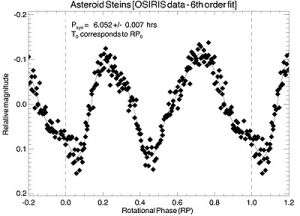
Brightness variation of the asteroid measured continuously over one day. The maximum in the light curve is about 23 percent brighter than the minimum. Credits: Stefano Mottola (DLR), OSIRIS team

During the very first observations of Rosetta’s flyby target 2867-Steins in March 2006 the onboard camera OSIRIS obtained the most accurate ‘light curve’ of this asteroid so far.

OSIRIS observed Steins from a distance of 159 million kilometres and, from there, it obtained images and important clues about its characteristics.

Although ESA’s Rosetta is still far away from its destination comet 67P/Churyumov-Gerasimenko and its flyby targets 2867-Steins and 21-Lutetia, scientists have already started to collect preliminary data about these two largely unexplored asteroids. Advanced knowledge of the asteroids’ properties (like size and rotation period) is essential for the preparation of the planned asteroid observation campaigns in September 2008 and July 2010, respectively.

“Lutetia was imaged by Rosetta on 2 and 3 January 2007, whereas Steins was already observed during a 24-hour observation campaign on 11 March 2006. Both observations were aimed at pre-characterizing the rotation direction of the asteroid. This can be done by the study of the so-called 'light curve' of the asteroid from different locations – by analysing how the light emitted by the observed object changes intensity for different observers, one can deduce in what direction the object rotates” explains Michael Küppers from the Max-Planck-Institute for Solar System Research. The Optical, Spectroscopic, and Infrared Remote Imaging System (OSIRIS) on board Rosetta is up to this ambitious task. On its interplanetary cruise it provided an observing geometry of Steins that cannot be obtained from Earth.

Although the brightness of the Steins asteroid during the measurement period was comparable to that of a candle seen at a distance of ~2000 kilometres, OSIRIS was able to measure brightness variations of the asteroid with an accuracy of better than two percent of its total brightness.

The observations show that Steins rotates with a spin period of slightly more than six hours, in agreement with previous earth-based observations. The asymmetry of the light curve suggests an irregular shape of Steins. However, OSIRIS found no evidence for a ‘tumbling’ motion of the asteroid or the presence of a satellite. Work is ongoing to construct the orientation of the spin axis of Steins from a combination of the OSIRIS observations with ground-based data.

Basically, asteroids are elemental components of the solar system, orbiting the sun for thousand of millions of years. For scientists, these minor bodies of rock or stone are much more than only boulders. Asteroids as well as comets carry important information about the origin of the Solar System – a better understanding of which is one of the primary goals of Rosetta. Rosetta will gather valuable data as it flies by these primordial rocks.

Rosetta’s instruments will provide information on the mass and density of the asteroids, thus telling us more about their composition, and will also measure their subsurface temperature and look for gas and dust around them.

Source: ESA


print this article email this article download pdf blog this article bookmark this article     Stumble it Digg this share on Facebook retweet share on Reddit add to delicious
Rate this story - 4.6 /5 (7 votes)


March 20, 2007 all stories

Comments: 0

4.6 /5 (7 votes)
  • Stumble this up

  • Digg this

  • share this

  • hide
  • Related Stories

  • Steins: A diamond in the sky
    created Sep 08, 2008 | popularity not rated yet | comments 0
  • Rosetta spacecraft meets asteroid Steins
    created Aug 25, 2008 | popularity not rated yet | comments 0
  • Perfect sight: Rosetta cameras track asteroid target
    created Aug 18, 2008 | popularity not rated yet | comments 0
  • Rosetta starts tracking asteroid Steins
    created Aug 04, 2008 | popularity not rated yet | comments 0
  • Rosetta closes in on Earth -- a second time
    created Nov 08, 2007 | popularity not rated yet | comments 0


  • hide
  • Relevant PhysicsForums posts

  • Question about 2-body gravity
    created Nov 24, 2009
  • life on Mars
    created Nov 24, 2009
  • Semi-major axis from cartesian co-ordinates
    created Nov 23, 2009
  • Primary Mirror grinding
    created Nov 23, 2009
  • More from Physics Forums - General Astronomy

Other News

Monster Waves on the Sun are Real

Monster Waves on the Sun are Real (w/ Video)

Space & Earth / Astronomy

created 12 hours ago | popularity 4.8 / 5 (12) | comments 1

Sometimes you really can believe your eyes. That's what NASA's STEREO (Solar Terrestrial Relations Observatory) spacecraft are telling researchers about a controversial phenomenon on the sun known as the "solar ...


Cosmic 'dig' reveals vestiges of the Milky Way's building blocks

Cosmic 'Dig' Reveals Vestiges of the Milky Way's Building Blocks

Space & Earth / Astronomy

created 16 hours ago | popularity 4.9 / 5 (15) | comments 1

(PhysOrg.com) -- Peering through the thick dust clouds of our galaxy's "bulge" (the myriads of stars surrounding its center), a team of astronomers has unveiled an unusual mix of stars in the stellar grouping ...


Climate experts debate strategies for reducing atmospheric carbon and future warming

Climate experts debate strategies for reducing atmospheric carbon and future warming

Space & Earth / Environment

created 12 hours ago | popularity 2.6 / 5 (7) | comments 10

(PhysOrg.com) -- Reducing carbon dioxide to safe levels may require extracting carbon from the air, says Cornell climate researcher.


No Wheel Stall in Diagnostic Drive

Spirit Mars Rover: No Wheel Stall in Diagnostic Drive

Space & Earth / Space Exploration

created 12 hours ago | popularity 4 / 5 (4) | comments 1

(PhysOrg.com) -- On Sol 2095 (Tuesday, Nov. 24), Spirit performed a set of diagnostic actions related to a stall of the right-rear wheel on the previous drive, three days earlier.


Cutting greenhouse pollutants could directly save millions of lives worldwide

Space & Earth / Environment

created 18 hours ago | popularity 2.2 / 5 (10) | comments 6

Tackling climate change by reducing carbon dioxide and other greenhouse emissions will have major direct health benefits in addition to reducing the risk of climate change, especially in low-income countries, according to ...