Mobile phones can soon survive being dropped
March 20, 2007 Mobile phones can soon survive being dropped

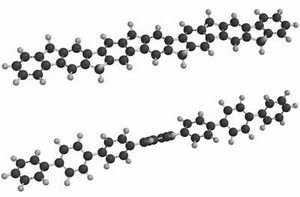
The reconstructed polymer (top) was found to conduct one thousand times better than the standard polymer (below) due to its fixed ladder-like structure. Credit: NWO

Dutch researcher Paulette Prins has demonstrated that plastic does not have to be a poorer conductor than present-day semiconductors. This opens up the way for a revolution in consumer electronics: mobile phones and MP3 players will soon survive being dropped.

Just imagine it. Consumer products that do not break if accidentally dropped, devices with flexible screens that can be rolled up, and products becoming a lot cheaper. Up until now it was a mere pipe dream. The limiting factor is the chips in such devices. These need to conduct electricity and plastic chips fail to make the grade. Plastic conducts at least 1000 times less well than the current generation of semi-conductors.

Prins showed that specially developed plastic can conduct just as well as existing semiconductors.

Conduction occurs when charge moves through the material. Prins discovered that in plastics, the movement of charge was mainly hindered by the structure of the material. Plastic is built up from polymers, which consist of complex chains. The greatest hindrances for conduction were the ends of the chains, fractures in the chains, and the chaos in and along the chains.

A German group of researchers rebuilt the chains. They formed a polymer with a relatively fixed, ladder-like structure. Prins made clever use of this. This polymer was found to conduct 1000 times better than had previously been shown for plastics.

The combination of simulations and advanced techniques makes Prins' research unique. She bombarded the material with electrons from a particle accelerator, which enabled her to study the rapid reactions in the plastic to an accuracy of 100 microseconds.

Subsequently she determined the conductance of the polymers by measuring the microwave absorption. This avoided the need to use electrodes. Such electrodes often disrupt the measurement. Prins published some of her findings in the leading journal Physical Review Letters.

Prins' research was funded by NWO.

Source: NWO


print this article email this article download pdf blog this article bookmark this article     Stumble it Digg this share on Facebook retweet share on Reddit add to delicious
Rate this story - 4.5 /5 (20 votes)


March 20, 2007 all stories

Comments: 0

4.5 /5 (20 votes)
  • Stumble this up

  • Digg this

  • share this

  • hide
  • Related Stories

  • Consumer advocates find BPA in food packaging
    created Nov 03, 2009 | popularity not rated yet | comments 0
  • Smart drug delivery system -- Gold nanocage covered with polymer (w/ Video)
    created Nov 01, 2009 | popularity not rated yet | comments 0
  • New technique paves way for medical discoveries
    created Oct 19, 2009 | popularity not rated yet | comments 0
  • Major advance in organic solar cells
    created Oct 19, 2009 | popularity not rated yet | comments 0
  • MicroRNAs hold promise for treating diseases in blood vessels
    created Jul 05, 2009 | popularity not rated yet | comments 0


  • hide
  • Relevant PhysicsForums posts

Other News

Stars Fueled by Dark Matter Could Hold Secrets to the Universe

Stars Fueled by Dark Matter Could Hold Secrets to the Universe

Physics / General Physics

created Nov 03, 2009 | popularity 4.5 / 5 (50) | comments 41

(PhysOrg.com) -- The first stars in the universe may have been very different from the stars we see today, yet they may hold clues to understanding some of the mysterious features of the universe. These "dark ...


Second Law of Thermodynamics May Explain Economic Evolution

Second Law of Thermodynamics May Explain Economic Evolution

Physics / General Physics

created Nov 02, 2009 | popularity 4.3 / 5 (30) | comments 28

(PhysOrg.com) -- Terms such as the "invisible hand," laissez-faire policy, and free-market principles suggest that economic growth and decline in capitalist societies seem to be somehow self-regulated. Now, ...


High-performance plasmas may make reliable, efficient fusion power a reality

High-performance plasmas may make reliable, efficient fusion power a reality

Physics / Plasma Physics

created Nov 02, 2009 | popularity 4.7 / 5 (39) | comments 31

In the quest to produce nuclear fusion energy, researchers from the DIII-D National Fusion Facility have recently confirmed long-standing theoretical predictions that performance, efficiency and reliability ...


'Teapot effect' solved

Solving Teapot Effect

Physics / General Physics

created Nov 02, 2009 | popularity 4.9 / 5 (11) | comments 10

(PhysOrg.com) -- A team of scientists from France have worked out why teapots dribble at low flow rates, and how to stop them. The effect is called the "teapot effect", and solving it could finally put an ...


Laser accelerated protons to the highest energies so far

Researchers use trident laser to accelerate protons to record energies

Physics / General Physics

created Nov 02, 2009 | popularity 4.7 / 5 (6) | comments 10

An international team of physicists at Los Alamos National Laboratory has succeeded in using intense laser light to accelerate protons to energies never before achieved. Using this technique, scientists can ...