New research reveals subtlety of superconductivity
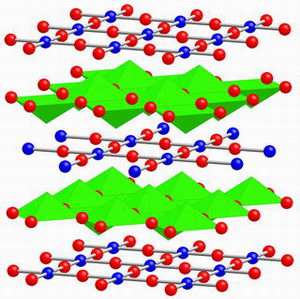
Argonne scientists helped lead the superconducting revolution 20 years ago this month with their landmark solution of the structure of the most widely known high-temperature superconductor YBa2Cu3O7. Now, they have solved another tantalizing superconductivity mystery: how a subtle change in the structure of so-called electron-doped superconductors switches the phenomenon of superconductivity on and off.
Superconductivity is the loss of all resistance to the flow of electric current at very low temperature, a surprising phenomenon with the potential to save enormous quantities of energy if it can be applied to the electric power grid. Twenty years ago, a new class of materials that superconduct at dramatically higher temperature, up to 164 K (about 165 below zero F), was discovered, promising widespread energy-saving applications. Most of these superconductors are “hole-doped,” so named because their superconductivity is triggered by removing electrons (adding “holes”) to an insulating magnetic compound. A few of the high-temperature superconductors, however, are “electron-doped,” requiring the addition of electrons to produce superconductivity.
The mystery of these electron-doped superconductors is that in addition to electron doping, they must be heated to high temperature during their manufacture to enable them to superconduct. No one could understand why the heat treatment was necessary; it did not seem to alter the structure or composition of the material, yet it dramatically transformed the material from an insulator to a superconductor.
“Our discovery opens the door to understanding how electron-doped superconductors work,” said Stephan Rosenkranz, an Argonne scientist on the experimental team. “We didn't realize the interplay of structure and superconductivity was so subtle. But now that we know what is good for superconductivity, we can vary the amount of the good and bad stuff in systematic ways to find out what makes them tick.”
The research team lead by scientists from Argonne, the University of Tennessee, and Brigham Young University found that heating the electron-doped superconductor Pr1-xLaCexCuO4 repaired subtle flaws in the microscopic structure of the material. These flaws are so delicate that their repair by heating escaped detection for nearly two decades. The Argonne team found them by effectively looking with two magnifying glasses. They correlated measurements of copper atom positions, using X-rays at the Advanced Photon Source (APS) at Argonne, with measurements of the oxygen atom positions by neutrons at the National Institute for Standards and Technology Center for Neutron Research.
The combination of these two measurements revealed a small change in the placement of both copper and oxygen atoms taking place during the heat treatment, leading to a perfect structure and superconductivity. Furthermore, the change is fully reversible: The material could be cycled from the flawed to the perfect structure, switching the superconductivity off or on.
The X-ray experiments for this work were led by Rosenkranz and Argonne's Peter Chupas and Peter Lee. They used the high-intensity X-ray beams produced by the APS to determine the precise location and type of each atom in the crystal structure. Branton Campbell, another member of the research team and former postdoctoral researcher at Argonne, now at Brigham Young University, compared this technique to putting an object on a table, hitting it with baseballs thrown from different angles, and then using the marks left where the bounced balls struck the surrounding walls to figure out what the object looks like. Other members of the experimental team include Pengcheng Dai from the University of Tennessee and Oak Ridge National Laboratory, Hye-Jung Kang, now at the National Institute of Standards and Technology, and scientists from Tokyo's Central Research Institute of Electric Power Industry, who made the samples.
The detailed results of these findings were published in the Nature Materials paper "Microscopic Annealing Process and its Impact on Superconductivity in T'-Structure Electron-Doped Copper Oxides," which is available online. Funding for this research was provided by the U.S. Department of Energy's Office of Basic Energy Science, the U.S. National Science Foundation and the Japan Society for the Promotion of Science.
Source: Argonne National Laboratory


