Burrowing, digging dinosaurs found in southwest Montana
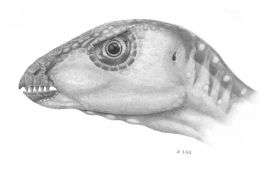
A new dinosaur that dug burrows and cared for its young in dens has been found in southwest Montana.
The 95-million-year-old bones of an adult Oryctodromeus cubicularis and two juveniles were found jumbled together in a burrow about 15 miles from Lima, Montana State University paleontologist David Varricchio said in an online paper published March 21 by the British scientific journal, Proceedings of the Royal Society B. Co-authors were Yoshihiro Katsura, a former MSU graduate student, and Anthony Martin from Emory University in Atlanta.
"The presence of an adult and two juveniles within a denning chamber represents some of the best evidence for dinosaur parental care," Varricchio said. "The burrow likely protected the adult and young Oryctodromeus from predators and harsh environmental conditions. Burrowing behavior may have allowed other dinosaurs to survive in extreme environments such as polar regions and deserts and questions some end-Cretaceous extinction hypotheses."
Martin wrote in an e-mail that, "Paleontologists will now look twice at the sediments surrounding these types of dinosaurs and maybe even look more carefully at large, odd structures in Mesozoic rocks. ‛Hmmm, I wonder if that's a dinosaur burrow ...' is now a hypothesis that will have to be considered."
Katsura found the remains of the Oryctodromeus in 2004 while prospecting on public land. The fossils were lying in the expanded end of a burrow that measured about 6.6 feet long. Sediment that filled the burrow just after the dinosaurs died preserved the skeletons and the burrow. Smaller tunnels branching from the main burrow indicated that insects or mammals shared the burrow.
The fossils laid within two or three feet of the surface in the Blackleaf Formation, Varricchio said. The formation existed during the Cretaceous Period, but is 30 million years older than the Hell Creek Formation of Eastern Montana. The Hell Creek Formation, which dates to the Late-Cretaceous Period, has been a rich source of Tyrannosaurus rex and triceratops fossils.
An MSU field crew removed the Oryctodromeus bones in 2005 with a stretcher they made out of two poles and a tarp, Varricchio said. The fossils went to MSU's Museum of the Rockies where they were prepared and analyzed. They will be displayed starting this summer in the "Hall of Giants," the third phase of the museum's Siebel Dinosaur Complex. Jamie Cornish, marketing director for the museum, said the grand opening for the complex will be held Saturday, June 9.
The burrowing dinosaurs didn't have the dramatic frills, horns or teeth of some other dinosaurs, but their fossils are valuable because they are the first vertebrate remains found in the Blackleaf Formation, Varricchio said.
"We have dinosaurs older and younger, but this is a little slice of time we haven't sampled before (in Montana)," Varricchio said. He added that the fossils also represent the first scientific evidence that some dinosaurs dug burrows and cared for their young in dens.
Martin said he became involved with the project in August 2005 when Varricchio sent him a photo and asked what he thought it might be. Running through some possibilities, Martin concluded that it was a large burrow, then asked what was at the other end. Was it a fossil crocodile?
"I just about fell out of my chair when he replied that it was an Early Cretaceous dinosaur," said Martin who visited the dig site in September 2005. He helped excavate and describe the fossils, then analyzed the burrow and fossils to predict behaviors.
The paleontologists didn't find complete skeletons, but found parts of everything from the head to the tip of the tail, Varricchio said. Recent erosion exposed the bones and burrows, but Varricchio theorized that a significant portion of both were lost to erosion before the fossils were discovered. Based on the vertebrae, the adult was almost seven feet long. Much of its length was in its tail.
The Oryctodromeus was a small plant-eating dinosaur that had several adaptations for digging, Varricchio said. Its snout could be used as a shovel. The large bony attachments in the shoulder could hold powerful muscles. Strong hip bones could help brace the dinosaur during digging. Unlike modern digging animals, however, the dinosaur had long hind limbs and was well adapted to running on two legs.
Source: Montana State University


