Hinode's X-Ray Telescope Reveals the Sun's Secrets
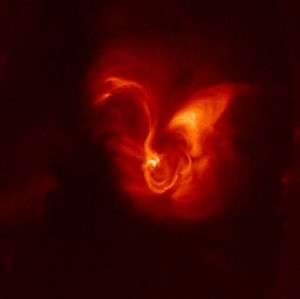
Even though the sun is the closest star to Earth and has been studied for hundreds of years, it still holds surprises. The recently launched Hinode spacecraft is one of the latest observatories to probe the sun from afar. One of three instruments on board Hinode is the X-Ray Telescope (XRT), which was developed and built by the Smithsonian Astrophysical Observatory and the Japan Aerospace Exploration Agency. Already, stunning X-ray views from the XRT are surprising astronomers and revealing new secrets about the sun.
"We've seen many new and unexpected things. For that reason alone, the mission is already a success," says Leon Golub, senior astrophysicist at the Harvard-Smithsonian Center for Astrophysics. "Everything we thought we knew about X-ray images of the sun is out of date."
Golub presented these findings today at a NASA Space Science Update in Washington, D.C.
The XRT collects X-rays emitted from the sun's corona - the hot, tenuous outer layer that extends from the sun's visible surface into the inner solar system. Gas in the solar corona reaches temperatures of millions of degrees. The energy source that heats the corona is a puzzle. The sun's surface is only 10,000 degrees Fahrenheit, while the corona is more than 100 times hotter.
The XRT has provided the first clear view of the possible energy source for the corona. It spied twisted and tangled magnetic fields that store huge amounts of energy. When those complicated magnetic structures relax to simpler configurations, a huge amount of energy is released. That energy heats the corona and powers solar eruptions like flares and coronal mass ejections.
"Theorists suggested that twisted, tangled magnetic fields might exist," says Golub. "With the XRT, we can see them clearly for the first time."
Solar astronomers are particularly interested in studying active regions - the areas of strong magnetic fields surrounding sunspots. Active regions are the sources of solar eruptions.
The XRT has uncovered new details in active regions, including gigantic arcing magnetic structures that dwarf the underlying sunspots.
Ultimately, the knowledge gained from the XRT and Hinode's other two instruments may help astronomers to forecast solar eruptions and the associated "space weather." Such forecasts would help protect astronauts as well as satellites and automated spacecraft.
Unlike instruments on TRACE and other dedicated solar observatories, the XRT is a "grazing incidence" telescope capable of studying so-called "soft" X-rays. Most solar X-ray telescopes observe lower-energy radiation.
The XRT also photographs the sun faster and with better resolution and greater sensitivity than previous grazing-incidence X-ray instruments.
Source: Harvard-Smithsonian Center for Astrophysics


