WIYN telescope to get innovative billion-pixel, $6.6 million camera
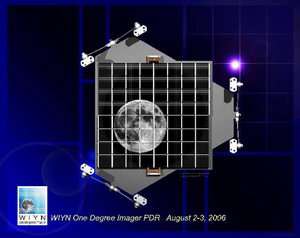
The number of larger-aperture telescopes is growing, but size isn't all that matters in a research telescope. Also important is how much of the sky the telescope can clearly image. A telescope used by Indiana University astronomers and their colleagues at Kitt Peak National Observatory near Tucson, Ariz., is about midway through a major improvement -- the addition of a new kind of camera that will allow scientists to record the telescope's entire exceptionally wide field of view for the first time.
Called the WIYN 3.5-meter telescope (representing the partners involved -- the University of Wisconsin, Indiana University, Yale University and the National Optical Astronomy Observatory), it has an important and unique advantage because of its superb image quality over a very wide field of view, about 1 degree wide on the sky or twice the diameter of the full moon. The WIYN telescope produces images with a sharpness approaching that of the Hubble Space Telescope at red and near infrared wavelengths, and it can capture a much larger segment of the sky than Hubble does.
The purpose of the four-year One-Degree-Imager Project is to take advantage of this wide but sharp field of view by creating a wide-field imager that can electronically make corrections for atmospheric blurring across the telescope's entire field of view, an area about 100 times larger than the field of view of the Hubble telescope. By taking optimal advantage of the telescope's superb image quality over an unusually wide field of view, ODI will provide WIYN astronomers with a unique observational facility.
The ODI camera combined with the 3.5-meter telescope will provide stunning images with high scientific content. The ODI will also present interesting information technology challenges in handling, mining and archiving the images, because every night of observing with the ODI will produce a terabyte of data. The new ODI imager will be so perfectly matched to the capabilities of the WIYN telescope that the combination will occupy a special forefront niche in ground-based astronomy. It will not be surpassed by another facility until the planned, but not yet funded, 6.5-meter Large-Aperture Synoptic Survey Telescope comes on line sometime in the next decade.
"The One Degree Imager will have two big advantages over other astronomical cameras," said Catherine Pilachowski, chair of the IU Astronomy Department. "First, it's big. ODI will have a billion pixels, in a 32,000 x 32,000 array. Because it's so big, ODI will be able to take pictures of a big region of sky at one time, an area of sky more than four times the area of the full moon. Most astronomical cameras only look at a much smaller piece of sky, so ODI will be a big gain for IU astronomers.
"The second advantage is that the detectors in ODI will be able to partially correct for the distortions of Earth's atmosphere," Pilachowski said. "Using a special technology, the camera will slosh the image around to follow the small but fast motions of the atmosphere that cause the telescope's image to blur. With ODI, IU astronomers will sometimes be able to take pictures that are nearly as sharp as those produced with the Hubble telescope, but over a much larger area of sky."
The next step in the development of ODI is a prototype camera called QUOTA. It incorporates the same "image sloshing" technology, but in a smaller version with 16 million pixels. The QUOTA camera is now being installed at WIYN as a test of the technology being developed for ODI.
When the QUOTA camera has been completed, it will be available for use by WIYN observers, including IU faculty and students. IU Emeritus Professor Kent Honeycutt will be one of the first users of the QUOTA camera this spring for observations of cataclysmic variables.
"Cataclysmic variables are close binary stars in which one star is transferring matter onto the other, a white dwarf," Pilachowski said. The matter forms a hot disk surrounding the white dwarf as the matter spirals in. Because CV systems are relatively small, astronomically speaking, changes in the brightness of the disk happen quickly.
"With ODI, Honeycutt will be able to capture the fast changes in brightness to learn about how matter forms into the disk and onto the white dwarf," Pilachowski said. "These physical processes are the same ones that control how matter accretes onto black holes, and CVs provide a good way to learn about accretion processes."
More information about WIYN is available at www.noao.edu/wiyn/
Source: Indiana University


