System monitors health of new composite military missiles
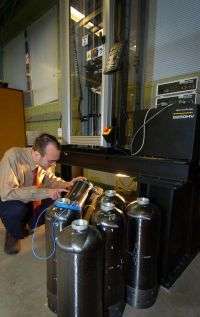
Engineers at Purdue University have designed and tested a "structural health monitoring" system to detect flaws that could hinder the performance of new types of military missiles made of composite materials instead of metal.
Missiles are sometimes damaged when struck by rocks and debris kicked up by helicopter rotors or when mishandled during shipping or maintenance.
Unlike missiles made of metallic alloys, which often show external signs of damage such as cracks or dents, damage in the new "filament wound" composite materials may not reveal telltale signs, said Douglas Adams, an associate professor of mechanical engineering.
The new monitoring system uses a mathematical model to pinpoint the location and severity of impacts based on vibration data collected by a sensor called a triaxial accelerometer.
"We have shown that 98 percent of the time we can detect, locate and quantify the force of impacts," Adams said. "This information is very useful because it enables the monitoring system to determine within seconds whether an impact is beyond the design threshold and is great enough to likely cause serious damage."
Findings will be detailed in a research paper to be presented Wednesday (March 21) during an International Society for Optical Engineering conference. The conference, Smart Structures and Materials and Non-Destructive Evaluation and Health Monitoring, takes place through Thursday (March 22) in San Diego. The paper was written by Adams, graduate student Nick Stites, undergraduate student Carlos Escobar, and doctoral student Jonathan White, all in Purdue's School of Mechanical Engineering; and Matt Triplett, an engineer from the U.S. Army's Aviation and Missile Research, Development and Engineering Center.
The research focuses on the missile casing, a 7-inch-wide, 30-inch-long central segment located between the rocket motor and warhead.
"The casing is essentially a cylinder that holds the solid rocket fuel, and it has to withstand the high pressures created as the fuel burns," said Adams, whose research is based at Purdue's Ray W. Herrick Laboratories.
The researchers are using a 15-foot-tall "impact tower" that rams a steel rod into the casing with enough force to punch holes in military armor. The testing simulates impacts from debris, tools striking the casing or mishaps, such as personnel accidentally dropping a missile.
"These sorts of impacts can cause damage that cannot be detected by visual inspections," Adams said.
The casings are made out of carbon fibers, Kevlar or other materials wound in layers. Missiles made of the composite materials perform better than their metallic counterparts because the casings are up to 40 percent lighter than those made from aluminum alloys. Their light weight also makes them less expensive to ship and easier to handle.
In addition to detecting damage caused by an accident, the technique also could determine how durable the material is after long-term storage and exposure to the environment.
"The military stores weapons systems for a long time, sometimes years, and then they deploy them, so you want to know how they are affected by factors such as humidity, ultraviolet radiation and other conditions," Adams said. "The ultimate goal of this work is to create a system that could be permanently installed in missiles to analyze the structural health in real time."
Another goal is to gather data to help engineers design more impact-resistant casings in the future.
Research shows that some designs are more prone to damage because the force of impact concentrates in a small area.
"You want a material system that distributes that impact load along many fibers so that no one fiber is carrying too much load, which could cause it to break," Adams said.
The more damage, the less pressure the casing can withstand before bursting.
A major challenge is designing an effective monitoring system that uses only one sensor.
"You can't be putting a lot of sensors everywhere because there are weight restrictions," Adams said. "So you have to figure out what you can do with so-called minimal sensing, with the fewest number of sensors possible."
The triaxial accelerometer measures vibrations from three directions. When engineers strike the casing at various points with a hammer, vibrations travel through the structure and are recorded by the sensor. Data from those measurements are then used to fine tune a mathematical model needed for the monitoring system.
Recent findings indicate the system effectively tracks the location and severity of impacts using only one sensor.
Future testing might simulate "ballistic impacts" from bullets or shrapnel from improvised explosive devices, Adams said.
The same technique could be applied to commercial aircraft and spacecraft, as well as bridges, railways and other elements of America's aging transportation infrastructure.
Source: Purdue University


