Researchers unveil details of chip cooling breakthrough
March 22, 2007 Researchers unveil details of chip cooling breakthrough

Enlarge

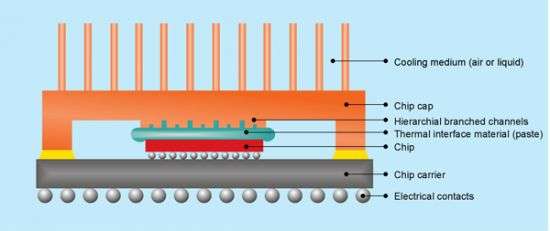
Schematic of the interface technology and cooling system. The image shows a cross-sectional schematic of the cooling architecture using the branched channel design. A highly viscous paste is brought between the chip cap and the hot chip in order to reduce the thermal resistance. Thanks to the tree-like branched "trenches" in the copper cap, the paste spreads very homogeneously and attains a thickness of less than 10 micrometers. With this technique, only half the pressure is needed to apply the paste and a twofold increase in cooling performance can be achieved. Credit: IBM

At the IEEE Semi-Therm Conference 2007, IBM researchers unveiled details of a new technique to significantly increase capabilities to cool computer chips.

The technique, developed by a team of scientists at the IBM Zurich Research Laboratory in cooperation with Momentive Performance Materials, formerly GE Advanced Materials, overcomes a barrier in chip cooling by improving the application of the "glue" that binds chips to their cooling systems. The new technology could allow faster computer chips to be cooled more efficiently.
Researchers unveil details of chip cooling breakthrough

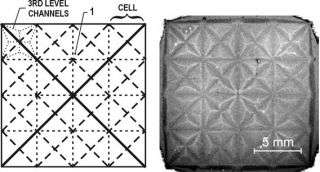
The right-hand image shows the paste after being applied using the new technology. The pattern arises from the hierarchical channel design of the interface that controls and optimizes the spread of the paste. The schematic on the left shows the hierarchical microchannel design for a 14-mm chip. Solid lines represent the first-level hierarchy, which is 220 micrometers wide, long-dashed lines = 150 micrometers width, short-dashed lines = 150 micrometers width. An example of a third-level channel design is shown in the upper left-most cell. Credit: IBM

In today's computer chips, as the circuits on chips become increasingly smaller, chips generate more heat than ever before. To remove the heat from the chip, a cooling system is attached to the microprocessor using a special adhesive or glue. This glue is necessary to bind the two systems together, yet it poses a real barrier in heat transport.

To improve the glue's heat-conducting properties, it is enriched with micrometer-sized metal or ceramic particles. These particles form clusters that build "heat-evacuation bridges" from the chip to the cooler to compensate for the glue's shortcomings. However, even highly particle-filled pastes are still inefficient, consuming up to 40 percent of the overall thermal budget, i.e. the cooling capacity available to draw heat away from the chip.

IBM researchers now unveiled the reason and presented a novel technique to solve this problem. By observing how the glue spreads when a chip is attached to its cooling element, scientists noticed that a cross formed in the paste as large numbers of particles were piling up, inhibiting the layers of glue from spreading out. The scientists were able to trace the cause of this back to the flow behavior of the paste, which simply follows the path of least resistance. Along the diagonals, the particles are pulled in opposite directions and, as a result, they remain where they are. As the squeezing process continues, however, they begin to pile up, forming what scientists call the "magic cross".

To overcome this problem, the team designed a special layout of micrometer-sized channels — or trenches — in a tree-like branched structure consisting of larger and smaller channels. This structure functions like an irrigation system for the paste at exactly those spots where the particles would pile up. This allows the particles to spread more homogeneously and reduces the thickness of the resulting paste gap.

The results obtained are impressive: The paste thickness was reduced by a factor of 3, and the pressure needed to squeeze the paste to the same bondline thickness was reduced to a similar extent. These lower assembly pressures ensure that the delicate components and interconnects below the chip are not damaged as the chip package is created. The channels also allow pastes with higher fill factors and higher bulk thermal conductivity to be squeezed into thinner gaps, thereby reducing the thermal resistance of the paste interface considerably by more than a factor of 3. The new technology allows air-cooling systems to remove more heat and helps to improve the overall energy efficiency of computers.

To further optimize the technology in real cooling systems and to demonstrate its feasibility, the IBM team cooperated with paste manufacturer Momentive Performance Materials, Wilton, CT, USA.

Together with other industry-leading suppliers, tools are being developed to define the surface channels through the same copper stamping process currently used to fabricate high-volume chip lids. This will define a full supply chain of low-cost parts to quickly integrate the new technique into products.

The work entitled "Hierarchical Nested Surface Channels for Reduced Particle Stacking and Low-Resistance Thermal Interfaces" by R. J. Linderman, T. Brunschwiler, U. Kloter, H. Toy, B. Michel will be published in Proc. 23rd IEEE Semi-Therm Symp. 2007.

Source: IBM


print this article email this article download pdf blog this article bookmark this article     Stumble it Digg this share on Facebook retweet share on Reddit add to delicious
Rate this story - 4.6 /5 (38 votes)


March 22, 2007 all stories

Comments: 0

4.6 /5 (38 votes)
  • Stumble this up

  • Digg this

  • share this

  • hide
  • Related Stories

  • Beating the backup blues
    created Apr 06, 2009 | popularity not rated yet | comments 0
  • Nanotube forests grown on silicon chips for future computers, electronics
    created Oct 01, 2007 | popularity not rated yet | comments 0
  • IBM researchers develop next-generation chip-cooling technologies
    created Oct 26, 2006 | popularity not rated yet | comments 0
  • New findings could help hybrid, electric cars keep their cool
    created Sep 22, 2009 | popularity not rated yet | comments 0
  • Makers hope new 'ultrathin' notebooks fill a niche
    created Sep 16, 2009 | popularity not rated yet | comments 0


  • hide
  • Relevant PhysicsForums posts

Other News

A system of space solar power system (SSPS)

Japan eyes solar station in space as new energy source

Technology / Energy

created 12 hours ago | popularity 4.6 / 5 (11) | comments 9

It may sound like a sci-fi vision, but Japan's space agency is dead serious: by 2030 it wants to collect solar power in space and zap it down to Earth, using laser beams or microwaves.


Campaigners are stepping up efforts to curb online tracking

Advertisers face resistance to on-line tracking

Technology / Internet

created 12 hours ago | popularity 5 / 5 (2) | comments 0

Campaigners are stepping up efforts to curb online tracking of Internet use by firms that deliver adverts tailored to the specific interests of consumers, as polls reveal widespread unease with the practice.


Framed for child porn -- by a PC virus

Framed for child porn -- by a PC virus

Technology / Internet

created 4 hours ago | popularity 5 / 5 (3) | comments 1

(AP) -- Of all the sinister things that Internet viruses do, this might be the worst: They can make you an unsuspecting collector of child pornography.


Software cos. eye key patent case in Supreme Court (AP)

Software cos. eye key patent case in Supreme Court

Technology / Business

created 13 hours ago | popularity 5 / 5 (4) | comments 1

(AP) -- With the technology industry looking on, the Supreme Court on Monday will explore what types of inventions should be eligible for a patent in a pivotal case that could undermine such legal protections ...


Sony offers 'Cloudy' early to people with its TVs

Technology / Business

created 4 hours ago | popularity not rated yet | comments 0

(AP) -- In a bid to sell living room electronics and spur buzz for "Cloudy with A Chance of Meatballs," Sony Corp. is offering the movie for free to U.S. buyers of its Internet-connected TVs and Blu-ray players starting ...